

Waking up with a tight jaw or sore temples can feel like a minor annoyance, but for many people it becomes a recurring pattern. You may also notice yourself clenching your teeth during the day while concentrating, driving, or even at rest.
Over time, this tension can begin to affect more than just the jaw.
Often, it is the body signaling that something deeper is out of balance.
At Ptak Family Chiropractic, we frequently see how jaw tension connects not only to stress, but also to posture, muscle patterns, and the way the nervous system is responding to daily demands.

The Connection Between Stress and Jaw Tension
The jaw is one of the most common places the body stores stress.
When the nervous system is under pressure, it often increases muscle activity especially in areas related to protection and control. The muscles responsible for closing the jaw are among the strongest in the body, and they tend to activate easily during times of mental or emotional strain.
This can show up as clenching during the day or grinding at night.
Over time, this repeated tension may contribute to soreness in the jaw, sensitivity in the teeth, headaches, or tension that extends into the neck and shoulders.
Your body is not doing this randomly. It is responding to stress the best way it knows how.
How Posture Influences the Jaw
Jaw tension is not just about the teeth. It is closely connected to the position of the head and neck.
When the head shifts forward common with phone use, computer work, and long periods of sitting it changes how the muscles of the jaw and neck interact.
A forward head position places additional demand on the muscles that support the skull and jaw. Over time, this can increase tension in the jaw joint and surrounding tissues.
In clinical practice, we often see that improving posture can significantly reduce the load placed on the jaw.
The position of your head directly affects the function of your jaw.

The Chain Reaction in the Body
The jaw does not function in isolation. It is part of a larger system that includes the neck, upper back, nervous system, and circulatory system. Chronic head and neck muscle tension can cause increase in lactic acid build up throwing your pH off balance as well a decrease circulation to your brain.
When tension builds in one area, it often influences others.
Jaw tension may contribute to headaches, particularly around the temples. It can increase tightness in the neck and shoulders. It may also affect how comfortably the jaw opens and closes.
This is why focusing only on the teeth does not always resolve the issue.
The body works as a connected system, not as separate parts.
How Jaw Alignment Can Influence Circulation and Nerve Function
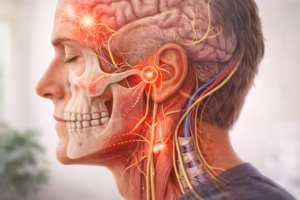
The jaw sits in close relationship to important muscles, blood vessels, and nerves that serve the face, head, and brain.
When the temporomandibular joint is not moving well or is under constant tension, it can influence how these surrounding tissues function.
Muscle tightness in the jaw and upper neck may contribute to changes in local circulation and place added stress on nearby structures. This same region is also closely connected to cranial nerves that influence sensation, muscle activity, and coordination.
While the body is highly adaptable, ongoing imbalance in this area can contribute to facial tension, headaches, and a general sense of pressure or fatigue.
This is not just a joint issue. It is part of a broader neurological and functional system.
Where Dental Appliances Can Play a Role
In some cases, particularly when clenching or grinding is significant, a custom dental appliance may be recommended.
These appliances are designed to reduce excessive pressure on the teeth and jaw, support a more balanced resting position, and protect the joint from ongoing strain.
For many patients, this can be an important part of care.
At the same time, it is helpful to recognize that appliances primarily manage the effects of tension. Addressing contributing factors such as posture, muscle balance, and overall movement patterns can further support long-term improvement.
The most effective approach is often a collaborative one. This is why w e work closely with Dr. Kari Sakurai, DDS, a local TMJ Santa Monica dentist.

Simple Habits That May Help Reduce Jaw Tension
Awareness is one of the most powerful tools.
Start by noticing when you are clenching during the day. Gently allow your teeth to separate and your tongue to rest comfortably on the roof of your mouth.
Breathing plays an important role as well. Slow, steady breathing can help calm the nervous system and reduce unnecessary muscle tension.
Applying a warm compress to the jaw in the evening may help relax the surrounding muscles. Reducing screen time before bed and creating a more relaxed nighttime routine can also support better recovery.
Small daily habits can create meaningful change over time.

Supporting the Body as a Whole
Addressing jaw tension often requires looking beyond the jaw itself.
Improving posture, supporting spinal movement, and helping the nervous system function more efficiently can all play a role in reducing tension patterns.
When the body is more balanced, it does not need to rely on protective patterns like clenching.
Many patients notice that as overall tension decreases, the jaw begins to relax as well.
When the body functions better, the need for compensation decreases.

Final Thought
Jaw tension is not just a local issue. It is often a reflection of how your body is adapting to stress, posture, and daily demands.
Paying attention to these signals early can help prevent more persistent patterns from developing.
With the right awareness and support, your body can move toward a more relaxed, balanced state.
Less tension. Better function. Greater ease.
Quick Answers
Why do I clench my teeth during the day
Clenching is often a response to stress or concentration and can become a learned habit over time.
Can posture affect my jaw
Yes. Forward head posture increases strain on the muscles that support the jaw and can contribute to tension.
Does jaw tension affect blood flow or nerves
Muscle tension in the jaw and upper neck can influence surrounding circulation and nerve function, contributing to symptoms like headaches and facial tension.
Do I need a dental appliance
In some cases, a dentist may recommend one to reduce strain and protect the joint. A collaborative approach often provides the best results.
Want Help Reducing Tension and Improving Balance
If you’re in the Santa Monica area and noticing jaw tension, headaches, or neck tightness, the team at Ptak Family Chiropractic is here to help you restore balance, improve function, and feel more at ease in your body.