

When people think about hydration, they usually think about energy, skin, or general health. They think I need to support my muscles and organs by drinking 1/2 my body weight in water eeach day.
But one of the most important and overlooked areas affected by hydration is your spine.
At Ptak Family Chiropractic, we help patients understand something deeper. Your spine is not just a structure. It is a living, adaptive system that depends on movement, hydration, and proper preparation to function at its best.
Like the rest of your body, it is always moving in one of two directions. It is either adapting toward degeneration or being supported toward restoration and longevity.
The Hidden Role of Water in Your Body
Every cell in your body depends on water. Even mild dehydration can influence energy levels, mental clarity, muscle function, and circulation.
But what many people do not realize is that some of the most water dependent structures in your body are your spinal discs.
Your Spinal Discs Are Built on Water
Between each vertebra sits a spinal disc, your body’s natural shock absorber.
Each disc has a strong outer layer or cartilage and a soft gel like center called the nucleus pulposus. That inner portion is made up of approximately 70 to 90 percent water.
A helpful way to think about a disc is like a sponge. When it is hydrated, it is full, resilient, and able to absorb stress. When it becomes dehydrated, it loses height, becomes stiffer, and cannot function as effectively.
The Daily and Lifetime Dehydration Cycle
Your spinal discs lose water every single day. You are actually a bit taller in the morning then you are in the evening.
As you sit, stand, and move, normal gravitational pressure compresses the discs and pushes fluid out. When you lie down at night, the discs attempt to reabsorb fluid, which is why we are talkler when we first wake up.
However, this is only part of the story. Discs do not just lose hydration throughout the day. They lose hydration gradually over a lifetime.
Without the right conditions, this leads to decreased disc height, increased mechanical stress, and less space available for proper nerve function. Many people accept this as normal aging, but it does not have to progress that way.
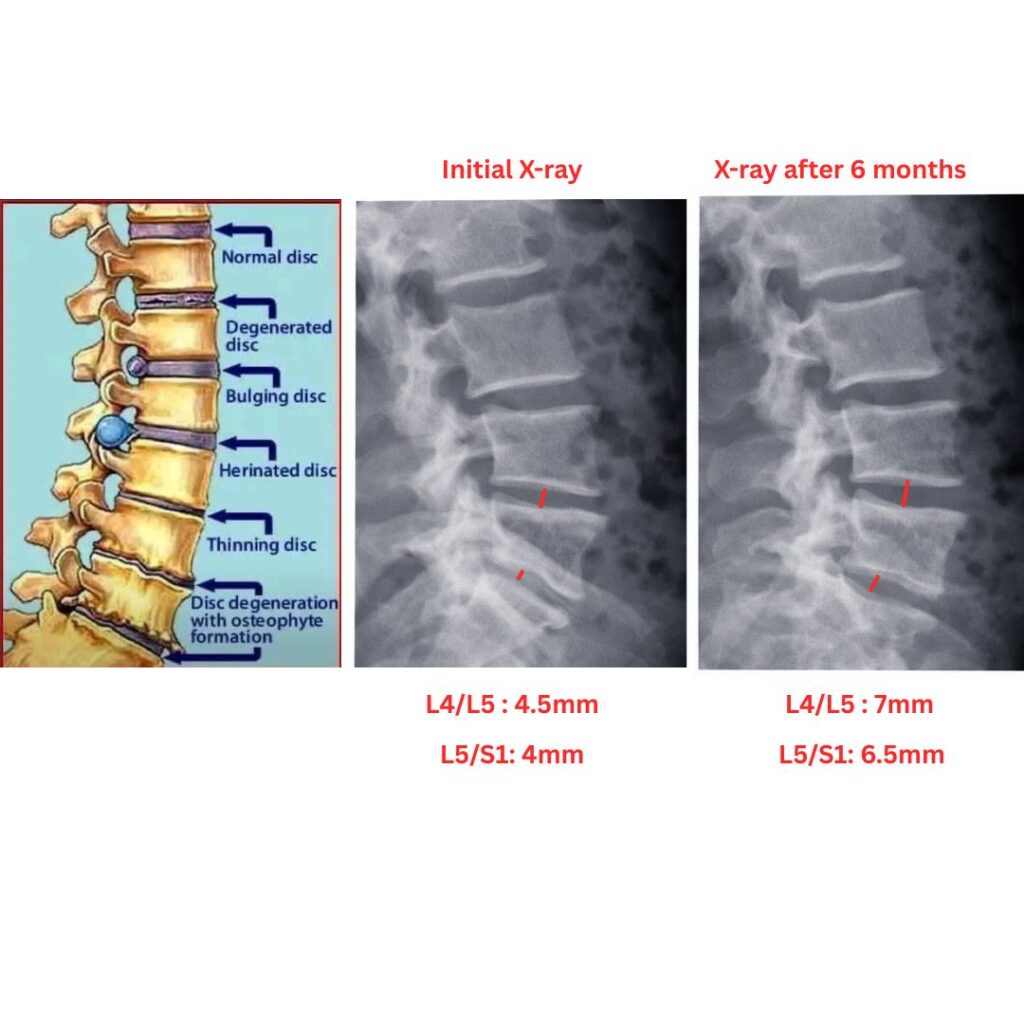
What Dehydrated Discs Feel Like
Dehydrated discs do not always create sharp pain. More often, they present as subtle but persistent changes such as stiffness in the morning, a dull or achy back, a sense of compression, or reduced flexibility.
Over time, this places additional stress on joints, muscles, and ligaments, and can influence how well your nervous system communicates with the rest of your body.
Why Drinking Water Alone Is Not Enough
Drinking water is essential, but hydration is not just about intake. It is also about absorption.
Spinal discs do not have a direct blood supply. They rely on movement and changes in pressure to draw in water and nutrients.
Without movement, discs remain compressed and fluid exchange is limited. This is why long periods of sitting can have such a significant impact on how your spine feels and functions.
Our Approach: Preparing and Rehydrating the Spine Before the Adjustment
At Ptak Family Chiropractic, we approach spinal care differently. We prepare the spine before making an adjustment.
We begin with specific warm up movements, including Wobble Chair exercises, to introduce gentle motion into the spine. This helps increase circulation, reduce stiffness, and begin the process of disc expansion and hydration. By expanding the pores in the disc, water can enter. The cool down phase allows the water to stay in the disc.
As the discs move, they slightly expand. This expansion helps open pathways that allow water and nutrients to enter the disc, supporting rehydration.
For the cervical spine, we utilize Cervical Dynamic Traction. The patient stands against a wall and actively moves in a controlled manner, helping restore the natural cervical lordosis while decompressing the intervertebral discs. This active process supports both structural integrity and neurological function.
Once the spine is more mobile, more hydrated, and more receptive, the adjustment becomes more specific, more comfortable, and more effective.

Measurable Changes You Can See and Feel
In our office, by following our hydration and warm up protocols, we commonly see an increase in overall patient height of approximately one half inch to one inch within the first year. This reflects improved disc hydration and spinal function.
Why This Matters for Long Term Health
This approach is not just about short term relief. It is about preserving the health of your spine over time.
When discs remain hydrated and maintain their height, they help preserve space for nerves, reduce stress on surrounding structures, and support better communication between the brain and body.
This is one of the most important ways to support long term function, longer term health and slow the progression of degeneration.
Simple Daily Habits That Support Disc Health
Small, consistent habits can make a meaningful difference.
Drinking water steadily throughout the day supports your body’s overall function.
Reducing sugary and highly caffeinated drinks can also help maintain better hydration levels.
Movement is equally important. Taking breaks from sitting, even briefly, allows your spine to decompress and encourages fluid movement within the discs.
These simple actions support not only comfort, but long term spinal health.
Quick Answers
Why is hydration important for spinal discs?
Spinal discs rely heavily on water to maintain their height, flexibility, and ability to absorb stress
Do discs lose water during the day?
Yes, normal daily activities compress the spine and gradually push fluid out of the discs
Can disc hydration be improved?
Yes, consistent hydration combined with movement and specific spinal exercises can support fluid exchange and disc health
Why do you prepare the spine before adjusting?
Preparing the spine helps improve mobility, supports disc hydration, and allows for a more effective and comfortable adjustment
Is this approach focused on long term health?
Yes, maintaining disc hydration and spinal function supports longevity, resilience, and overall body performance and immune health.
A Different Way to Think About Your Health
Most people wait until something hurts before they take action.
But your body often gives subtle signals long before pain appears. A stiff spine, a tight neck, or reduced flexibility are all early indicators that your body may need support.
With the right approach, your body has the ability to rehydrate, rebalance, and restore function.
We’re Here to Help
If your spine has been feeling stiff, compressed, or less resilient than it used to, there may be underlying factors that have not yet been addressed.
At Ptak Family Chiropractic, we focus on preparation, precise adjustments, and long term spinal health.
If you are ready to better understand your body and support it for the future, our team is here to help.
Call us today at 310-473-7991 and lets start your journey to improved spinal health!