

Most people think neck pain starts when they feel it.
In reality, it starts long before that.
By the time discomfort shows up, your body has already been adapting, compensating, and quietly breaking down for weeks, months, or even years. Pain is not the beginning of the problem. It is the signal that your body can no longer keep up with the compensation.
This is why so many people say, “I don’t know what happened… it just started hurting.”
But it didn’t just start. Your body has been trying to manage the problem for a long time.
The Real Starting Point: Forward Head Posture
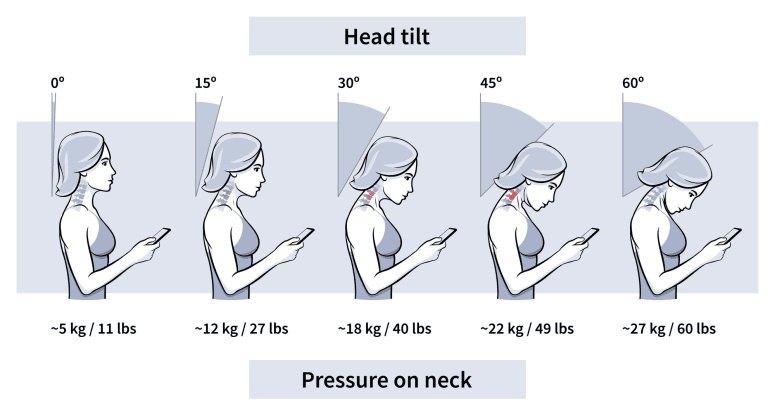
Your head weighs about 10 to 12 pounds. When it sits directly over your shoulders, your spine manages that weight efficiently.
But posture has changed.
Phones, laptops, and long hours at a desk have shifted the average head position forward. And when your head moves forward, even slightly, everything changes.
For every small forward shift, the load on your neck increases dramatically. At about a 45-degree tilt, your neck is no longer supporting 10 pounds… it is handling up to 50 pounds of force.
Think about that for a moment.
Your neck, upper back, and even your lower back are now working to support what is essentially a 50-pound bowling ball all day long.
This is not just a neck issue. This becomes a full spine problem.
As we discussed in our previous posture article, when the head moves forward, the body must compensate. The lower spine will either flatten and lose its natural curve or shift into a “butt-back” posture to keep you upright. Either way, the entire system is now under stress.
Why You Don’t Feel It Right Away
The body is incredibly adaptive.
It will do whatever it can to keep you moving and functioning, even if that means doing it inefficiently.
Muscles begin to tighten to hold you upright. Other muscles weaken because they are no longer being used properly. Your joints start moving differently. Your nervous system adapts to this new “normal.”
At first, you feel nothing.
Then maybe a little tightness.
Then stiffness.
Then one day, pain.
The key point is this: your body was unaware of the dysfunction in a way that would create immediate alarm, so the pattern continued. The signal for proper healing never fully registered, and the dysfunction persisted beneath the surface.
The Nerve-Muscle Loop Most People Miss
Most people believe neck pain is just a muscle problem.
It is not.
When your head sits forward, the joints in your cervical spine lose their normal alignment. This creates stress and irritation on the nerves exiting the spine.
Those nerves control muscles.
When a nerve is irritated, it sends an altered signal to the muscle. The muscle responds by tightening, guarding, or becoming dysfunctional. That dysfunction then reinforces the poor posture, which continues to irritate the nerve.
This creates a cycle.
Nerve irritation leads to muscle dysfunction. Muscle dysfunction reinforces poor posture. Poor posture increases nerve irritation.
Over time, this loop becomes your default pattern.
This is also why neck issues often lead to headaches. The suboccipital region, where the skull meets the neck, is highly sensitive. Chronic irritation here can directly contribute to head pain. Many chronic headaches actually originate from the neck, not the head.
Why Sitting Is the Hidden Driver

Prolonged sitting is one of the biggest contributors to this problem.
When you sit for extended periods, especially at a computer, the muscles in the front of your body begin to shorten. Your chest tightens. Your shoulders roll forward. Your head follows.
At the same time, the muscles that are supposed to hold you upright weaken.
This imbalance becomes a pattern.
And the longer it continues, the more your body accepts it as normal.
We were not designed to sit for hours at a time. Yet for many people, this is exactly what they do every day. Over time, this repetitive stress can be just as damaging as heavy physical labor.
Why Neck Pain Is Rarely “Just Acute”
There are two broad categories we look at in practice.
An acute injury, such as a car accident or sudden strain, is usually more straightforward. The body has not yet built long-term compensations, so care tends to progress more quickly.
Chronic postural dysfunction is different.
This is where most people fall.
If your posture has been off for months or years, your body has adapted at multiple levels. Muscles, joints, and your nervous system have all learned a new pattern. Changing that requires more than a quick fix.
It requires retraining.
What Chiropractic Care Actually Does
An adjustment is not just about “cracking your neck.”
It is about restoring communication.
When we adjust the spine, we are reducing interference within the nervous system. This allows muscles to receive a clearer signal and begin functioning the way they were designed to.
Over time, this helps reset patterns that have been dysfunctional for far too long.
But adjustments alone are not enough.
That is why our approach includes specific pre-adjustment preparation designed to activate the brain and nervous system before the adjustment even takes place. This is where real change begins.
When the brain is engaged and the body is prepared, the adjustment becomes more effective and more lasting.
Why Recovery Takes Time
One of the biggest misconceptions is how long it takes to truly correct this problem.
If your body has been compensating for years, it is unrealistic to expect full correction in a few visits.
Most people begin to experience meaningful, stabilizing changes around the six-month mark. True correction and long-term improvement take longer because you are rewiring patterns that have been deeply ingrained.
The good news is that progress builds.
Each visit reinforces the last. Each change compounds over time.
Prevention Is Simpler Than Correction
If you are not currently in pain, this is where you have the greatest opportunity.
You do not need perfect posture. That is not realistic.
What you need is variability and resilience.
Change your position regularly. Move every 30 to 60 minutes. Strengthen the muscles that support your posture. Give your body the ability to handle the stress you place on it.
Because the goal is not perfection.
It is adaptability.
When to Take Action
The earlier you address this, the easier it is to correct.
Do not wait for severe pain.
Do not ignore recurring stiffness or headaches.
Do not assume it will resolve on its own.
If you are experiencing neck discomfort, chronic tension, headaches, or even shoulder and arm symptoms, your body is already telling you something.
The longer you wait, the more compensation builds, and the longer it takes to unwind.
The Bigger Picture
Neck pain is rarely just about the neck.
It is about how your body has adapted over time.
When you restore alignment, reduce nerve interference, and retrain movement patterns, the body responds the way it was designed to.
Your body is not failing you.
It has been protecting you.
Now it is simply asking for a better strategy.
If you are ready to understand what is really causing your neck issues and what can be done to correct it, our office is here to help guide you through that process.