
Most parents have never heard of primitive reflexes.
Yet they play a foundational role in how a child’s brain develops, how their body moves, and how they learn, focus, and behave.
When these reflexes develop and integrate properly, they quietly set the stage for coordination, attention, emotional regulation, and academic success.
When they don’t, the effects can show up in ways that are often misunderstood.
What looks like ADHD, clumsiness, poor posture, or learning challenges may actually be rooted in something much earlier in development.
Primitive reflexes.
What Are Primitive Reflexes
Primitive reflexes are automatic movement patterns that are present at birth. They originate in the brainstem and are designed to help infants survive and begin interacting with their environment.
These reflexes guide early movements like sucking, grasping, turning the head, and reacting to stimuli.
As a child grows, higher centers of the brain begin to take over. These reflexes are meant to integrate, meaning they fade away and are replaced by more controlled, voluntary movement.
This process is one of the earliest and most important steps in neurological development.
If integration does not occur properly, the nervous system can remain in a more primitive, less efficient state.
And that affects everything built on top of it.
Why Primitive Reflexes Matter More Than You Think

Retained primitive reflexes can interfere with how the brain and body communicate.
This can show up as:
Difficulty sitting still
Poor posture
Trouble focusing
Impulsivity
Emotional sensitivity
Challenges with reading and writing
Coordination issues
Sensory sensitivities
These are not random symptoms.
They are signals that the nervous system may not be developing as efficiently as it could.
When the foundation is unstable, everything built on top of it becomes more difficult.
The Major Primitive Reflexes and When They Should Integrate

Understanding a few key reflexes can help you recognize patterns in your child.
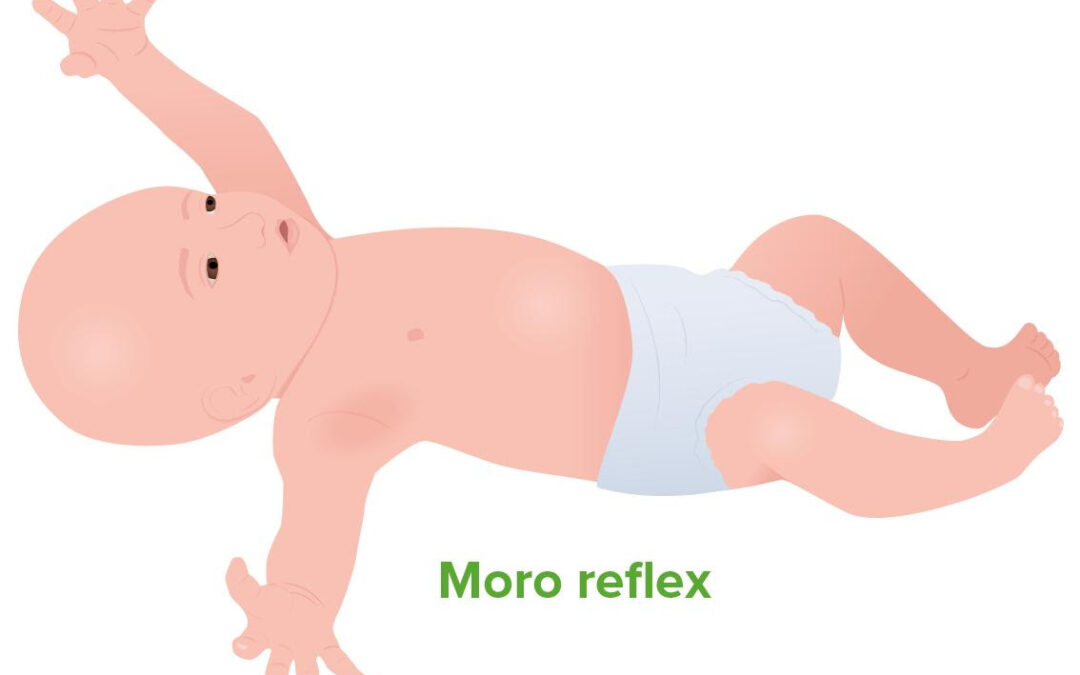
Moro Reflex (Startle Reflex)
Present at birth
Should integrate by 4–6 months
This reflex causes a sudden extension of the arms and legs in response to stimuli, followed by a contraction.
If retained, it may contribute to anxiety, emotional reactivity, difficulty handling stress, and hypersensitivity to sound or light.
These children often appear “on edge” or easily overwhelmed.
ATNR (Asymmetrical Tonic Neck Reflex)
Present at birth
Should integrate by 5–7 months
When the head turns to one side, the arm and leg on that side extend while the opposite side flexes.
If retained, it can interfere with crossing midline, which is essential for reading and writing.
Children may struggle with handwriting, tracking words across a page, or coordinating both sides of the body.
STNR (Symmetrical Tonic Neck Reflex)
Develops around 6–9 months
Should integrate by 9–11 months
This reflex helps a child transition from lying to crawling.
If retained, it can affect posture and sitting still. These children may slump, fidget constantly, or have difficulty maintaining attention at a desk.
TLR (Tonic Labyrinthine Reflex)
Present at birth
Should integrate by around 6 months
This reflex influences muscle tone based on head position.
If retained, it may lead to poor balance, coordination issues, motion sensitivity, and difficulty with spatial awareness.
Spinal Galant Reflex
Present at birth
Should integrate by 3–9 months
This reflex is activated when the lower back is stimulated.
If retained, it can contribute to fidgeting, poor sitting tolerance, bedwetting, and sensitivity to clothing around the waist.
What Happens If These Reflexes Remain
When primitive reflexes are retained, the brain is essentially working with interference.
Instead of smooth, coordinated communication, there are competing signals.
The body may react when it doesn’t need to.
The brain may struggle to filter input.
Energy that should be used for learning and focus is instead used for compensation.
This is why a child can be intelligent, capable, and trying hard, yet still struggle.
It is not a lack of effort.
It is a lack of integration.
How to Help Integrate Primitive Reflexes
The encouraging news is this.
The brain is adaptable.
With the right input, these reflexes can be reduced or integrated over time.
The key is specific, repetitive movement patterns that mimic early developmental stages.
Cross Crawl
Have your child touch their right elbow to their left knee, then alternate sides.
This improves coordination between both sides of the brain and supports integration of reflexes like ATNR.
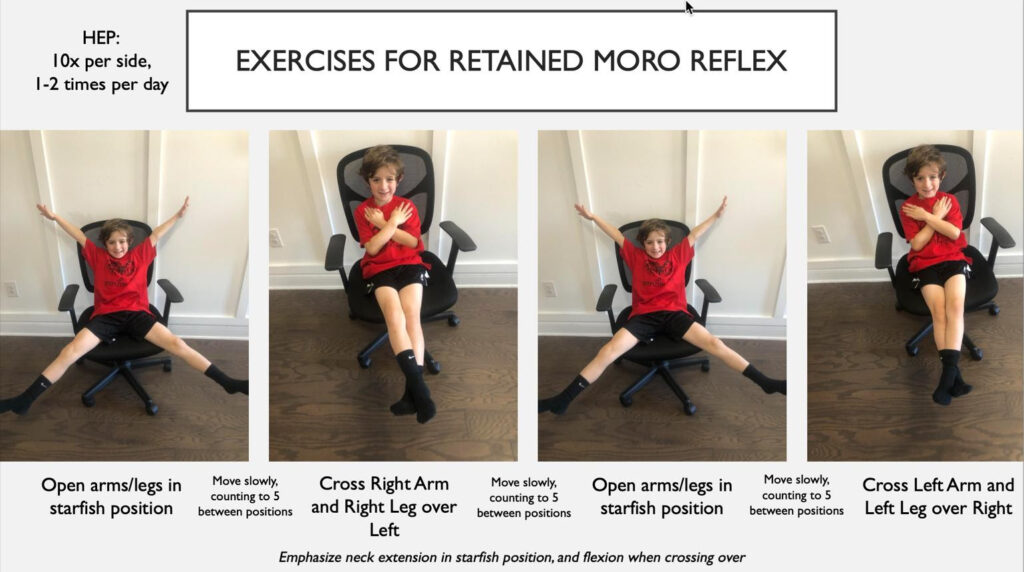
Starfish Exercise (for Moro Reflex)
Start curled up, then slowly extend arms and legs outward while breathing deeply, then return to a curled position.
This helps regulate the nervous system and reduce startle reflex sensitivity.
Rocking on Hands and Knees
Position your child on hands and knees and gently rock forward and backward.
This mimics early developmental movement and supports integration of STNR.
Superman Hold
Lift arms and legs while lying face down and hold steady.
This strengthens postural muscles and improves body awareness.
Snow Angels (on Floor)
Lying on the back, move arms and legs in a slow, controlled pattern like making a snow angel.
This supports coordination and full-body awareness.
Why Consistency Is Everything
These exercises are not quick fixes.
They are inputs.
And the brain changes through repetition.
Done occasionally, they help.
Done consistently, they can create meaningful improvements in focus, behavior, coordination, and learning.
A Different Way to Look at Your Child’s Challenges
At Ptak Family Chiropractic, we view these patterns through a neurological lens.
The body and brain are not separate.
Movement, posture, and spinal function all influence how the brain processes information and how a child experiences the world.
When we improve the foundation, everything else has the opportunity to improve as well.
This is not about labeling your child.
It is about understanding them.
Helping Your Child Reach Their Potential
If your child is struggling with focus, coordination, behavior, or learning, there is always a reason.
And there is always a path forward.
When we identify what may be interfering with development and apply the right strategies, we can help the brain and body work together more effectively.
If you would like help understanding what may be affecting your child and what steps you can take, we are here for you.
Call our office or schedule a consultation today.
Let’s help your child build the foundation they need to grow, learn, and thrive. (310) 473-7991.