
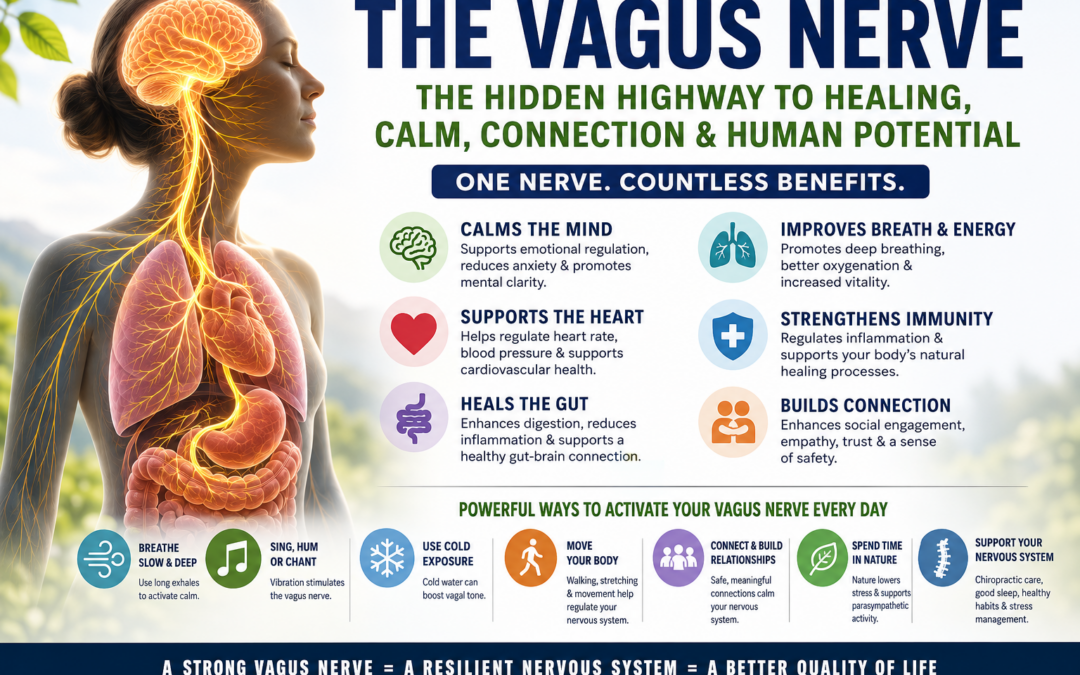
The Vagus Nerve The Hidden Highway to Healing, Calm, Connection, and Human Potential
There may be no structure in the human body more important — and more misunderstood — than the vagus nerve.
Most people have never heard of it.
Yet this extraordinary neurological pathway influences nearly every major system in your body including your heart, lungs, digestion, immune system, inflammation levels, sleep, hormones, emotional state, resilience, recovery, healing ability, and overall quality of life.
The vagus nerve is not simply “a nerve.” It is one of the master communication highways between your brain and body.
It is one of the primary regulators of the parasympathetic nervous system — the part of your nervous system responsible for healing, recovery, restoration, repair, emotional regulation, adaptability, and resilience.
In many ways, the quality of your life is deeply connected to the quality of your vagal function.
And in today’s modern world, millions of people are unknowingly living in a state where this system is chronically suppressed.
They are surviving.
But they are not truly recovering.
Not truly regulating.
Not truly healing.
Not truly thriving.
Understanding the vagus nerve changes how you understand stress, health, inflammation, healing, emotions, and even the human experience itself.
What Is the Vagus Nerve?
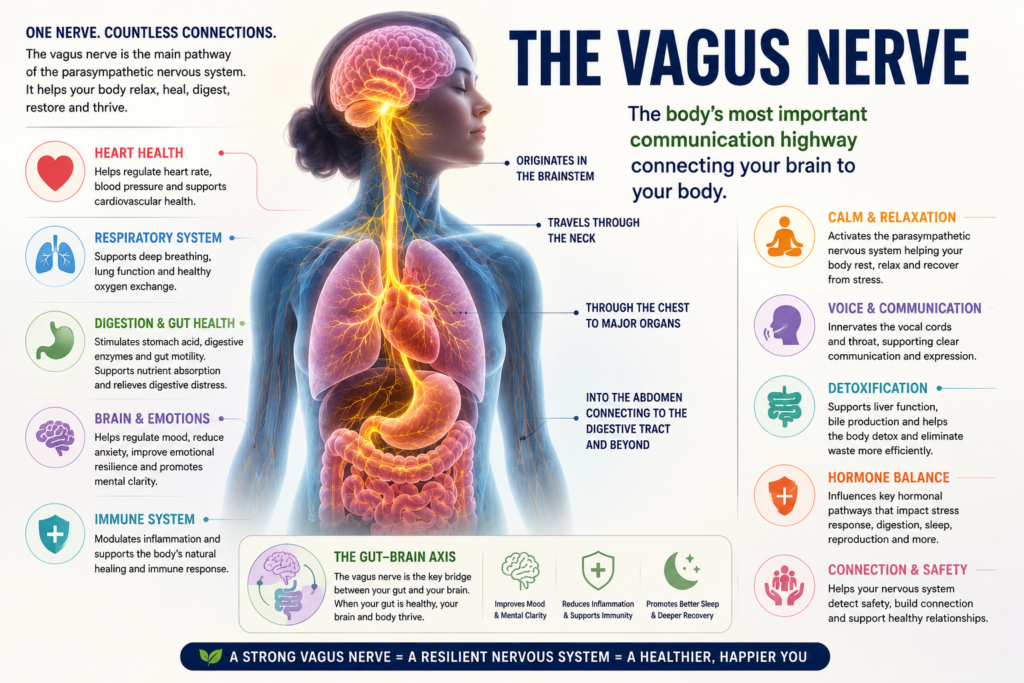
The word vagus comes from the Latin word meaning “wandering,” which is fitting because the vagus nerve travels farther throughout the body than any other cranial nerve.
The vagus nerve begins in the brainstem and travels through the neck into the chest and abdomen, connecting to major organs and systems along the way.
It communicates with the:
- Heart
- Lungs
- Diaphragm
- Digestive tract
- Liver
- Pancreas
- Spleen
- Vocal cords
- Throat
- Facial muscles
- Immune system
- Gut microbiome
The vagus nerve is one of the primary communication highways between your brain and body.
Remarkably, nearly 80% of vagal nerve fibers are sensory, meaning most communication is actually traveling from the body back up to the brain.
Your brain is constantly listening to your body.
Every breath.
Every heartbeat.
Every digestive signal.
Every inflammatory response.
Every muscular tension pattern.
Every emotional state.
The vagus nerve helps your brain determine whether your body feels safe… or threatened.
And this matters far more than most people realize.
The Parasympathetic Nervous System
Your Healing and Recovery System
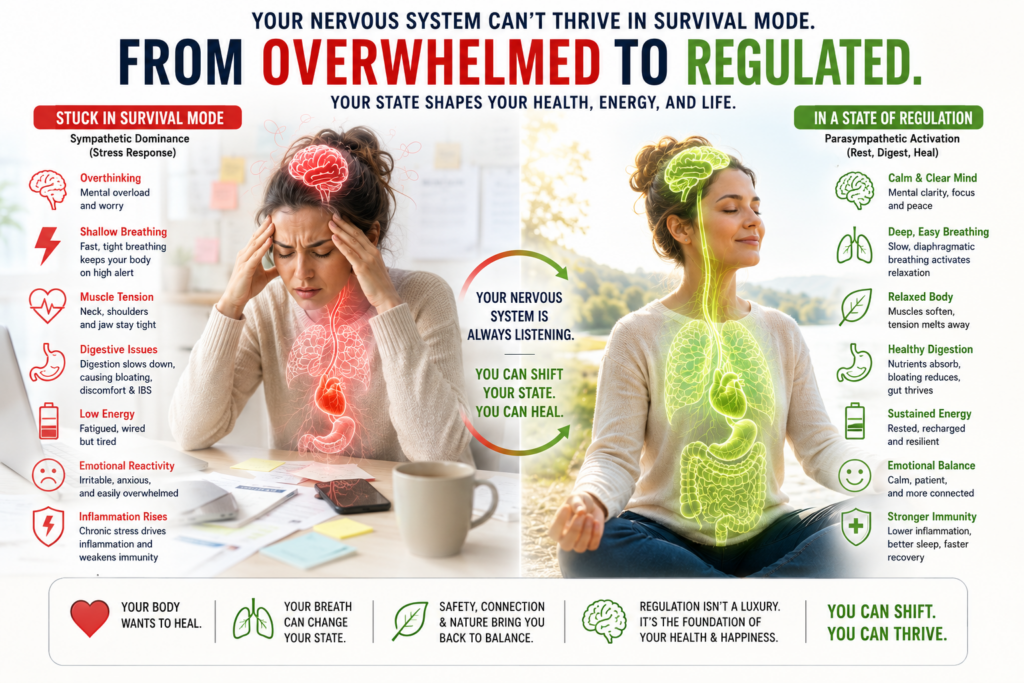
The autonomic nervous system has two primary branches:
The sympathetic nervous system, commonly known as fight-or-flight.
And the parasympathetic nervous system, often referred to as rest, digest, heal, regulate, and recover.
The vagus nerve is one of the primary regulators of the parasympathetic nervous system.
When this system activates appropriately:
- Heart rate slows
- Breathing deepens
- Digestion improves
- Muscles relax
- Blood pressure normalizes
- Inflammation decreases
- Hormonal balance improves
- Sleep quality improves
- Emotional regulation improves
- Healing and recovery accelerate
This is where restoration happens.
This is where healing happens.
This is where the body repairs itself.
The problem is that many people rarely enter this state deeply anymore.
The Modern Nervous System Crisis
One of the greatest hidden epidemics in modern society is nervous system dysregulation.
People are exhausted but wired.
Tired but unable to relax.
Overstimulated but emotionally disconnected.
Chronically tense but unaware of it.
Living with elevated stress hormones for years.
The body begins interpreting everyday life as danger.
Emails.
Traffic.
Financial pressure.
Social media.
Poor sleep.
Inflammation.
Technology overload.
Emotional stress.
Poor posture.
Pain.
Chronic uncertainty.
Eventually the nervous system forgets how to fully relax.
And when the body no longer feels safe internally, physiology changes.
Digestion changes.
Breathing changes.
Hormones change.
Inflammation changes.
Muscle tone changes.
Pain perception changes.
Even emotional patterns and resilience may shift.
Many chronic conditions may involve autonomic nervous system imbalance including:
- Anxiety
- Chronic stress
- Digestive disorders
- IBS
- Tension headaches
- Migraines
- Chronic inflammation
- Sleep disturbances
- Burnout
- Fatigue
- Brain fog
- TMJ dysfunction
- Fibromyalgia
- High blood pressure
- Emotional dysregulation
The body was never designed to remain in survival mode continuously.
Vagal Tone
The Health of Your Nervous System
You will often hear the phrase “vagal tone.”
Vagal tone refers to the functional health and adaptability of the vagus nerve.
Healthy vagal tone means your body can move fluidly between activation and recovery.
Stress occurs.
Then the body recovers.
Challenge occurs.
Then regulation returns.
Poor vagal tone may make it difficult for the body to shift out of stress physiology.
The nervous system gets “stuck.”
This may show up as:
- Chronic tension
- Shallow breathing
- Anxiety
- Poor digestion
- Sleep problems
- Emotional reactivity
- Fatigue
- Elevated resting heart rate
- Poor stress tolerance
- Chronic inflammation
A healthy vagus nerve does not mean life becomes stress-free.
It means your body becomes more adaptable to stress.
And adaptability may be one of the greatest predictors of long-term health.
The Gut-Brain Connection
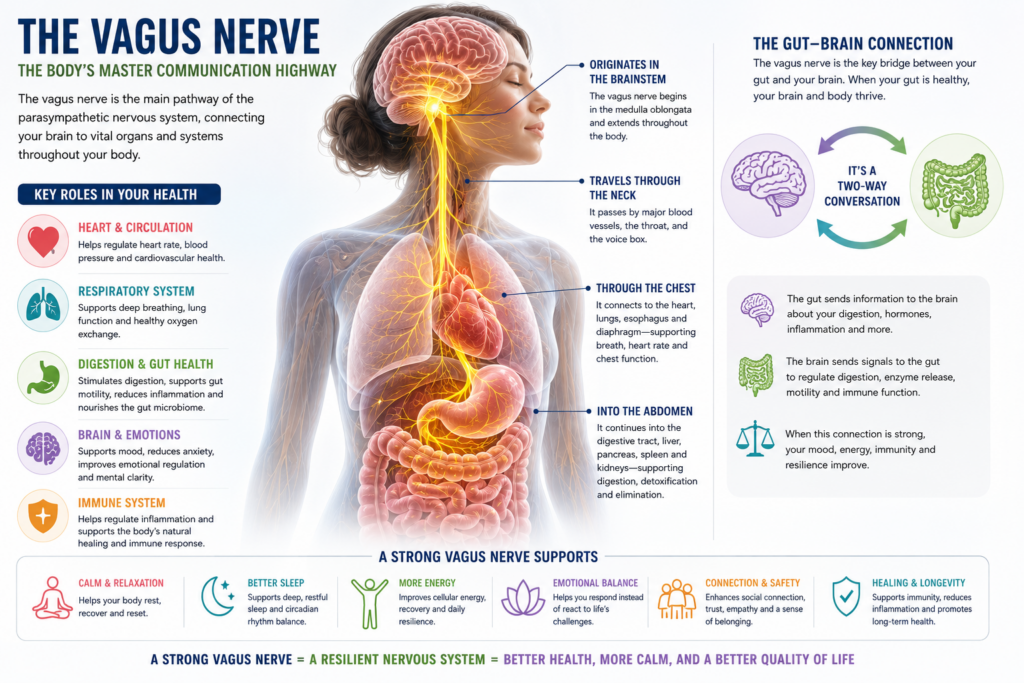
One of the most fascinating roles of the vagus nerve is its involvement in the gut-brain connection.
Your gut and brain are constantly communicating.
This is why emotional stress can affect digestion.
And why digestive dysfunction can affect mood and emotions.
The vagus nerve helps regulate:
- Stomach acid production
- Digestive enzyme release
- Intestinal motility
- Gut inflammation
- Microbiome communication
This may help explain why chronic stress frequently contributes to:
- Bloating
- Constipation
- Acid reflux
- IBS
- Nausea
- Digestive discomfort
The nervous system and digestive system are deeply interconnected.
A body trapped in stress physiology often cannot digest optimally.
The Vagus Nerve and Inflammation
The vagus nerve also plays a major role in regulating inflammation.
Researchers often refer to this as the inflammatory reflex.
Healthy vagal signaling may help modulate excessive inflammatory responses throughout the body.
Chronic stress and autonomic imbalance may contribute to persistent low-grade inflammation.
And chronic inflammation has been associated with:
- Cardiovascular disease
- Metabolic dysfunction
- Autoimmune conditions
- Chronic pain
- Neurodegenerative disorders
- Mood disorders
The nervous system and immune system are in constant communication.
Health is never isolated to one single system.
The Vagus Nerve and Human Emotion
One of the most profound aspects of the vagus nerve is its relationship to emotional regulation and human connection.
The vagus nerve influences:
- Facial expression
- Vocal tone
- Eye contact
- Emotional safety
- Calm presence
- Social engagement
- Compassion
- Trust
- Connection
When the nervous system feels safe, humans connect more easily.
When the nervous system feels threatened, humans protect.
Many emotional responses are not simply psychological.
They are physiological.
Sometimes people do not need to “try harder.”
Sometimes their nervous system simply needs support returning to regulation.
How to Activate the Vagus Nerve Naturally
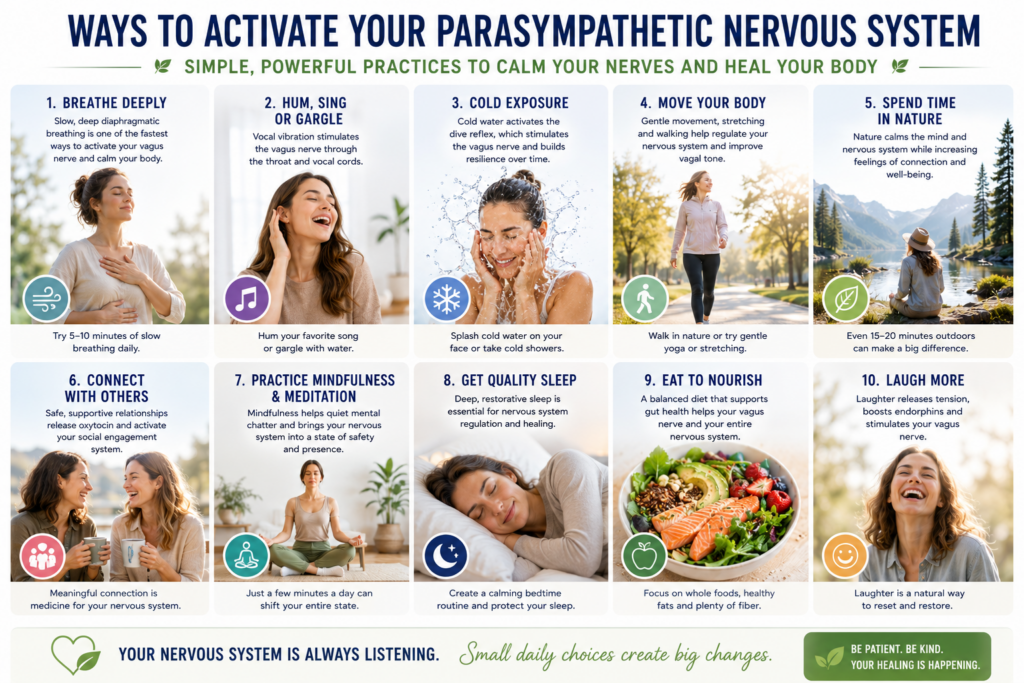
One of the most empowering realities about the vagus nerve is that it can be influenced intentionally.
Small daily habits can profoundly shape nervous system regulation over time.
Deep Diaphragmatic Breathing
Slow breathing is one of the fastest ways to stimulate parasympathetic activity.
Especially:
- Slow exhalations
- Nasal breathing
- Belly breathing
- Rhythmic breathing patterns
Fast shallow chest breathing often signals stress.
Slow diaphragmatic breathing signals safety.
Humming, Chanting, Singing, and Prayer
The vagus nerve connects to the throat and vocal cords.
This may explain why humming, chanting, singing, prayer, and vocal vibration often feel calming and grounding.
Many ancient healing traditions understood this long before modern neuroscience.
Cold Exposure
Cold exposure may stimulate vagal pathways and improve autonomic adaptability.
Examples include:
- Cold face immersion
- Cold showers
- Contrast therapy
- Cold plunges
The goal is not punishment.
The goal is adaptability and resilience.
Movement and Exercise
The human body was designed for movement.
Walking, stretching, mobility work, rhythmic exercise, yoga, dance, and nature walks may all help regulate the nervous system.
Movement helps discharge stress physiology.
Sedentary lifestyles often reinforce nervous system dysregulation.
Nature and Sunlight
Natural environments often help shift the nervous system toward parasympathetic dominance.
Fresh air, sunlight, reduced stimulation, and rhythmic movement in nature may help calm the nervous system profoundly.
Many people notice they breathe differently near the ocean, in forests, or under open skies.
The nervous system recognizes environmental safety cues.
Human Connection
One of the most overlooked vagus nerve activators is healthy human connection.
Feeling seen.
Feeling heard.
Feeling understood.
Feeling safe.
Feeling loved.
Supportive relationships can regulate physiology.
Chronic conflict and isolation can dysregulate physiology.
Humans are biologically wired for connection.
Chiropractic Care and Nervous System Regulation
The spine and nervous system are intimately connected.
Mechanical stress, spinal dysfunction, postural distortion, restricted motion, muscle tension, and upper cervical imbalance may all influence nervous system physiology.
Particularly important is the upper cervical region near the brainstem where autonomic regulation is heavily coordinated.
Chiropractic care is not simply about pain relief.
It is about optimizing nervous system function.
Improving motion.
Reducing mechanical stress.
Enhancing neurological communication.
Supporting adaptability and regulation.
Many patients report improvements not only in pain, but also in:
- Sleep
- Digestion
- Stress tolerance
- Breathing
- Emotional calmness
- Recovery
- Energy levels
While chiropractic care is not a direct “vagus nerve treatment,” optimizing spinal and nervous system function may profoundly influence parasympathetic balance and nervous system regulation.
Sleep and the Nervous System
Sleep is one of the body’s greatest parasympathetic healing states.
Poor sleep disrupts autonomic regulation.
And autonomic dysregulation disrupts sleep.
This creates a vicious cycle.
Supporting vagal function often improves sleep quality.
And improving sleep often improves nervous system regulation.
Everything is connected.
Trauma, Stress, and the Body
One of the deepest truths about the nervous system is this:
The body remembers.
Past trauma, chronic stress, emotional overwhelm, physical injury, and unresolved tension patterns may influence autonomic function for years.
Sometimes healing requires more than positive thinking.
Sometimes the nervous system itself needs support.
This may involve:
- Breathwork
- Meditation
- Chiropractic care
- Movement
- Therapy
- Somatic work
- Prayer
- Community
- Nervous system retraining
- Mindfulness practices
Healing is not weakness.
Rest is not weakness.
Regulation is not weakness.
The body was designed to heal when given the opportunity.
The Ultimate Goal Is Not Relaxation
It Is Adaptability
The healthiest nervous systems are not permanently calm.
They are adaptable.
Able to rise to challenge when necessary.
Able to recover afterward.
Able to transition fluidly between activation and restoration.
This is resilience.
This is regulation.
This is health.
Final Thoughts
Your Nervous System Is Always Listening
Every thought.
Every breath.
Every posture.
Every relationship.
Every stress.
Every environment.
Every habit.
Your nervous system is constantly interpreting the world around you.
The vagus nerve helps determine whether your body moves toward protection… or healing.
Toward survival… or restoration.
Toward exhaustion… or vitality.
The goal is not to eliminate stress completely.
The goal is to create a nervous system capable of recovery.
A nervous system that feels safe enough to heal.
A nervous system adaptable enough to thrive.
A nervous system connected enough to fully experience life.
Because perhaps the greatest human experience is not simply being alive.
It is feeling regulated, connected, resilient, present, and capable of healing from within.
And the vagus nerve may be one of the most important gateways to that experience.
The question is:
What signals are you giving it every day?
If you are ready to support your nervous system, improve adaptability, and help your body move toward healing instead of survival, we would be honored to help.
Ptak Family Chiropractic
3122 Santa Monica Blvd. Suite 102
Santa Monica, CA 90404
(310) 473-7991
www.ptakfamilychiropractic.com
Because when the nervous system functions better… life often does too.