
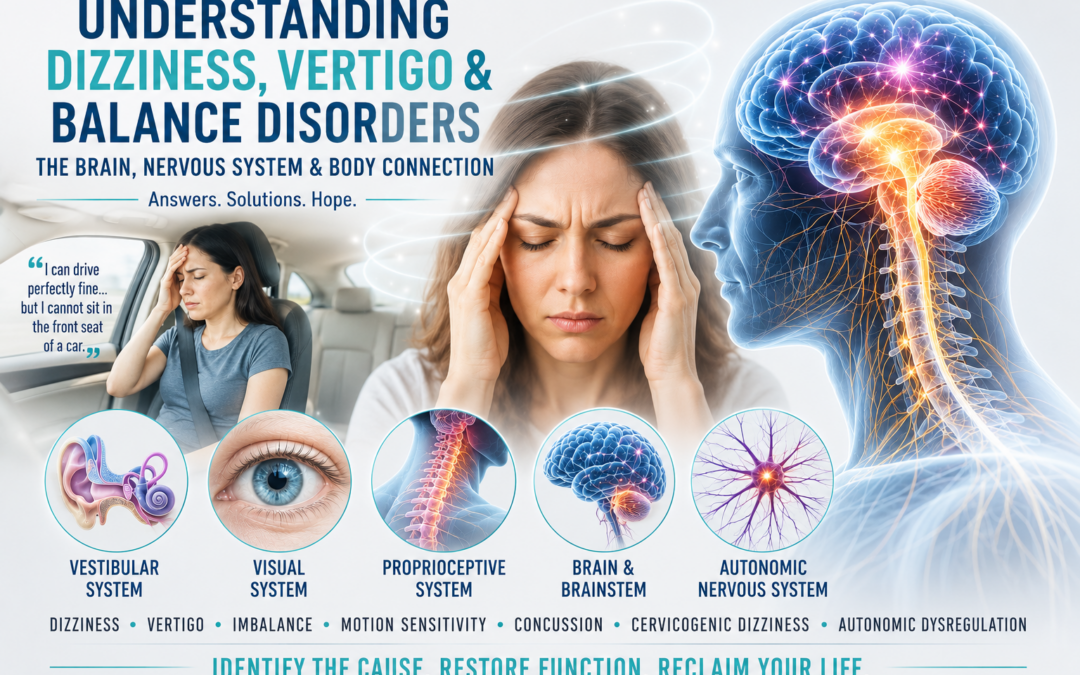
Why So Many People Feel Dizzy, Off-Balance, Motion Sensitive, Foggy, Unstable, or Overwhelmed — And How Proper Neurological Evaluation and Rehabilitation May Finally Provide Answers
Every day people walk into doctors’ offices saying:
“The room spins.”
“I feel dizzy all the time.”
“I feel like I’m walking on a boat.”
“I get overwhelmed in grocery stores.”
“I feel off balance for no reason.”
“I feel disconnected from my body.”
“I can drive perfectly fine… but I cannot sit in the front passenger seat of a car.”
“Traffic makes me panic.”
“I feel motion sick when someone else is driving.”
“My MRI was normal, but I still feel terrible.”
“I’ve been told it’s anxiety.”
For some people the symptoms come suddenly.
For others they slowly develop over months or years.
And one of the biggest problems in healthcare today is that dizziness is often treated as though it is one simple condition.
It is not.
Dizziness is one of the most neurologically complex symptoms in the human body.
Because balance is not controlled by the inner ear alone.
Balance is created by massive communication between:
- The vestibular system
- The eyes
- The brainstem
- The cerebellum
- The autonomic nervous system
- The upper cervical spine
- Proprioception
- Sensory integration pathways
- Postural control systems
- Motion prediction systems
- Right and left brain communication
When these systems lose synchronization, the body may begin producing symptoms that are frightening, exhausting, confusing, and life altering.
The encouraging news is this:
Many people suffering from dizziness, vertigo, imbalance, motion sensitivity, and neurological overload have never actually had a comprehensive functional neurological and proprioceptive evaluation to determine WHY their symptoms are occurring in the first place.
Understanding the source of the dysfunction is often the first major step toward recovery.
The Three Major Balance Systems
Your brain determines where you are in space by constantly integrating information from three major systems simultaneously.
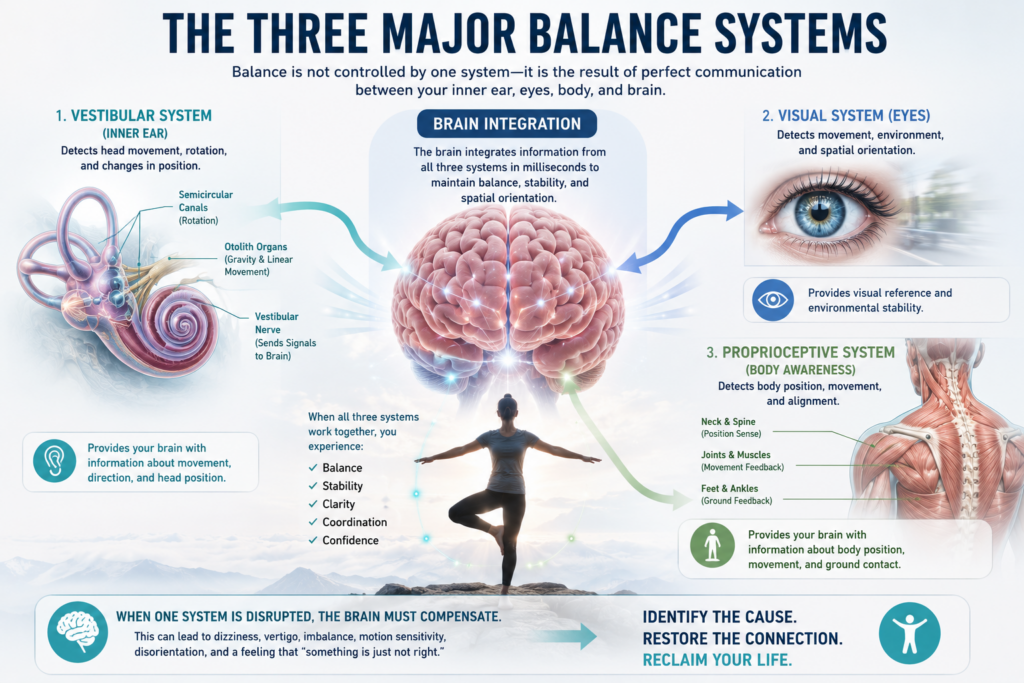
1. The Vestibular System (Inner Ear)
The vestibular system is located inside the inner ear.
It detects:
- Head movement
- Rotation
- Gravity
- Acceleration
- Directional change
Tiny structures inside the vestibular apparatus constantly tell the brain whether your body is moving, tilting, accelerating, or remaining stable.
2. The Visual System
Your eyes constantly orient you to the world around you.
Visual input helps stabilize posture, movement, and orientation.
This is why many dizzy patients feel worse in:
- Grocery stores
- Airports
- Crowds
- Escalators
- Traffic
- Busy visual environments
The nervous system becomes overwhelmed trying to process excessive visual motion and sensory information.
3. The Proprioceptive System
Proprioception is the body’s internal positioning and movement system.
Neurological receptors in the:
- Muscles
- Joints
- Ligaments
- Feet
- Spine
- Neck
…constantly tell the brain where the body is positioned in space.
The upper cervical spine is especially important because it contains one of the highest concentrations of proprioceptive receptors in the body.
The brain integrates all three systems into one coordinated perception of stability.
When one system becomes dysfunctional — or when the brain can no longer integrate them correctly — dizziness, vertigo, disequilibrium, motion sensitivity, and neurological overload may develop.
Dizziness vs Vertigo — They Are NOT the Same
One of the most misunderstood concepts in healthcare is that dizziness and vertigo are not identical.
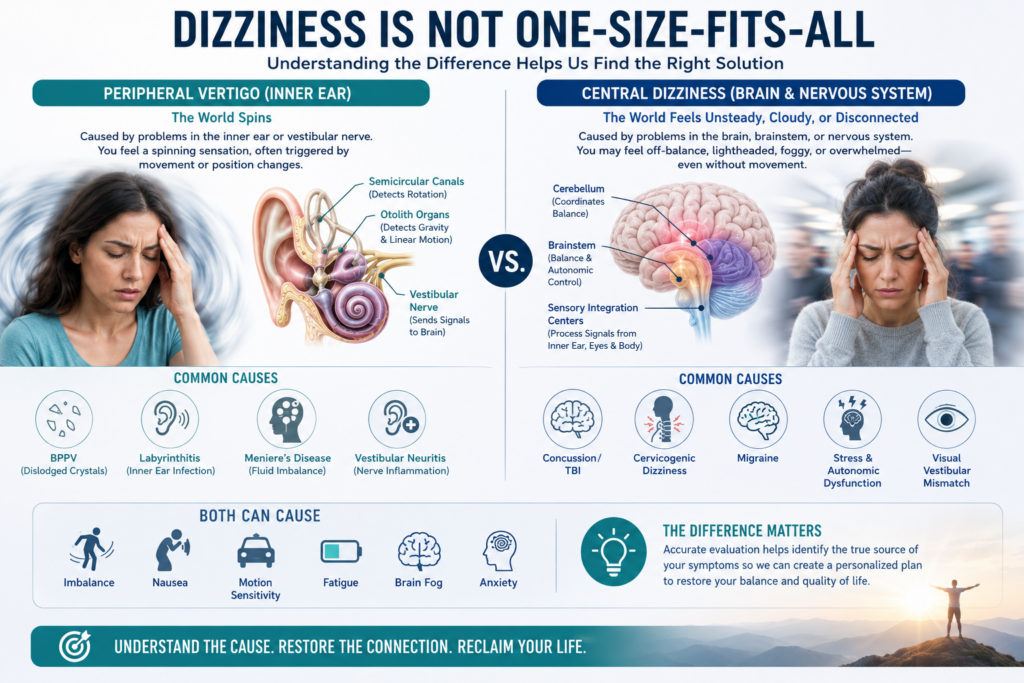
Vertigo
Vertigo is the false sensation of movement.
Patients commonly describe:
- Spinning
- Tilting
- Rocking
- Swaying
- Falling sensations
- Feeling pulled sideways
Vertigo often involves dysfunction within:
- The vestibular system
- Inner ear
- Brainstem
- Central vestibular pathways
It may also include:
- Nausea
- Vomiting
- Sweating
- Severe motion sensitivity
- Eye jerking movements called nystagmus
Dizziness
Dizziness is a much broader term.
Patients may actually mean:
- Lightheadedness
- Brain fog
- Floating sensations
- Disequilibrium
- Feeling disconnected
- Motion sensitivity
- Feeling unstable
- Feeling “off”
This may involve:
- Brainstem dysfunction
- Autonomic nervous system dysregulation
- Proprioceptive mismatch
- Concussions
- Cervical dysfunction
- Sensory integration overload
- Blood pressure instability
- Central neurological dysfunction
Understanding this distinction is critically important because rehabilitation depends heavily on the underlying cause.
Peripheral Vertigo — Inner Ear Disorders
Peripheral vertigo originates primarily within the vestibular apparatus of the inner ear.
Common Causes Include:
Benign Paroxysmal Positional Vertigo (BPPV)
Tiny calcium crystals become displaced inside the semicircular canals.
Symptoms often include:
- Sudden spinning
- Rolling over in bed causing vertigo
- Looking upward triggering dizziness
- Short intense episodes
Vestibular Neuritis
Inflammation of the vestibular nerve, often after viral illness.
Labyrinthitis
Inflammation involving both balance and hearing systems.
Ménière’s Disease
A disorder involving abnormal inner ear fluid regulation.
Symptoms may include:
- Vertigo
- Ear fullness
- Ringing in the ears
- Hearing fluctuations
Rehabilitation for Inner Ear Vertigo
Inner ear rehabilitation focuses on helping recalibrate vestibular function.
Common Approaches Include:
Canalith Repositioning Maneuvers
Especially for BPPV.
Examples include:
- Epley maneuver
- Semont maneuver
- Brandt-Daroff exercises
The goal is repositioning displaced inner ear crystals.
Gaze Stabilization Exercises
Patients focus on a target while moving the head side to side.
This retrains vestibulo-ocular reflex pathways.
Habituation Exercises
Repeated controlled exposure to provoking movements helps reduce hypersensitivity.
Balance Retraining
Examples include:
- Tandem walking
- Single-leg standing
- Foam surface balancing
- Dynamic movement drills
Central Vertigo and Neurological Dizziness
Central vertigo originates within the brain and nervous system itself.
This is often far more complex than simple inner ear vertigo.
Structures commonly involved include:
- Brainstem
- Cerebellum
- Vestibular nuclei
- Midbrain
- Cortical sensory integration pathways
These patients often do NOT describe true spinning.
Instead they say:
- “I feel off.”
- “I feel disconnected.”
- “I feel foggy.”
- “I feel unstable.”
- “I feel like I’m floating.”
- “I feel overwhelmed in stores.”
- “My nervous system feels overloaded.”
The Brainstem and Autonomic Nervous System
The brainstem is one of the major balance-processing centers in the body.
It regulates:
- Vestibular integration
- Eye coordination
- Heart rate
- Blood pressure
- Breathing
- Postural reflexes
- Spatial orientation
- Autonomic nervous system activity
When the brainstem becomes dysregulated, patients may experience:
- Motion sensitivity
- Anxiety sensations
- Heart palpitations
- Brain fog
- Visual overwhelm
- Lightheadedness
- Sensory overload
This is one reason dizziness and anxiety overlap so frequently.
The body no longer feels neurologically stable.
Brainstem Rehabilitation Approaches
Rehabilitation often focuses on improving sensory integration and autonomic regulation.
Examples Include:
Eye Movement Rehabilitation
Including:
- Smooth pursuits
- Saccadic eye exercises
- Gaze fixation training
Vestibulo-Ocular Integration Drills
Coordinating eye movement with head movement.
Breathing Rehabilitation
Slow diaphragmatic breathing to reduce sympathetic overactivation.
Vagal Stimulation Strategies
Examples may include:
- Humming
- Controlled breathing
- Meditation
- Cold facial stimulation
- Parasympathetic activation work
Graded Sensory Exposure
Gradually retraining tolerance to:
- Motion
- Visual complexity
- Crowds
- Busy environments
Cerebellar Dysfunction and Rehabilitation
The cerebellum plays a major role in:
- Coordination
- Timing
- Balance
- Precision
- Movement smoothing
- Spatial accuracy
Cerebellar dysfunction may produce:
- Swaying
- Clumsiness
- Motion sensitivity
- Wide-based gait
- Poor coordination
Rehabilitation May Include:
Coordination Exercises
Examples:
- Finger-to-nose drills
- Alternating movement exercises
- Rapid directional changes
Balance Challenges
Including:
- Tandem walking
- Foam surface exercises
- Uneven terrain balancing
Dual-Task Training
Combining:
- Cognitive tasks
- Eye tracking
- Movement tasks
Rhythmic Movement Training
Helping improve cerebellar timing and coordination.
Proprioception and Cervicogenic Dizziness
The upper cervical spine communicates directly with:
- The vestibular nuclei
- Brainstem
- Cerebellum
- Eye coordination centers
If abnormal sensory input develops from the neck due to:
- Whiplash
- Concussions
- Poor posture
- Injury
- Muscle tension
- Subluxation patterns
…the brain may receive distorted information about head position and orientation.
This may produce:
- Floating sensations
- Disequilibrium
- Brain fog
- Motion sensitivity
- Head pressure
- Neck tightness
- Visual instability
Rehabilitation for Proprioceptive Dysfunction
Cervical Rehabilitation
Including:
- Deep neck flexor training
- Cervical stabilization exercises
- Postural correction
Joint Position Retraining
Helping restore accurate head-position awareness.
Sensorimotor Integration Work
Combining:
- Eye movement
- Neck movement
- Balance work
- Postural control
Why Grocery Stores, Crowds, and Busy Environments Trigger Symptoms
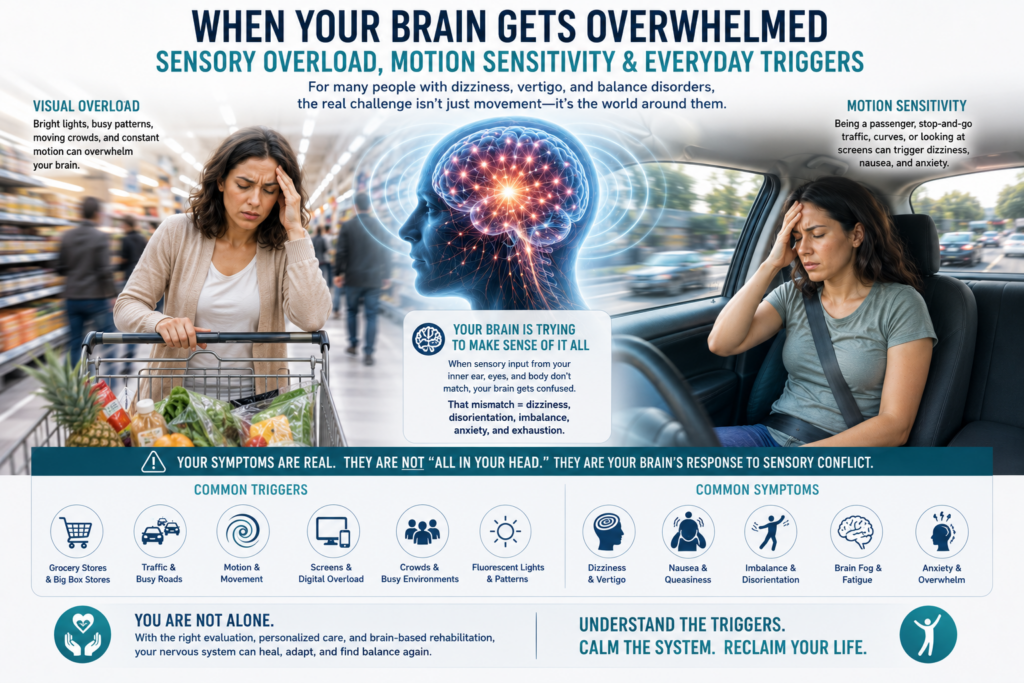
This is extremely common in central vestibular dysfunction.
Large visually complex environments create enormous amounts of sensory input.
The brain must rapidly coordinate:
- Visual processing
- Vestibular information
- Spatial orientation
- Postural control
- Motion prediction
When the nervous system becomes overloaded, symptoms may worsen dramatically.
Patients may feel:
- Foggy
- Overstimulated
- Disconnected
- Disoriented
- Unstable
Why Some People Can Drive Fine But Cannot Ride Passenger
One of the most common — yet least understood — symptoms in vestibular and neurological patients is difficulty riding in a car, especially as a passenger.
Patients often say:
- “I can drive, but I cannot sit passenger.”
- “Traffic overwhelms me.”
- “I panic in the front seat.”
- “I feel motion sick when someone else is driving.”
- “My nervous system cannot process all the movement.”
This symptom is extremely real.
And it is often neurological.
Why Driving Feels Different Than Riding Passenger
When you are driving, your brain actively predicts movement.
You are:
- Steering
- Anticipating turns
- Preparing for braking
- Visually tracking the environment
- Coordinating movement with expectation
The nervous system feels more in control.
But when riding passenger, the brain must react to movement instead of initiating it.
For people with:
- Vestibular dysfunction
- Concussion history
- Central vertigo
- Autonomic dysregulation
- Proprioceptive mismatch
- Motion sensitivity
…the nervous system may become overwhelmed trying to process:
- Speed
- Peripheral motion
- Lane changes
- Traffic flow
- Directional acceleration
- Visual complexity
This creates sensory mismatch and neurological overload.
The body may respond with:
- Dizziness
- Nausea
- Panic sensations
- Sweating
- Hypervigilance
- Brain fog
- Motion sickness
Many patients mistakenly believe:
“I’m developing anxiety.”
But often the anxiety developed AFTER the nervous system lost confidence in processing movement and spatial orientation.
Rehabilitation for Passenger-Seat Motion Sensitivity
Vestibular Rehabilitation
Helping recalibrate motion-processing pathways.
Eye Movement Training
Improving visual tracking and vestibulo-ocular coordination.
Cervical Proprioceptive Rehabilitation
Improving neck-based sensory input.
Autonomic Regulation Strategies
Helping reduce sympathetic overactivation.
Graded Motion Exposure
Slowly retraining tolerance to:
- Traffic
- Passenger riding
- Visual motion
- Complex movement environments
Concussions and Persistent Dizziness
Concussions frequently disrupt:
- Vestibular integration
- Eye tracking
- Brainstem regulation
- Proprioception
- Autonomic stability
Symptoms may persist long after imaging appears normal.
This is because many post-concussion problems involve functional neurological dysregulation rather than structural damage visible on MRI or CT scans.
Chiropractic, Functional Neurology, and the Brain-Body Balance Connection
One of the most important things patients must understand is this:
Many forms of dizziness, vertigo, imbalance, motion sensitivity, and neurological disequilibrium are not simply “ear problems.”
They are often problems involving how the brain and nervous system process, integrate, and coordinate information.
At Ptak Family Chiropractic our approach focuses on the relationship between:
- The brain
- Nervous system
- Vestibular system
- Upper cervical spine
- Proprioceptive input
- Postural control systems
- Sensorimotor integration
- Autonomic nervous system regulation
Through comprehensive neurological, postural, orthopedic, spinal, vestibular, and proprioceptive evaluation, it is often possible to better determine:
- WHY a patient feels dizzy
- Whether symptoms are more vestibular, central, proprioceptive, autonomic, or cervicogenic in nature
- Whether concussion or whiplash may be contributing
- Whether sensory integration dysfunction is present
- Which neurological systems may not be functioning or integrating properly
This becomes critically important because proper rehabilitation depends heavily on identifying the underlying source of dysfunction.
Depending on the individual patient, care in our office may involve:
- Chiropractic adjustments
- Upper cervical correction
- Vestibular rehabilitation
- Proprioceptive rehabilitation
- Eye movement exercises
- Cervical stabilization work
- Balance retraining
- Postural rehabilitation
- Functional neurological rehabilitation approaches
- Autonomic nervous system regulation strategies
The goal is not simply masking symptoms.
The goal is improving neurological communication, sensory integration, adaptability, stability, and overall nervous system function.
Many patients are surprised to discover that improving:
- Cervical biomechanics
- Vestibular integration
- Proprioceptive signaling
- Brain-body coordination
- Postural control
- Autonomic regulation
…may significantly influence how stable, clear, coordinated, and neurologically regulated they feel.
Functional Neurology and Neuroplasticity
One of the most encouraging concepts in neurological rehabilitation is neuroplasticity.
The brain can adapt.
The nervous system can reorganize.
Function can improve.
Functional neurology and vestibular rehabilitation approaches — including concepts taught through organizations such as the Carrick Institute — often emphasize individualized rehabilitation based on which neurological systems are dysfunctional.
The goal is not merely symptom suppression.
The goal is improving neurological integration and nervous system adaptability.
Final Thoughts
Dizziness is not one condition.
Vertigo is not always an inner ear problem.
And balance is far more neurologically complex than most people realize.
True stability requires constant communication between:
- The vestibular system
- Eyes
- Brainstem
- Cerebellum
- Proprioceptive system
- Autonomic nervous system
- Upper cervical spine
- Sensory integration pathways
When these systems lose synchronization, symptoms may emerge that are frightening, exhausting, confusing, and life altering.
But the encouraging news is this:
The nervous system is adaptable.
The brain is plastic.
Function can improve.
And for many patients, understanding WHY they feel dizzy is the first major step toward recovery.
If you or a loved one struggles with dizziness, vertigo, motion sensitivity, balance problems, passenger-seat intolerance, post-concussion symptoms, brain fog, cervicogenic dizziness, or chronic neurological overload, a comprehensive neurological and chiropractic evaluation may help provide important answers and direction toward proper care.
At Ptak Family Chiropractic we believe the nervous system matters, balance matters, and proper neurological function is foundational to how human beings move, heal, adapt, and experience the world around them.
Call to schedule your no charge consultation by calling (310) 473-7991.