
Why Many Spectrum Disorders Involve Far More Than Psychology, Behavior, or Emotion Alone
By Dr. Jeffrey Ptak, DC, DSS, MSS, MA
For decades, conditions such as ADHD, OCD, Autism Spectrum Disorder, Tourette Syndrome, anxiety disorders, schizophrenia, and even Parkinson’s disease have largely been discussed through emotional, behavioral, psychological, or psychiatric frameworks.
But modern neuroscience is increasingly revealing something much deeper.
Many of these conditions involve physical neurological regulation systems tied to:
- movement
- posture
- sensory integration
- autonomic regulation
- motor timing
- coordination
- balance
- brain-body communication
In other words:
The nervous system does not separate movement from attention, posture from emotion, balance from behavior, or sensory processing from cognition.
They are all connected.
And when the brain’s regulatory systems become dysregulated — especially networks involving the basal ganglia, caudate nucleus, cerebellum, motor cortex, autonomic nervous system, and sensory integration pathways — the effects may appear behavioral, emotional, cognitive, social, sensory, or movement-related.
That changes how we understand these conditions.
And it changes how we approach helping people.
Perhaps one of the greatest mistakes modern healthcare ever made was separating the brain from the body.
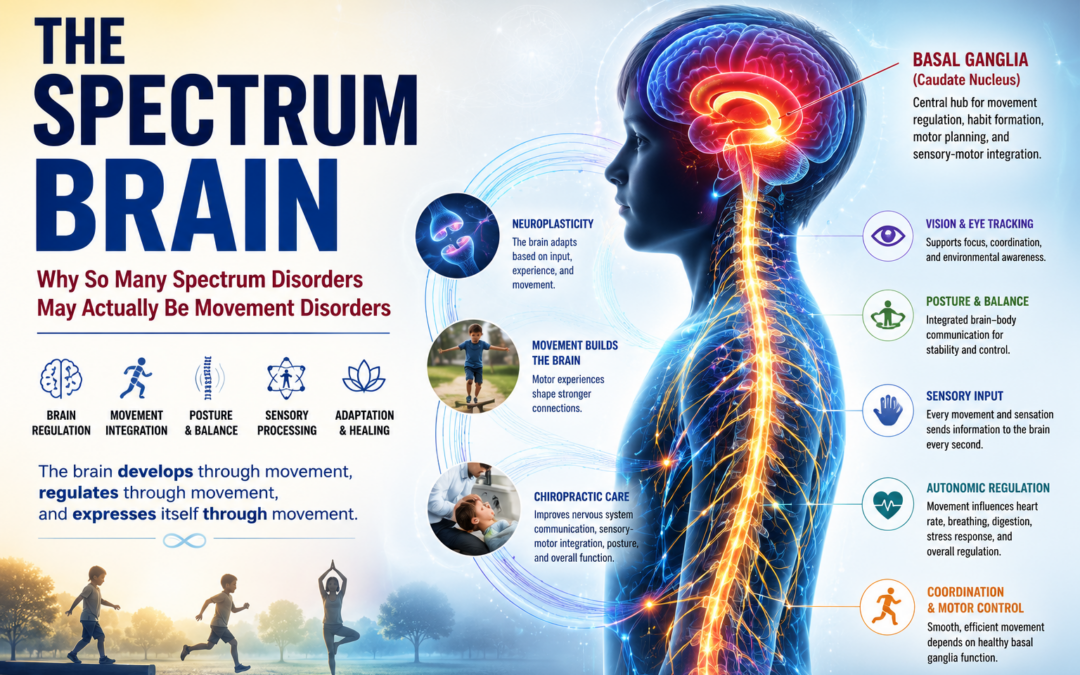
Because the brain develops through movement, regulates through movement, and expresses itself through movement.
The Brain’s Regulation Networks
Deep within the brain lies a group of structures called the basal ganglia.
These structures help regulate:
- movement
- timing
- posture
- sensory filtering
- attention
- motor planning
- behavioral inhibition
- automatic movement patterns
- emotional regulation
- habit circuitry
- coordination
One particularly important structure is the caudate nucleus.
The caudate helps the brain decide:
- what to focus on
- what to ignore
- when to move
- when to stop
- how to shift attention
- how to transition between behaviors
- how to regulate movement and sensory input
When these systems become dysregulated, symptoms may appear very differently from person to person.
One individual may experience hyperactivity.
Another may experience compulsive thoughts.
Another may experience sensory overwhelm.
Another may experience tics.
Another may experience anxiety, rigidity, or disorganized thinking.
But underneath many of these conditions lies a common theme:
Neurological regulation.
Not simply behavior.
ADHD and ADD: A Regulation Disorder, Not Simply an Attention Disorder
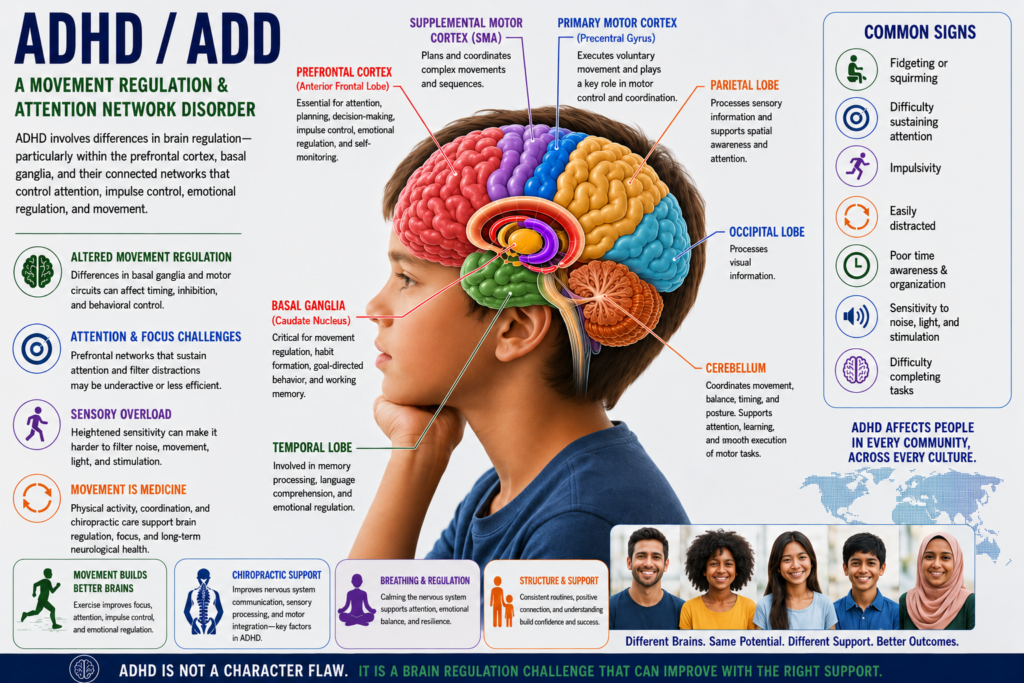
ADHD is often described as an attention disorder.
But neurologically, it also involves movement regulation systems connected to:
- the prefrontal cortex
- basal ganglia
- supplementary motor areas
- cerebellum
- sensory integration pathways
Many individuals with ADHD struggle with:
- fidgeting
- impulsive movement
- poor motor timing
- restlessness
- difficulty filtering sensory input
- coordination challenges
- posture instability
- sensory overload
- difficulty sitting still
These are not simply “behavior problems.”
They are signs that the nervous system may be struggling to regulate movement, attention, timing, posture, and sensory input simultaneously.
This is one reason movement often helps improve focus.
Exercise, coordination training, balance work, vestibular stimulation, rhythmic activity, chiropractic care, and nervous system-based therapies may help improve neurological adaptability and regulation.
The bigger neurological picture becomes difficult to ignore:
ADHD involves far more than attention alone.
OCD: When the Brain Gets Stuck
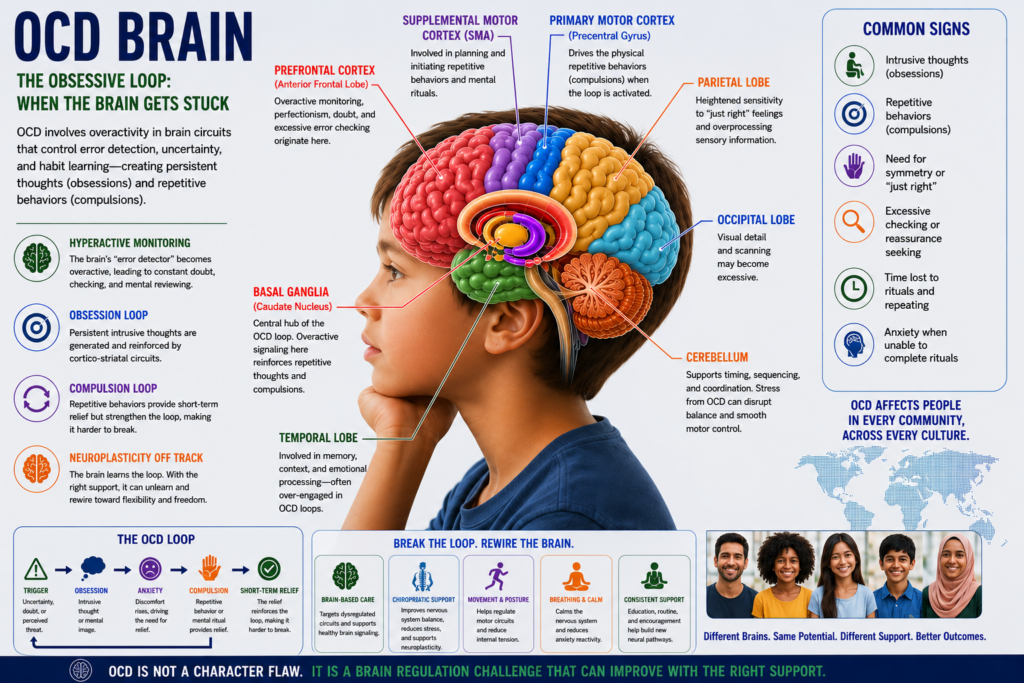
Obsessive Compulsive Disorder is increasingly associated with dysregulation involving:
- the caudate nucleus
- frontal lobe circuits
- basal ganglia loops
These systems help regulate:
- initiation
- inhibition
- transition
- motor sequencing
- thought shifting
- habit circuitry
When these systems become overactive or “stuck,” repetitive neurological loops may emerge.
The brain struggles to disengage.
This is not simply a personality issue or weakness.
It reflects dysregulation within the brain’s regulation and filtering systems.
Again, the nervous system’s movement and regulatory circuits appear deeply involved.
Autism Spectrum Disorder and the Sensory-Motor Brain

Autism Spectrum Disorder involves far more than social communication differences.
Research increasingly points toward differences involving:
- sensory integration
- movement coordination
- cerebellar function
- autonomic regulation
- posture
- balance
- motor timing
- vestibular processing
- sensory filtering
Many individuals on the spectrum experience:
- hypersensitivity
- coordination differences
- altered gait
- posture changes
- vestibular differences
- repetitive movement patterns
- sensory overload
- autonomic dysregulation
Again, these are not merely social or behavioral traits.
They involve whole-brain regulation systems tied to movement, sensation, posture, coordination, and neurological integration.
The nervous system learns through movement.
The brain develops through sensory experience.
And the spine plays a major role in delivering sensory input into the brain.
Tourette Syndrome and Tic Disorders
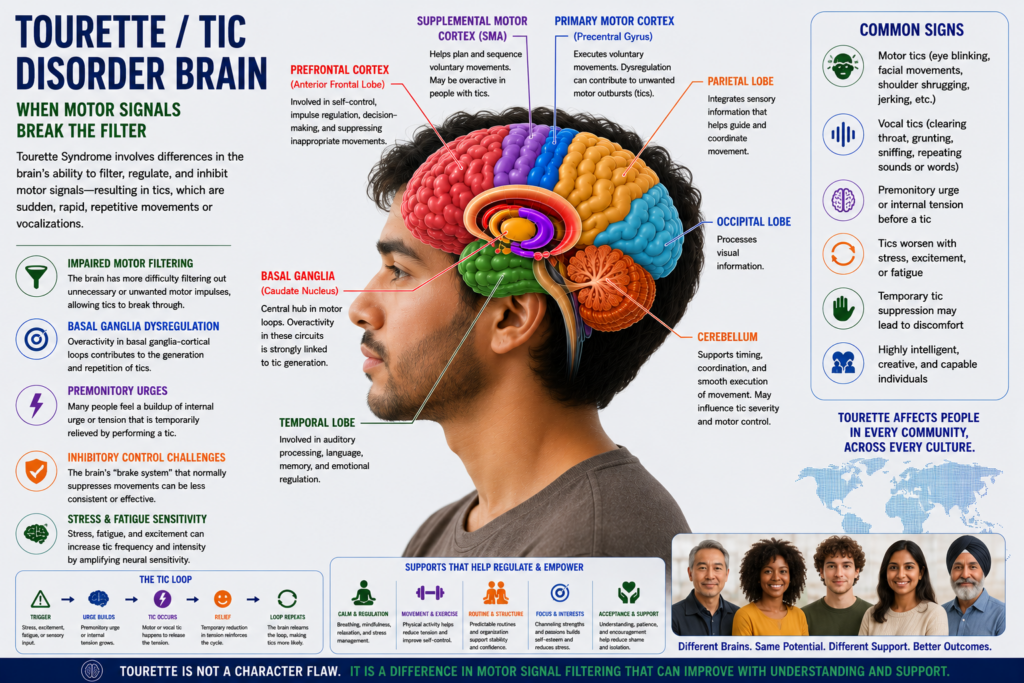
Tourette Syndrome and tic disorders are strongly connected to dysfunction within:
- the basal ganglia
- caudate nucleus
- motor inhibition circuits
- dopamine pathways
These systems normally help suppress unnecessary movement.
When inhibition becomes dysregulated, involuntary motor output may occur.
Tics are not intentional.
They are neurological discharge patterns.
Again, this moves the conversation far beyond behavior alone.
Stress, inflammation, sensory overload, sleep deprivation, autonomic imbalance, and nervous system stress often worsen symptoms because the brain’s regulatory systems become even more overloaded.
Anxiety and Autonomic Dysregulation
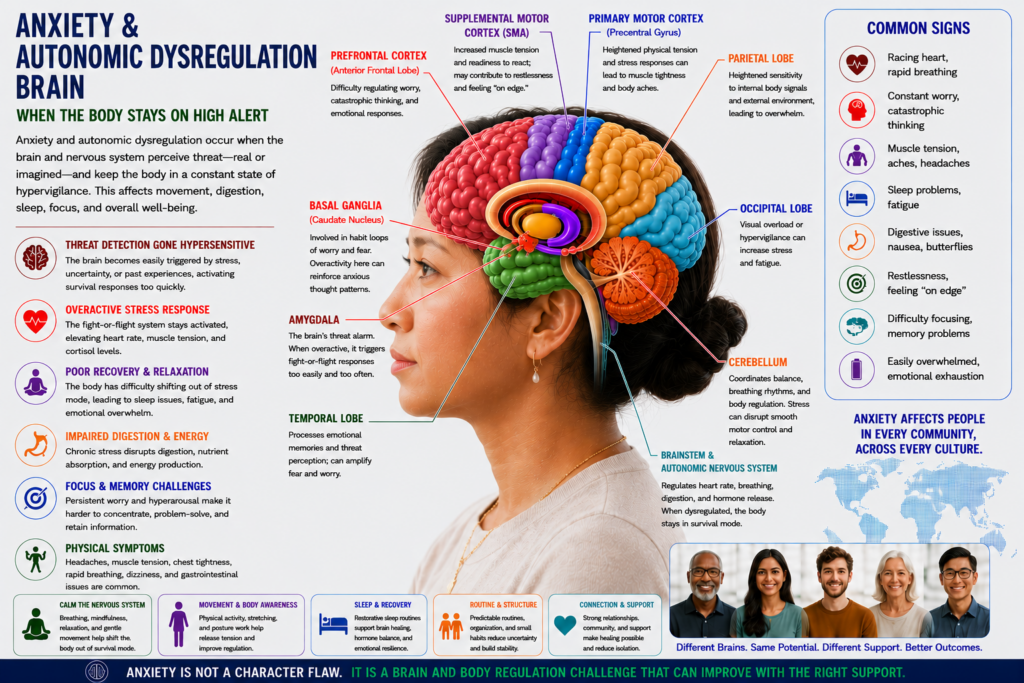
Anxiety is not merely emotional.
It is profoundly neurological and physiological.
The autonomic nervous system — especially the sympathetic “fight or flight” response — becomes overactive.
Structures involved may include:
- the amygdala
- hypothalamus
- brainstem
- vagus nerve networks
- basal ganglia
- autonomic regulation pathways
Symptoms may include:
- shallow breathing
- muscle tension
- elevated heart rate
- digestive issues
- hypervigilance
- sleep disturbances
- jaw clenching
- restlessness
- panic responses
Again, these symptoms are not occurring “only in the mind.”
They involve deeply physical nervous system regulation systems tied to survival physiology, posture, breathing, sensory input, muscle tone, and autonomic balance.
This is why regulating the body physically often helps regulate the brain neurologically.
Schizophrenia and Sensory Filtering
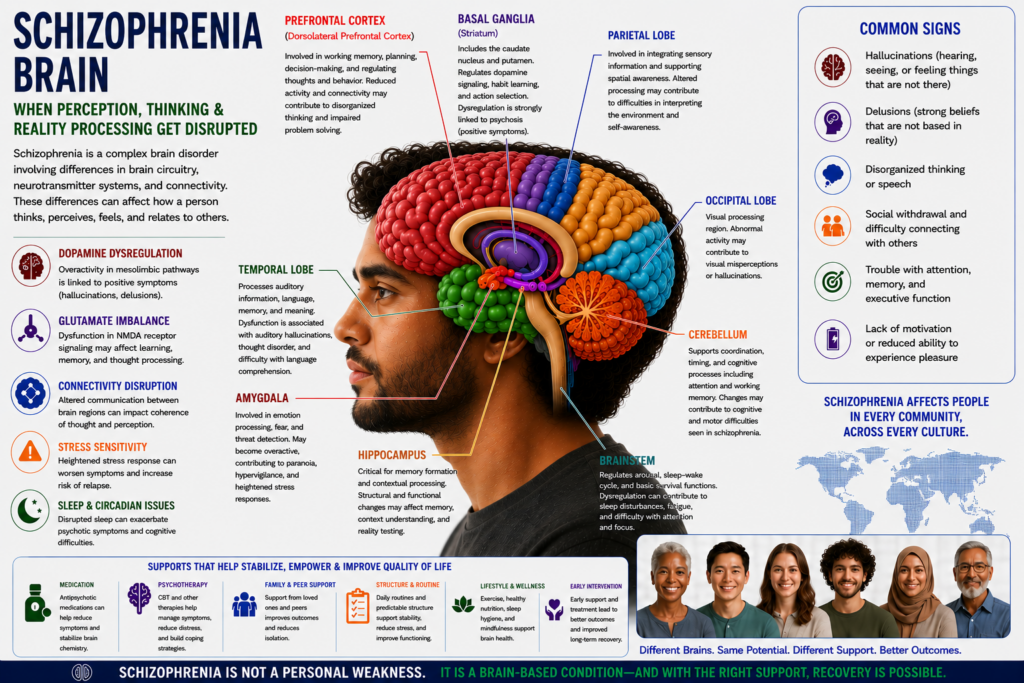
Schizophrenia is extraordinarily complex.
But one of the major themes involves sensory filtering and brain connectivity.
Structures such as:
- the thalamus
- basal ganglia
- hippocampus
- frontal cortex
- dopamine pathways
play major roles in:
- perception
- interpretation
- sensory gating
- reality processing
- thought organization
- neurological integration
The brain may struggle to properly filter and organize incoming information.
Again, this moves schizophrenia far beyond simplistic psychological labels alone.
It reflects complex disturbances involving neurological timing, sensory regulation, perception, autonomic function, and brain connectivity.
Parkinson’s Disease: The Ultimate Movement Disorder
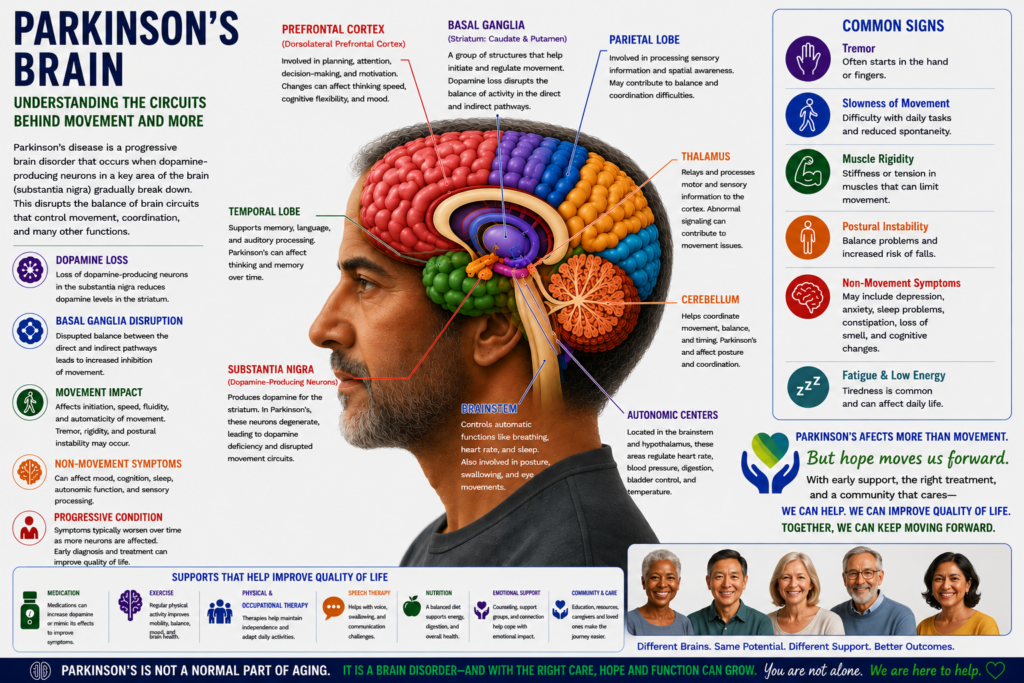
Parkinson’s disease powerfully demonstrates how important the basal ganglia truly are.
In Parkinson’s:
- dopamine-producing neurons degenerate
- movement becomes harder to initiate
- posture changes
- gait becomes altered
- rigidity develops
- tremors may occur
- autonomic function may decline
This condition beautifully reinforces one of the central themes of this article:
Movement regulation is deeply neurological.
The nervous system controls:
- movement
- balance
- timing
- posture
- coordination
- fluidity
- adaptability
Parkinson’s disease reminds us that movement and neurological regulation are inseparable.
Chiropractic Care and the Integrated Nervous System
Chiropractic care is not simply about pain.
At its best, chiropractic care is about improving communication between the brain and body.
The spine contains thousands of sensory receptors constantly feeding information into the nervous system.
Every movement of the spine changes neurological input into the brain.
That input influences:
- posture
- balance
- movement
- coordination
- autonomic regulation
- sensory processing
- muscle tone
- body awareness
- nervous system adaptability
Research increasingly suggests spinal motion influences brain function.
When spinal movement becomes restricted, altered sensory input may affect how efficiently the nervous system regulates itself.
This is one reason many patients report improvements in:
- posture
- balance
- movement quality
- body awareness
- stress tolerance
- focus
- sleep
- coordination
- nervous system regulation
Again, chiropractic is not presented as a cure for spectrum disorders.
But it may serve as a meaningful supportive component within a broader neurological healthcare approach focused on improving regulation, adaptability, movement quality, sensory integration, posture, and nervous system communication.
The Brain Can Change
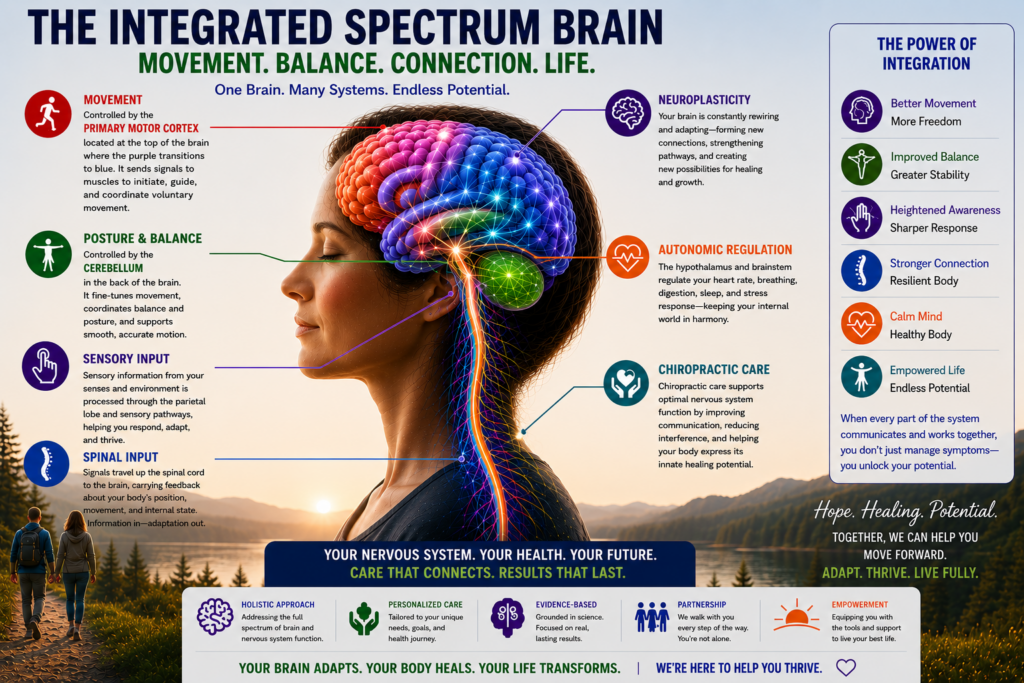
Perhaps the most hopeful concept in neuroscience is neuroplasticity.
The brain is adaptable.
Movement changes the brain.
Balance changes the brain.
Sensory input changes the brain.
Exercise changes the brain.
Posture changes the brain.
Breathing changes the brain.
Sleep changes the brain.
Human connection changes the brain.
And healthy neurological input matters.
Perhaps many conditions traditionally viewed only through psychological, emotional, behavioral, or psychiatric frameworks also involve deeply physical neurological regulation systems tied to:
- movement
- posture
- sensory integration
- autonomic balance
- timing
- coordination
- brain-body communication
That does not eliminate the role of medicine.
It expands the conversation.
It expands understanding.
And perhaps most importantly:
It expands hope.
The future of healthcare may not lie in separating the brain from the body.
It may lie in finally understanding they were never separate to begin with.
Ptak Family Chiropractic
3122 Santa Monica Blvd. Suite 102
Santa Monica, CA 90404
(310) 473-7991
Ptak Family Chiropractic Website
References
- Graybiel AM. The Basal Ganglia and Chunking of Action Repertoires.
- Middleton FA, Strick PL. Basal Ganglia and Cerebellar Loops.
- Kandel ER et al. Principles of Neural Science.
- Bear MF et al. Neuroscience: Exploring the Brain.
- Volkow ND et al. Dopamine and ADHD.
- Leisman G et al. Movement and Cognition.
- Doidge N. The Brain That Changes Itself.
- Shaffer F, Ginsberg JP. Heart Rate Variability and Autonomic Regulation.
- Plaza-Manzano G et al. Neurochemical Effects of Spinal Manipulation.
- National Institute of Neurological Disorders and Stroke (NINDS).