
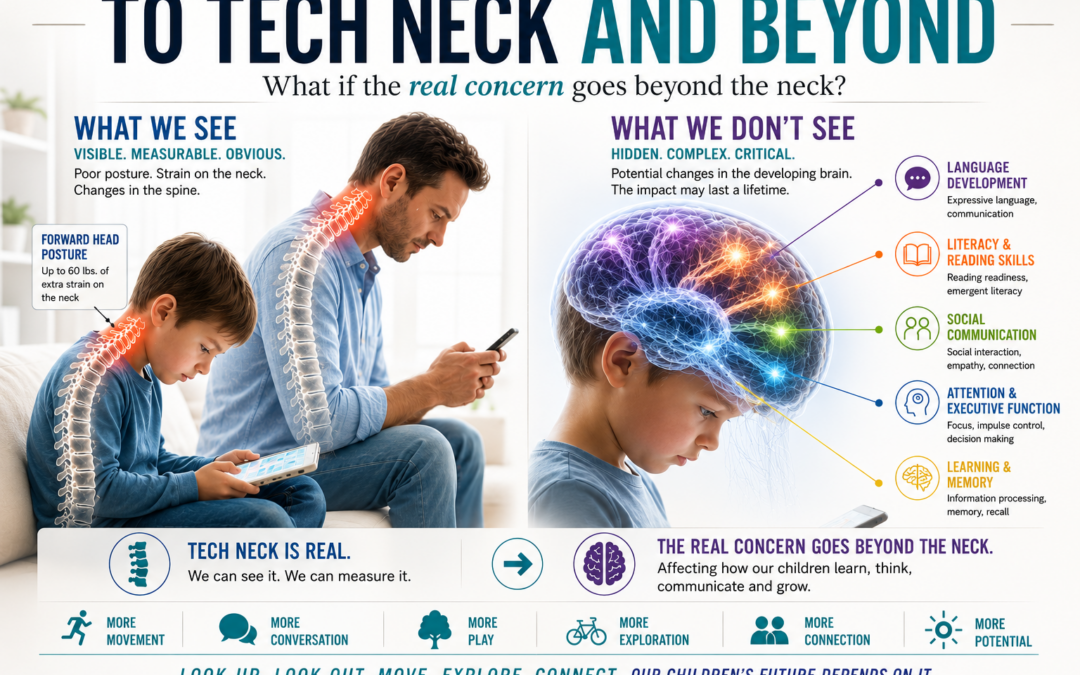
What If The Real Concern Goes Beyond The Neck?
We have all heard about Tech Neck.
The neck pain.
The headaches.
The rounded shoulders.
The loss of the normal cervical curve.
For years, healthcare professionals have warned us about the physical consequences of spending hours each day looking down at phones, tablets, computers, and gaming devices.
Those concerns are real.
In a recent Fortune article, spine surgeon Dr. Michael Gerling warned that today’s children and young adults may be heading toward a future healthcare crisis driven by excessive screen use, poor posture, chronic neck problems, and long-term spinal degeneration.
Many healthcare professionals share those concerns.
But what if Tech Neck is far more unhealthy than we ever imagined?
What if the greatest health concern isn’t the strain placed upon the muscles, ligaments, joints, discs, and nerves of the neck?
What if the real concern is what excessive screen exposure may be doing to the developing brains of our children?
Because while we can easily see poor posture, we cannot see what may be happening inside the brain.
And that may be the bigger story.
We Know Tech Neck Is Real
The mechanical consequences of Tech Neck are not difficult to understand.
The human head weighs approximately 10 to 12 pounds when balanced properly over the shoulders.
As the head moves forward, the forces experienced by the neck increase dramatically.
Muscles work harder.
Ligaments experience greater stress.
Joints experience greater compression.
The spine adapts.
Over time, those adaptations may contribute to neck pain, headaches, muscle tension, reduced mobility, and increased stress on spinal discs and joints.
Decades ago, neurosurgeon Alf Breig demonstrated how loss of normal spinal alignment could increase mechanical tension throughout the spinal cord and central nervous system.
His work reinforced an important principle:
Structure influences function.
For chiropractors, this conversation is not new.
For more than a century, chiropractic has focused on the relationship between structure and function—how the body’s physical adaptations influence the nervous system’s ability to communicate, coordinate, and adapt.
Long before the term Tech Neck existed, chiropractors were concerned with the effects of poor posture, reduced movement, and chronic stress on the developing body.
Yet perhaps posture is only the visible part of the story.
A Different Kind of Health Concern
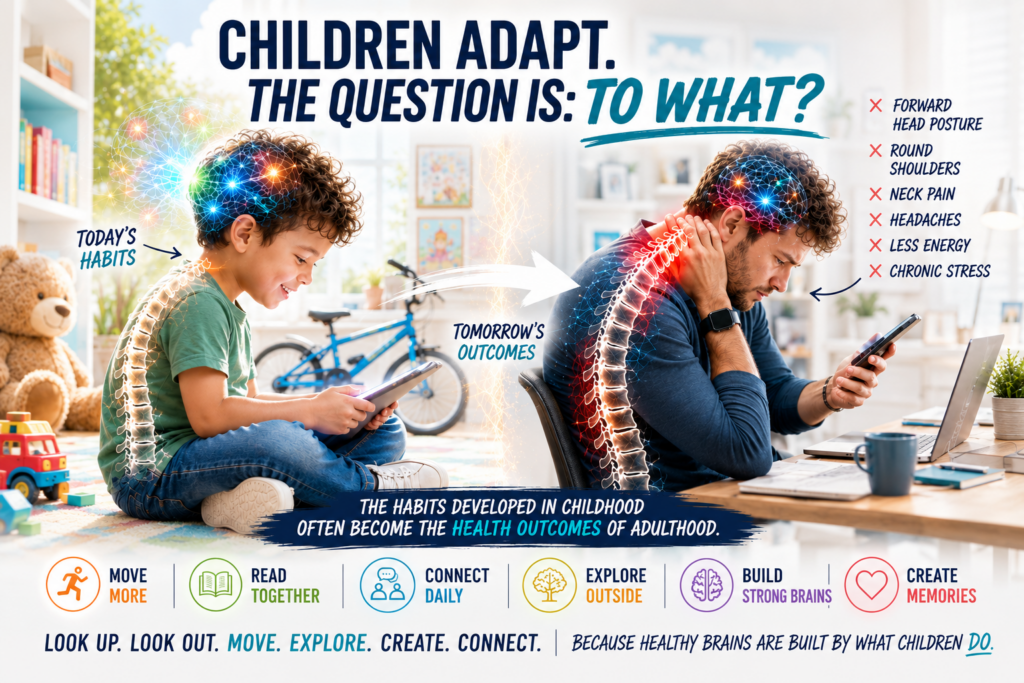
For years, the conversation surrounding Tech Neck focused primarily on posture.
That made sense.
Poor posture is visible.
Parents can see it.
Doctors can measure it.
X-rays can document it.
The developing brain is much harder to see.
Recent MRI research involving healthy children between the ages of three and five years old identified associations between higher screen exposure and differences in white matter organization within regions of the brain involved in language, literacy, and communication.
Think about that.
Not when these children become adults.
Not twenty years from now.
Today.
During one of the most important periods of neurological development.
White matter functions as the communication network of the brain. It helps different regions communicate efficiently with one another and plays a critical role in learning, language development, reading readiness, and information processing.
Researchers also reported associations between higher screen exposure and lower performance in areas related to:
- Expressive language
- Rapid naming
- Emergent literacy skills
These findings do not prove that screens directly cause these changes.
However, they raise important questions that deserve serious consideration.
Have we underestimated the health consequences of excessive screen exposure?
Children Don’t Just Use Their Brains. They Build Them.

This may be the most important concept in this entire discussion.
Children do not simply use their brains.
They build them.
Every movement provides information to the developing nervous system.
Every challenge provides information.
Every conversation provides information.
Every interaction provides information.
Every experience helps shape the architecture of the developing brain.
Movement is not simply exercise.
Movement is brain development.
This understanding aligns closely with a principle chiropractors have emphasized for generations:
The nervous system develops and adapts in response to the information it receives.
Movement provides information.
Balance provides information.
Gravity provides information.
Experience provides information.
The developing brain is constantly learning from the environment it is exposed to.
The human nervous system was not designed to develop primarily through a screen.
It was designed to develop through life itself.
The Question Few Parents Are Asking
Most conversations about screen time focus on what children are watching.
Perhaps the more important question is:
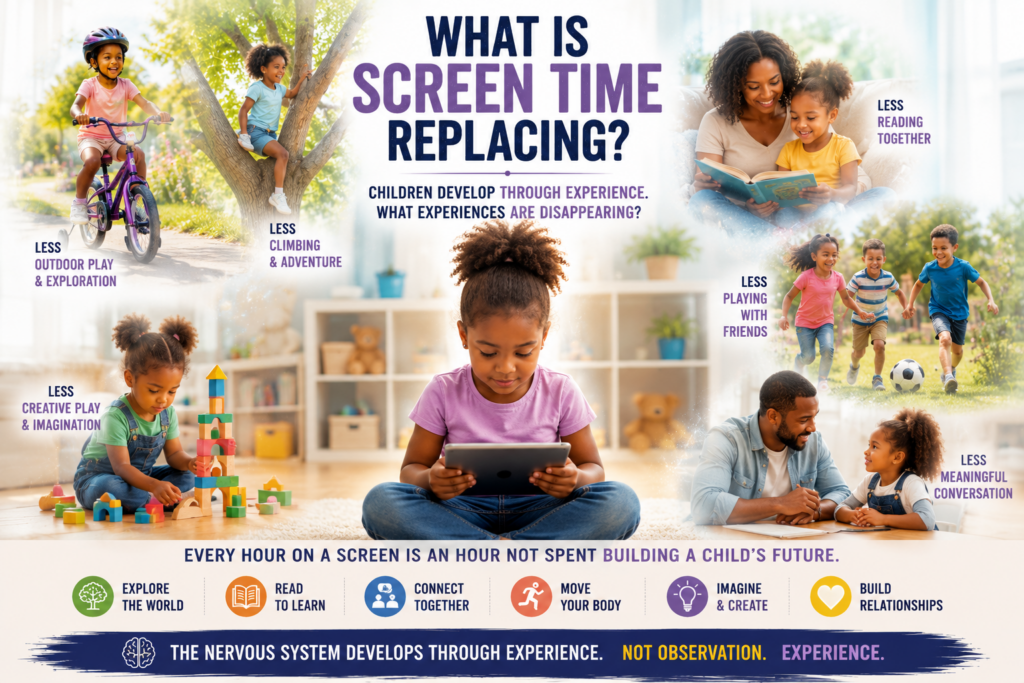
What are children no longer doing?
When screen time increases, what experiences are being displaced?
Less conversation.
Less reading.
Less storytelling.
Less imaginative play.
Less climbing.
Less balancing.
Less running.
Less jumping.
Less exploring.
Less face-to-face interaction.
Less opportunity to engage with the physical world.
A tablet can provide information.
A screen can provide entertainment.
But neither can replace the experiences through which children develop.
The nervous system develops through experience.
Not observation.
Experience.
The Consequences May Already Be Here
The concern is not that today’s children may experience problems decades from now.
The concern is that some consequences may already be appearing.
Language delays.
Reading readiness concerns.
Attention challenges.
Reduced physical activity.
Poor posture.
Less social interaction.
Fewer opportunities for healthy neurological development.
The body and brain adapt long before they complain.
That has always been true.
What we repeatedly do becomes what we eventually become.
That principle applies to muscles.
It applies to posture.
And it applies to the brain.
This Is Not About Fear
Technology is not the enemy.
Technology has transformed communication, education, and access to information.
The goal is not eliminating screens.
The goal is balance.
Children need technology.
But they also need movement.
They need conversation.
They need creativity.
They need exploration.
They need outdoor experiences.
They need physical challenges.
They need human connection.
Most importantly, they need opportunities to experience the world rather than simply observe it.
Why This Matters To Us

At Ptak Family Chiropractic, we have spent nearly four decades helping people understand a simple truth:
The body adapts.
The nervous system adapts.
The question is not whether adaptation is occurring.
The question is:
What are we adapting to?
For years, we have encouraged our patients to move more, sit less, improve posture, strengthen healthy habits, and engage more fully with the world around them.
Today, those conversations feel more important than ever.
Because this discussion is no longer simply about neck pain.
It is no longer simply about posture.
It is about the future health and development of our children.
It is about preserving the experiences that help build healthy brains, healthy bodies, and healthy human beings.
As chiropractors, we cannot replace outdoor play.
We cannot replace reading.
We cannot replace imagination, creativity, movement, exploration, and meaningful human connection.
But we can help families understand how posture, movement, spinal health, and nervous system function contribute to overall well-being.
We can help identify unhealthy adaptations before they become larger problems.
And we can continue encouraging children and adults alike to spend more time experiencing life and less time merely observing it.
The future health of our children will not be determined by a single adjustment, a single exercise, or a single decision.
It will be shaped by thousands of daily choices.
Choices to move.
Choices to explore.
Choices to create.
Choices to connect.
Choices to look up.
Choices to look out.
If you are concerned about your child’s posture, screen habits, movement patterns, spinal health, or overall development, we invite you to schedule a consultation with our office.
Together, we can help create an environment that supports healthy growth, healthy adaptation, and a healthier future.
Because healthy brains are not built only by what children watch.
Healthy brains are built by what children do.
And that future begins today.
References
- Gerling M. The “Tech Neck” Time Bomb: Why 43 Million Young Americans Could Cripple U.S. Health Care Within a Generation. Fortune. June 24, 2026.
- Breig A. Adverse Mechanical Tension in the Central Nervous System. Almqvist & Wiksell International.
- Hutton JS, Dudley J, Horowitz-Kraus T, DeWitt T, Holland SK. Associations Between Screen-Based Media Use and Brain White Matter Integrity in Preschool-Aged Children. JAMA Pediatrics. 2020;174(1).
- Madigan S, McArthur BA, Anhorn C, Eirich R, Christakis DA. Associations Between Screen Use and Child Language Skills: A Systematic Review and Meta-analysis. JAMA Pediatrics. 2020.
- Hutton JS, Horowitz-Kraus T, Mendelsohn AL, DeWitt T, Holland SK. Home Reading Environment and Brain Activation in Preschool Children Listening to Stories. Pediatrics. 2015.
- American Academy of Pediatrics. Media and Young Minds. Pediatrics. 2016.
- World Health Organization. Guidelines on Physical Activity, Sedentary Behaviour and Sleep for Children Under 5 Years of Age. 2019.
- Christakis DA. Interactive Media Use at Younger Than the Age of 2 Years: Time to Rethink the American Academy of Pediatrics Guideline? JAMA Pediatrics. 2014.
- Tamana SK, Ezeugwu V, Chikuma J, et al. Screen Time Is Associated With Inattention Problems in Preschoolers: Results From the CHILD Birth Cohort Study. PLoS One. 2019.