
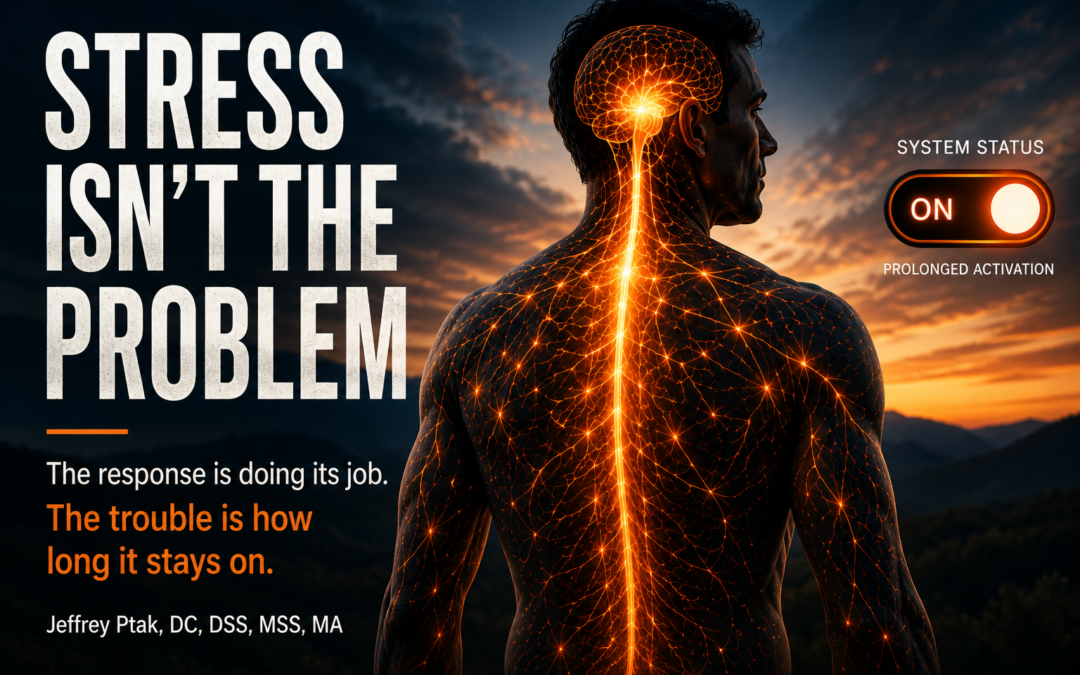
Almost everything people believe about stress is built on a mistake, and the mistake is in the first
sentence: that the stress response is something going wrong.
It isn’t.
When your brain registers a challenge — or anticipates one — a great many systems shift at once.
Heart rate and blood pressure change. Hormonal signaling changes. Muscle tension changes. Attention
narrows. Digestion slows. Immune activity is redirected. Energy stops going toward projects with a long
payoff and starts going toward the next few minutes.
That is not malfunction. That is a body correctly reading its situation and reallocating accordingly.
If you have ever wondered why you can carry something up a flight of stairs in an emergency that you
could not carry on an ordinary Tuesday, that is the system working exactly as designed.
The problem is not the response. The problem is that a response built for five minutes will run
for five years if nothing tells it to stop.
The Variable Nobody Asks About
Bruce McEwen spent a career studying this and gave it a name: allostatic load.
His formulation is the one I keep returning to because it identifies the actual variable — and the actual
variable is not intensity.
The chemistry that carries out the stress response — cortisol and the catecholamines chief among them
— protects you in the short term. Over longer intervals, the same chemistry exacts a cost.
Not different chemistry. The same chemistry, running longer than it was built to run.
Which means the distinction that matters is not between good stress and bad stress. Nearly every
conversation about stress is organized around that split, and it points in the wrong direction.
The distinction that matters is between a system that switches on and off cleanly and a system
that switched on and never switched off.
A hard week is not the thing. A hard week is what the response was designed for.
Four years of a situation that never resolved is the thing — and people in year four rarely describe
themselves as stressed, because it stopped feeling like an event and started feeling like their
personality.
Why It Can Look Like Several Problems
People in that condition seldom arrive with one complaint. They arrive with a list.
The shoulder, and also the sleep, and also the gut, and also the six weeks it now takes to get over a cold.
That is not necessarily a coincidence, and it is not vagueness on the patient’s part. A system running an
expensive process continuously has less available for everything else — repair, digestion, immune
surveillance, recovery.
What shows up is not always one dramatic failure but a general rise in the cost of running the body.
Several things may get slightly worse at once, and none of them is bad enough on its own to explain the
whole picture.
This is where I have to be careful, and I want to be, because this is the exact point at which people in
my profession can overreach.
I cannot tell you that stress caused your shoulder problem. Nobody can.
In any individual person, the honest answer is that the causal arrows cannot always be separated. Poor
sleep, inactivity, financial strain, physical discomfort and physiological load can influence one another.
Untangling which came first in one life is often beyond what the evidence permits.
Anyone who tells you confidently that your stress caused a specific diagnosis has left the science
behind, however satisfying the explanation may sound.
What I can tell you is that the pattern is real, that duration matters, and that duration is the variable
people often forget to ask about.
A Better Question
This changes the first question.
The standard clinical opening is: What’s wrong?
It is a reasonable question, and it finds a great deal. But it assumes the body has malfunctioned, and it
goes looking for the broken part.
If the stress response itself is not a malfunction — if it is an adaptive response to a situation that has
not changed — then another question belongs alongside the first:
What is this body responding to, and how long has it been responding?
The second half of that question matters.
In practice, I find that people can often answer it more precisely than they expected.
Not stress in general. Something specific.
A change in a relationship. A financial problem. An illness in the family. A difficult job. An injury.
Months without adequate sleep. A responsibility that was supposed to be temporary and somehow
became permanent.
Something with a beginning. And frequently, something that is still going on.
The answer does not necessarily produce a treatment. What it can produce is a more accurate account
of the situation, which is different from a diagnosis and sometimes just as important.
A body that has been responding to something real for four years is not necessarily a body that simply
“broke down.”
It may be a body that has been paying attention for a very long time.
Maybe It’s Time to Ask a Different Question
If you have been dealing with recurring tension, discomfort, poor sleep or symptoms that keep
returning despite repeatedly treating the symptom itself, there may be value in looking at the larger
picture.
Not because “stress causes everything.” It doesn’t.
And not because every symptom can be explained by stress. It can’t.
But because your symptoms deserve more than one question.
At Ptak Family Chiropractic, we look at how your body is moving, how your nervous system is
functioning, what physical demands it has been adapting to, and how long those patterns have been
present.
Sometimes the most useful place to begin isn’t: “How do we make this symptom go away?”
It is: “Why might my body still be responding this way?”
Your Body Is Talking. Are You Listening?
If something keeps coming back, keeps tightening up, or simply doesn’t make sense, talk with one of
our doctors.
Ask us a better question. We’ll help you look for a better answer.
PTAK FAMILY CHIROPRACTIC
3122 Santa Monica Blvd., Suite 102 · Santa Monica, CA 90404
310.473.7991 · ptakfamilychiropractic.com
We Listen. We Care. We Get Results.
References
McEwen BS. Protective and damaging effects of stress mediators. New England Journal of Medicine. 1998;338(3):171–179.
McEwen BS, Seeman T. Protective and damaging effects of mediators of stress: elaborating and testing the concepts of allostasis
and allostatic load. Annals of the New York Academy of Sciences. 1999;896:30–47.
Educational purposes only. Nothing here is clinical advice for any individual, and nothing here claims that chiropractic care treats disease
outside the evidence supporting a particular intervention. Persistent or worsening symptoms deserve a medical evaluation.