
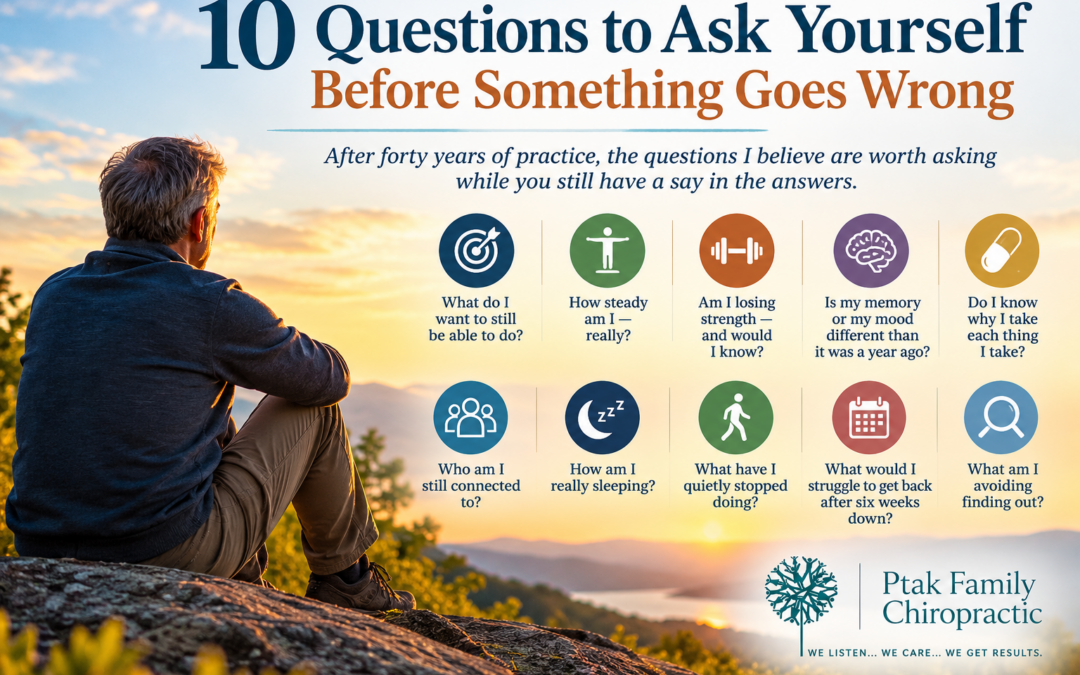
After forty years of practice, the questions I believe are worth asking while you still have a say in the answers.
Ten questions worth asking before something goes wrong: what you want to still be able to do, how steady you are, whether you are losing strength, whether your memory or mood has changed, why you take what you take, who you are still connected to, how you are sleeping, what you have quietly stopped doing, what you would struggle to get back after six weeks down, and what you are avoiding finding out. Each one includes what to do about your answer. None of them requires a symptom to begin.
Over forty years of caring for patients, I’ve learned that some of the most important questions about our health are the ones we don’t think to ask until something goes wrong.
We tend to pay attention when something hurts, when an activity becomes difficult, or when a test reveals a problem. But what about the things that change so gradually we barely notice them?
What are we no longer doing? What are we taking for granted? And what would we like to still be capable of doing ten or twenty years from now?
These are ten questions I believe are worth asking before something goes wrong.
Some are supported by established medical and public-health research. Others come directly from what I’ve observed in my patients and experienced in my own life.
All ten are questions we can begin asking ourselves today.
1. What Do I Actually Want to Be Able to Do — and Does Anyone Know?
Every other question on this list is a means to this one. Without an answer, care gets organized around whatever is loudest rather than around what you are trying to protect.
I will say this much for starting here: it is where the people who study aging start too. The framework most widely used in American geriatric care — the 4Ms, from the Institute for Healthcare Improvement and the John A. Hartford Foundation — does not begin with a disease. Its first M is What Matters: what the person in front of you actually wants to be able to do.
My answer. I want to still be practicing. I want to still be writing. I want to still be a beginner at something, which matters more than it sounds. Everything I do physically is in service of those three things.
What to ask yourself. Name one specific thing you intend to still be doing ten years from now. Not a value — an activity, with a verb in it. Then ask whether the person who looks after your health knows what it is.
2. How Steady Am I — Really?
Balance is a capacity many of us never deliberately learned to train. It is also one of the first things I check, because unsteadiness tends to be noticed late and explained away early.
There are three questions I would ask anyone over 65, and they are the same three the Centers for Disease Control and Prevention puts in front of clinicians in its fall-prevention program. Have you fallen in the past year? Do you feel unsteady when standing or walking? Do you worry about falling?
Vision and hearing belong in this question too. Both feed your balance, both are assessed in the World Health Organization’s framework for older adults, and both can go unchecked for years.
My answer. I work on balance deliberately, in a way that costs me no extra time: I stand on one leg while I brush my lower teeth, then switch legs for the upper. That is my routine, built on top of years of practice, and it is not where I would start someone who is already unsteady.
What to ask yourself. Answer those three questions honestly. Any yes is worth an examination rather than a resolution to be more careful. Start balance work on a firm floor with something solid to hold, at a level you can hold comfortably, and have someone guide the progression if you are unsteady or have fallen.
3. Am I Losing Strength — and Would I Know?
Muscle mass declines with age and strength tends to follow. The part that matters is that it is not a one-way street. Older adults gain strength when they train, and that has been shown repeatedly.
What strikes me is how few people know which direction they are moving. Nothing in an ordinary year measures it, so the change registers only when something becomes difficult.
My answer. I weight train two or three days a week and practice yoga three or four days a week. Not to be stronger than I was at 40. To keep what I have, and to know where it stands.
What to ask yourself. Pick one thing you can measure now and write it down — how many times you can stand up from a chair without using your hands, how long you can carry a loaded bag, how far you can walk before it becomes an event. None of those is a verdict on your health; they are markers you can repeat. Check one again in a few months. And if something is already limited, there is no reason to wait for the second measurement to start working on it.
4. Is My Memory or My Mood Different Than It Was a Year Ago?
This is the question people are most likely to notice privately and least likely to raise. It is also on every expert list I have seen, including the 4Ms, where it is the third M.
I raise it because some causes of changed memory or mood are treatable and some are reversible. That is not a promise about any individual. It is a reason to ask rather than to wait.
What to ask yourself. Has anything changed in how you remember, concentrate, or feel most days, compared with a year ago? Has anyone who knows you well mentioned it? If the answer to either is yes, that belongs with your physician, and it is worth raising early rather than after a year of wondering.
5. Do I Know Why I Take Each Thing I Take — and When Was It Last Reviewed?
In a 2019 national survey, 89% of adults 65 and older reported currently taking a prescription medicine, and 54% reported taking four or more. Every one of those was started for a reason. Not all of those reasons are still current, and nobody finds that out unless somebody looks.
Let me be clear about what I am not saying. This is not an argument against medication. Some conditions are not negotiable, and some of the healthiest people I know take something every day. It is an argument for knowing why.
My answer. I take no prescription or over-the-counter medications. I am not in a position to tell you why. Some of it is what I do. Some of it is luck, and the absence of a disease that would have made all of this harder.
What to ask yourself. List everything you take, including what you buy without a prescription and every supplement. Beside each one, write why. Then bring that list to the physician who prescribed them and ask which ones still need to be there. Do not stop anything on your own.
6. Who Am I Still Connected To?
I did not expect to be putting this on a list about physical health, and then I read the research.
In 2023 the U.S. Surgeon General issued an advisory naming social isolation and loneliness as independent risk factors for cardiovascular disease, dementia, depression and premature death. The meta-analysis underneath that finding associated social isolation with roughly a 29% higher likelihood of mortality, loneliness with about 26%, and living alone with about 32%.
Those are associations across populations, not predictions about any one person, and that is still a larger signal than most of what people worry about.
What to ask yourself. Name the people you would call. Then ask when you last actually did, and what you are doing to keep those relationships alive rather than assuming they will keep.
7. Am I Sleeping — and If Not, Do I Know Why?
This one is mine. It is not a named domain in the frameworks, and I think it should be.
Sleep sits underneath pain, recovery, mood, memory and balance all at once, and it is the thing I hear about last. People will describe a year of poor sleep as background rather than as a finding.
What to ask yourself. How long does it take you to fall asleep, how many times are you up, and do you wake rested? Persistent poor sleep is worth evaluating rather than absorbing. It can have identifiable and treatable causes, including some that are medical.
8. What Have I Stopped Doing — and Did I Decide To?
This question comes from watching it happen for forty years.
People rarely quit things. They stop one at a time, sensibly, for a reason that made sense that week. Something gets handed to someone else. A route gets changed to avoid the stairs. A standing arrangement quietly lapses. Together those decisions are the shape of a life getting smaller, and almost nobody notices while it is happening.
People give things up for all sorts of reasons — priorities change, money changes, someone needs caring for, an illness intervenes. But some of those decisions were made to avoid discomfort rather than after anyone examined what the discomfort was. Those are the ones worth revisiting, because they may not need to be permanent.
What to ask yourself. Name three things you did five years ago and do not do now. Then ask, for each one, whether you chose it or whether it simply happened.
9. If I Lost Six Weeks, What Wouldn’t Come Back on Its Own?
A fall, an illness, a surgery, a hospital stay. Six weeks of doing very little.
Some of what you lose in that time returns by itself. Some of it takes work, and some of it takes help. How much strength, endurance and mobility you had beforehand can make a real difference in what it takes to recover afterward — and that is built in advance, never during.
This is the question on this list I care about most, because the answer is only useful before you need it.
What to ask yourself. If you were flat for six weeks, what would be hardest to get back? Build that one now, while nothing is wrong.
10. What Am I Avoiding Finding Out?
This is the uncomfortable one, and I have saved it for last on purpose.
Most people are not failing to check. They are declining to look. There is a test they have not scheduled, a symptom they have not mentioned, a question they have not asked because they are not sure they want the answer.
I understand it. And over forty years of caring for patients and their families, I have watched it happen on a larger scale than one person’s test result.
People do tell me what they are afraid of, once they trust me enough to say it out loud, and it is never abstract. They are afraid of needing someone to bathe them, dress them, help them in the bathroom, get them in and out of bed. Of taking pills they never used to take. Of catching everything that goes around. Of giving up the things they love doing on their own — not because they decided to, but because their body or their memory stopped cooperating. Of leaving their home for somewhere they did not choose. Of becoming a burden on the people they spent a lifetime taking care of. Of running out of money before they run out of years. And of dying.
I have also watched it from the other side — families making hard decisions about caregiving, nursing homes and money, and trying to provide what someone needs without exhausting the people providing it. Watching my own parents grow older gave me another view of the same questions.
Many people never face most of that, and plenty stay independent and engaged into very old age. But these are the fears people actually carry, and the hardest questions inside them are not medical. Will I be able to stay in my home? Who will care for me if I cannot care for myself? How will we afford it? What happens when someone I love needs more help than I can give?
I have heard those questions in my office for four decades, and almost always after a crisis had already forced them.
Not knowing does not buy time. It spends it.
What to ask yourself. Two things. What is the one thing you suspect about your own health and have not had looked at? And what is the one conversation with your family you have been putting off? Each of those is a next step, with whoever is the right person for it.
What All Ten Have in Common
Not one of them requires a symptom to begin.
That is the whole point. And when medical care becomes necessary, you want people who know exactly what to do. But that care starts after the thing you were hoping to avoid.
Every question above can be answered this week, by you, with no appointment and no test. Several of the answers will point you toward a clinician, and that is what they are for.
One assignment, if you take nothing else from this article: answer question 1 and question 9. What do you intend to still be doing in ten years, and what would be hardest to get back if you lost six weeks. The gap between those two answers is your work.
I cannot promise anyone more years. I can tell you which questions are worth asking while you still have a say in the answers.
An Invitation
Whether you live in Santa Monica or are reading this from somewhere else, you are welcome at Ptak Family Chiropractic.
We’ll look at how you move, how your joints function, and what your strength, balance and neurological findings show us. What we find determines what we do — and if what you need belongs with your physician or another specialist, we’ll tell you that too.
Two of these questions are ones we can take straight into an examination — question 1 and question 8. What do you intend to still be doing in ten years, and what have you stopped doing without deciding to? Bring us those two answers. We never charge you to sit down and talk about your needs. Call Ptak Family Chiropractic at 310.473.7991 and make an appointment.
Or visit ptakfamilychiropractic.com.
Selected References
Institute for Healthcare Improvement and The John A. Hartford Foundation. Age-Friendly Health Systems: the 4Ms framework. Issue brief, March 2022.
World Health Organization. Integrated care for older people (ICOPE): guidelines on community-level interventions to manage declines in intrinsic capacity. Geneva: World Health Organization; 2017.
Sarmiento K, Lee R. The CDC’s STEADI initiative: promoting older adult health and independence through fall prevention. American Family Physician. 2017;96(4):220–221.
Holt-Lunstad J, Smith TB, Baker M, Harris T, Stephenson D. Loneliness and social isolation as risk factors for mortality: a meta-analytic review. Perspectives on Psychological Science. 2015;10(2):227–237.
Office of the Surgeon General. Our Epidemic of Loneliness and Isolation: the U.S. Surgeon General’s Advisory on the Healing Effects of Social Connection and Community. Washington, DC: U.S. Public Health Service; 2023.
Kaiser Family Foundation. Data note: prescription drugs and older adults. KFF Health Tracking Poll, February 2019.
Volpi E, Nazemi R, Fujita S. Muscle tissue changes with aging. Current Opinion in Clinical Nutrition and Metabolic Care. 2004;7(4):405–410.
World Health Organization. WHO Guidelines on Physical Activity and Sedentary Behaviour. Geneva: World Health Organization; 2020.
Sherrington C, Fairhall NJ, Wallbank GK, et al. Exercise for preventing falls in older people living in the community. Cochrane Database of Systematic Reviews. 2019;1:CD012424.
About the author. Dr. Jeffrey Ptak, DC, DSS, MSS, MA, founded Ptak Family Chiropractic in Santa Monica and has practiced since 1986. He is the author of the forthcoming book It’s Like You Never Left, to be published by Indigo River Publishing.
Educational information only; not a diagnosis or a substitute for individualized care. The personal practices described here are one person’s choices and are not recommendations or treatment for any condition. Do not start, stop or change any prescribed or over-the-counter medication or supplement without consulting the prescribing physician. Begin new physical activity at a level appropriate to your current health, and practice balance only with stable support and, where appropriate, supervision. Seek prompt medical evaluation for new or progressive weakness, persistent numbness, unexplained weight loss, fever, night pain that consistently wakes you, or new changes in memory, mood or speech. Seek emergency care immediately for sudden loss of balance with slurred speech, facial drooping, one-sided weakness, double vision or a severe sudden headache.
Ptak Family Chiropractic
We listen… We care… We get results…
Chiropractic for Adults and Children
3122 Santa Monica Blvd., Suite 102 · Santa Monica, CA 90404
310.473.7991 · ptakfamilychiropractic.com
Mon / Wed / Thurs 8:00–12:15 and 2:00–6:00 · Tues / Fri 8:00–12:00 · Sat 10:00–12:00