
Why Human Health Depends on How Well You Adapt to Gravity
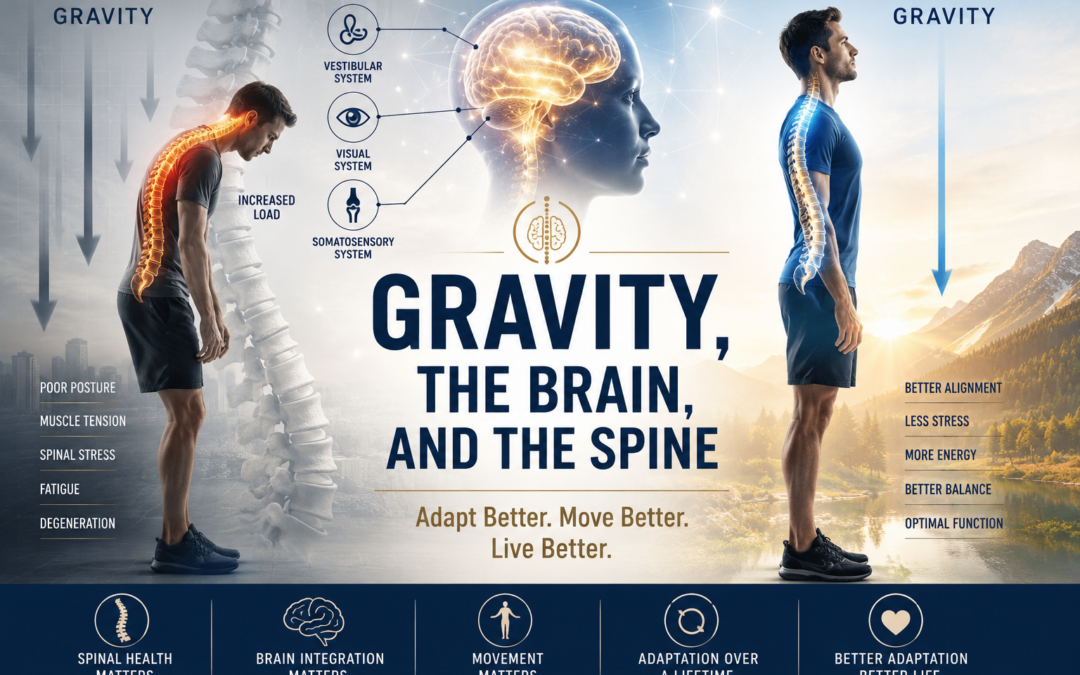
Gravity is the most constant physical stress your body will ever face.
It never turns off.
Every second of every day, gravity is compressing your spine, loading your joints, challenging your balance, and forcing your nervous system to constantly adapt.
Most people never think about it.
But gravity influences posture, movement, balance, energy, coordination, spinal health, brain function, and even the aging process itself.
In many ways, the human body is an anti-gravity machine.
And when the brain and body stop adapting efficiently to gravity, people slowly begin to break down.
Your Brain Is Constantly Measuring Gravity
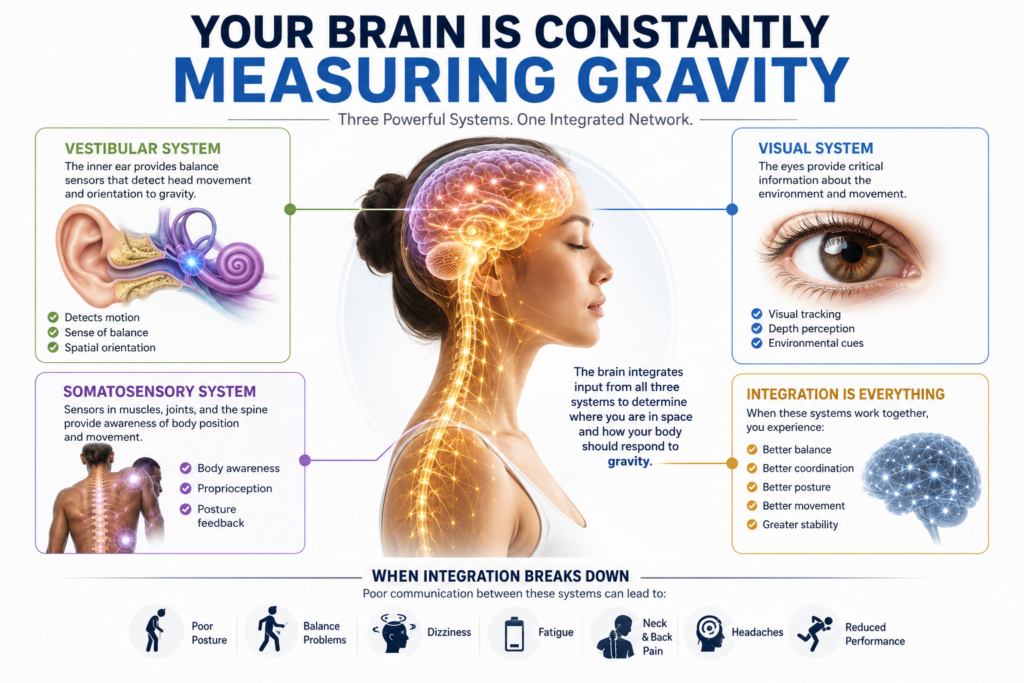
Modern neuroscience and functional neurology have shown that the brain continuously monitors:
- Head position
- Eye movement
- Balance
- Spatial orientation
- Posture
- Movement
- Muscle tone
Specialized receptors in the inner ears, eyes, muscles, joints, and spine constantly feed information into the brain about where your body is in space relative to gravity.
Functional neurologist Dr. Cedrick Noel has helped popularize the idea that many chronic health and movement problems may involve a poor neurological relationship with gravity itself.
His work focuses heavily on the integration of:
- The vestibular system (balance)
- The visual system (eyes)
- The proprioceptive system (body awareness)
Interestingly, this connects directly with what we discussed in our recent article on brain integration.
The brain is not designed to function in isolated compartments.
True neurological efficiency depends on integration.
The emotional brain, motor brain, sensory brain, visual brain, balance centers, autonomic nervous system, and higher cognitive centers must all communicate together efficiently.
When integration decreases, compensation increases.
And gravity exposes those weaknesses immediately.
Gravity Exposes Neurological Weakness
A well-integrated nervous system handles gravity efficiently.
A poorly integrated nervous system often compensates through:
- Poor posture
- Muscle tension
- Fatigue
- Balance issues
- Coordination problems
- Chronic stress patterns
- Altered movement
- Increased wear and tear on the spine and joints
Many people are unknowingly fighting gravity all day long.
The body begins using excessive energy simply trying to stay upright and stable.
This is one reason patients often report feeling:
- Lighter
- Taller
- More balanced
- More energized
after chiropractic adjustments.
The body is functioning more efficiently against gravitational stress.
Chiropractic and the Anti-Gravity System
Your spine is the central support structure of your anti-gravity system.
When spinal motion, posture, and neurological communication become altered, gravity no longer distributes evenly through the body.
Over time this may contribute to:
- Forward head posture
- Disc compression
- Degeneration
- Joint stress
- Reduced mobility
- Muscle imbalance
- Chronic tension
- Fatigue
Chiropractic care helps restore:
- Motion
- Spinal mechanics
- Neurological communication
- Postural efficiency
- Movement patterns
- Brain-body integration
This is not simply about pain relief.
It is about improving the body’s ability to adapt to the constant physical force acting upon it every second of every day.
Gravity and Aging
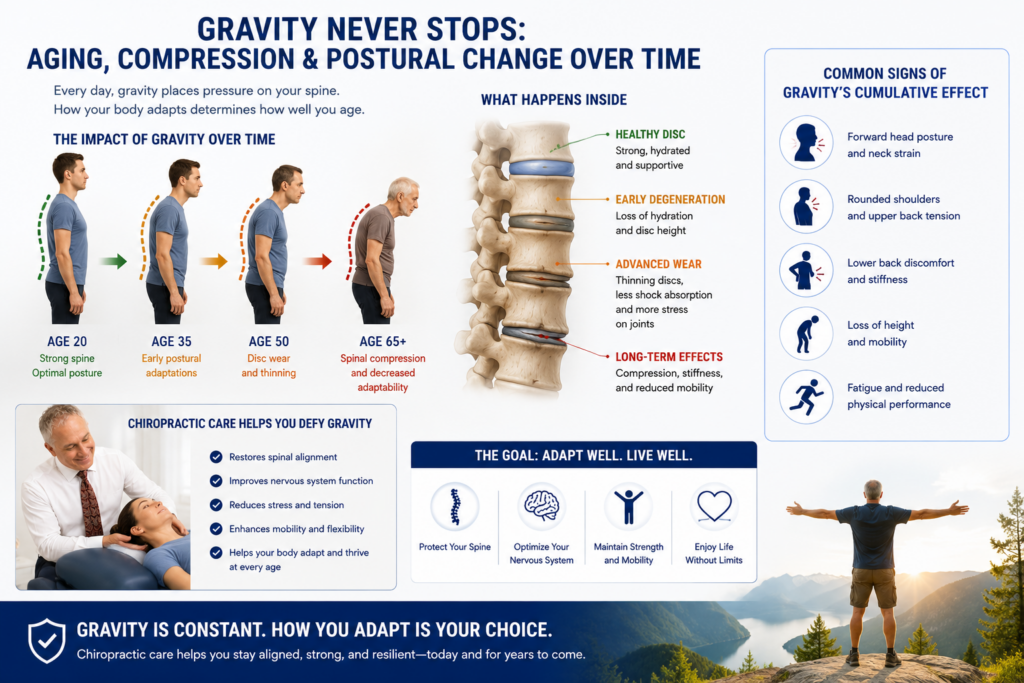
One of the clearest signs of aging is compression.
People literally collapse forward over time.
Disc spaces narrow. Posture changes. Balance declines. Movement decreases.
Gravity never stops applying force to the body.
The healthier and more integrated the nervous system remains, the better the body can resist long-term breakdown.
Children are adapting to gravity too.
From infancy through adolescence, the nervous system is constantly learning balance, coordination, posture, movement, and spatial awareness.
Movement, play, crawling, climbing, running, jumping, sports, and physical activity all help children build stronger neurological and structural relationships with gravity.
Healthy movement early in life helps create healthier posture, better coordination, stronger balance systems, and greater resilience later in life.
Final Thoughts
You cannot escape gravity.
But you can improve how your brain, spine, and nervous system adapt to it.
At Ptak Family Chiropractic, we focus on improving spinal function, posture, neurological integration, and movement efficiency so the body can better handle the physical demands of life.
Because health is not simply about avoiding pain.
It is about adapting well to gravity, stress, movement, and life itself.
A strong spine. A resilient nervous system. Better adaptation. Better movement. Better life.
References
- Kandel ER, Schwartz JH, Jessell TM. Principles of Neural Science. McGraw-Hill Education.
- Panjabi MM. The Stabilizing System of the Spine. Journal of Spinal Disorders.
- Plaza-Manzano G, et al. Changes in biochemical markers of pain perception and stress response after spinal manipulation. Journal of Orthopaedic & Sports Physical Therapy. 2014.
- Carrick Institute — Educational material on vestibular integration, proprioception, posture, and neurological rehabilitation.
- Dr. Cedrick Noel — Concepts involving neurological adaptation to gravity, vestibular integration, and postural orientation.
- National Institute of Neurological Disorders and Stroke — Information regarding balance systems, proprioception, vestibular processing, and neurological coordination.
- American Posture Institute — Educational material on posture, biomechanics, and spinal loading.
- Research literature on vestibular-visual-somatosensory integration and postural control in human movement science.