
Your low back gets better. Then it comes back. Then it gets better. Then it gets WORSE.
Why?
After 40 years of treating low-back pain, we’ve learned to look beyond the place that hurts.
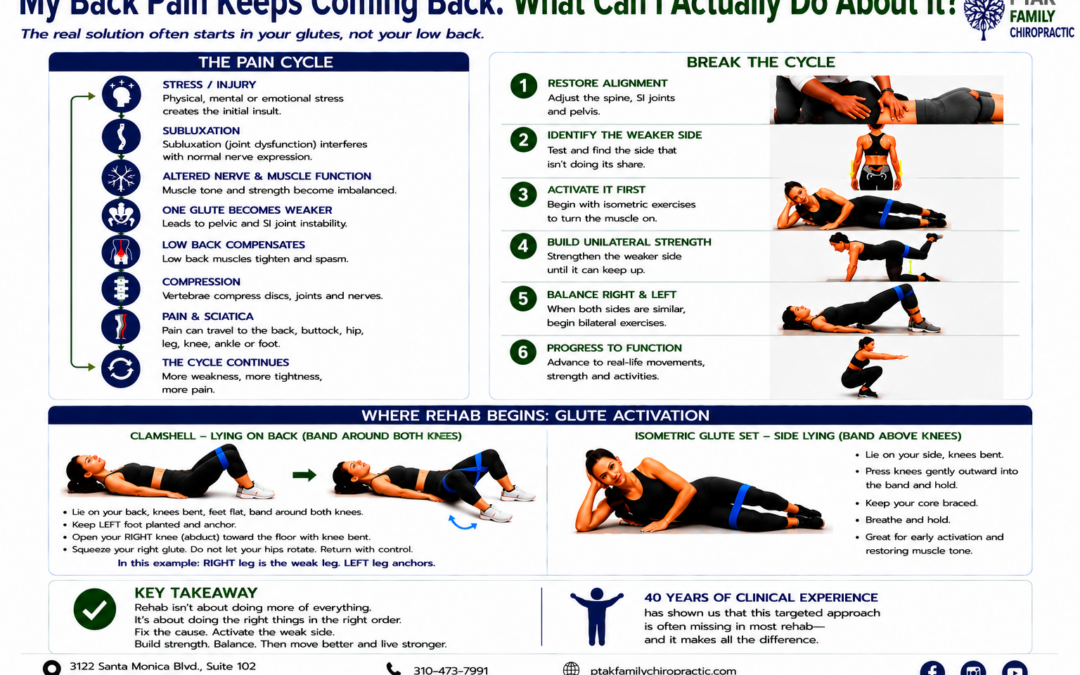
An injury—or physical, mental, or emotional stress—can alter spinal and pelvic joint function. And because joints are richly supplied with sensory receptors, including mechanoreceptors, a joint problem is also a nervous-system problem.
Change joint function → change neurological input → muscle function can change.
One glute may become weaker. The pelvis becomes less stable. The low-back muscles compensate by tightening, guarding and eventually going into spasm.
That can increase stress on the joints, discs and nerves—and the cycle continues.
So Why Doesn’t Exercise Always Fix It?
If one glute is weaker and you immediately exercise both sides together, the stronger side may simply keep doing more of the work.
You can exercise without correcting the imbalance.
That’s why our approach may begin differently:
Adjust and restore joint function.
Identify the weaker side.
Activate and strengthen that side FIRST.
Restore right-to-left balance.
THEN strengthen both sides together.
Sometimes this takes weeks. Sometimes months.
Crawl before you walk. Walk before you run.
After 40 years in practice, this is one of the most important missing pieces we see in people whose low-back pain improves…and then keeps coming back.
Don’t just chase the pain.
Find the imbalance.
Break the cycle.
Restore balance.
Then build strength.
Still wondering why your low back pain keeps coming back?
Got Questions? Ask One of Our Doctors.
Ptak Family Chiropractic
3122 Santa Monica Blvd., Suite 102
Santa Monica, CA 90404
310-473-7991