
The Definitive Chiropractic Authority Guide to Better Sleep, Better Alignment, Better Recovery, and a Healthier Nervous System
Every day patients ask me:
“What mattress do you sleep on, Doc?”
“What pillow should I buy?”
“Should I get a Tempur-Pedic?”
“Is memory foam bad?”
“What’s best for side sleepers?”
“Should I sleep with a pillow between my knees?”
“What about my child’s mattress?”
“Can my mattress actually be causing my pain?”
The answer is yes.
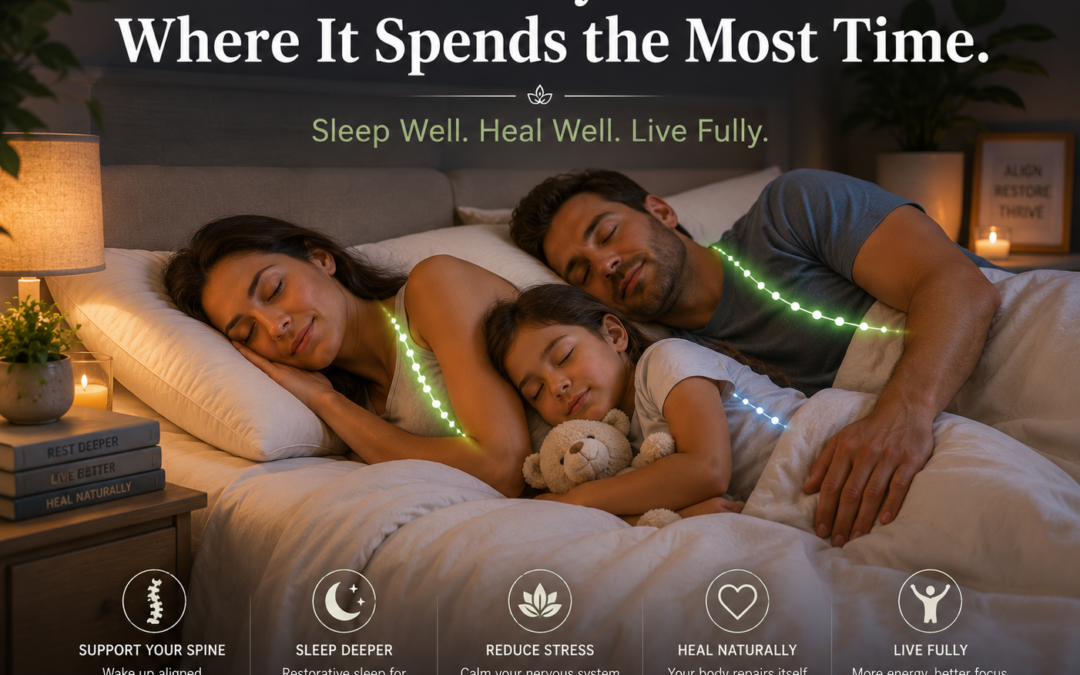
Your mattress and pillow may be helping your body recover every night… or they may quietly be reinforcing spinal stress, muscular imbalance, inflammation, poor posture, nerve irritation, and chronic tension patterns for 7–8 hours every single night.
Most people spend roughly one-third of their lives sleeping.
That means your sleep environment matters far more than most people realize.
At Ptak Family Chiropractic, we do not look at mattresses and pillows simply from a “comfort” perspective.
We look at them through the lens of:
- spinal biomechanics,
- posture,
- nervous system function,
- structural balance,
- tissue stress,
- pressure distribution,
- muscular compensation,
- recovery,
- and long-term adaptation.
Because the body adapts to the positions it spends the most time in.
And for most people… that position is in bed.
The Biggest Mistake People Make When Choosing a Mattress
Most people choose mattresses based on:
- softness,
- advertisements,
- hotel experiences,
- influencer recommendations,
- or how a mattress feels for 5 minutes in a showroom.
But your body does not sleep on a mattress for 5 minutes.
It sleeps on it:
- every night,
- for years,
- often for decades.
The question is not:
“Does this feel comfortable initially?”
The real question is:
“What position does this mattress place my spine in for thousands of hours every year?”
That is an entirely different conversation.
Comfort and Support Are NOT the Same Thing
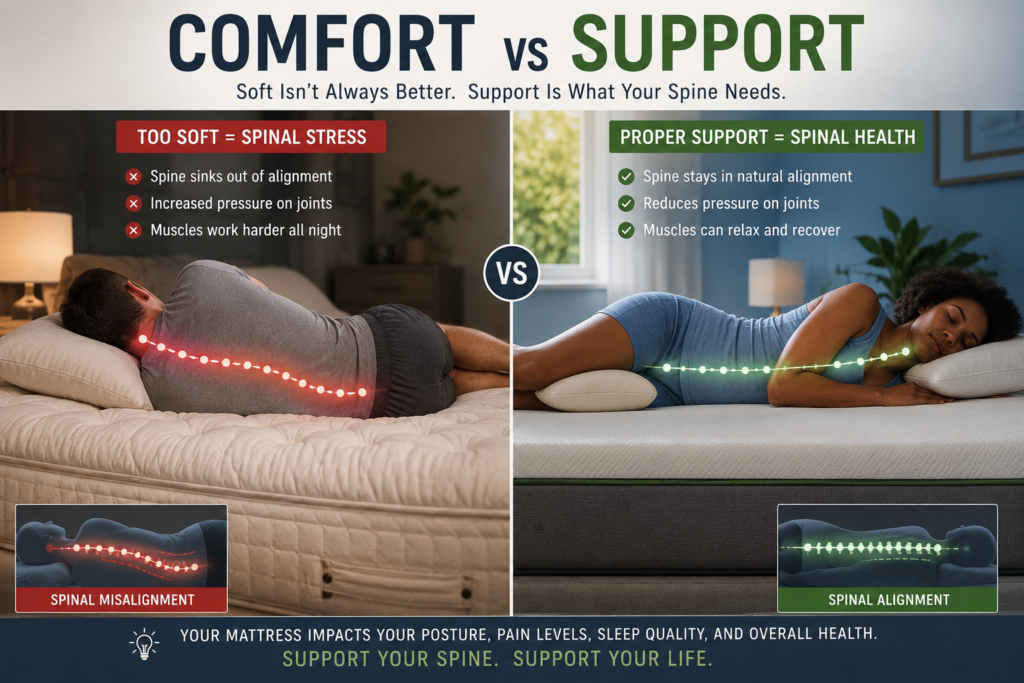
A mattress can feel soft and luxurious while simultaneously allowing:
- pelvic collapse,
- lumbar twisting,
- shoulder compression,
- forward head posture,
- muscular imbalance,
- and rotational stress patterns.
Many ultra-soft mattresses feel amazing initially because they reduce surface pressure.
But over time they may also:
- distort spinal alignment,
- reduce movement,
- increase muscular guarding,
- reinforce asymmetrical posture,
- and increase stress on already unstable areas.
Research consistently shows that medium-firm support often provides the best combination of comfort and spinal support for many adults with back pain.
The goal is not hardness.
The goal is neutrality.
The Goal: Neutral Spinal Alignment
An ideal sleep surface should:
- support the natural curves of the spine,
- reduce excessive twisting,
- minimize pressure points,
- allow movement,
- and decrease unnecessary muscular tension.
That means:
- the neck should remain neutral,
- the shoulders should not jam upward,
- the hips should not excessively sink,
- and the lower back should not collapse or rotate.
The right mattress for one person may be terrible for another.
Why?
Because body structure matters.
Why Body Type Changes Everything
A petite 110-pound side sleeper has dramatically different support needs than:
- a 240-pound back sleeper,
- a pregnant woman,
- a teenage athlete,
- a patient with scoliosis,
- or someone with chronic spinal degeneration.
The mattress must match:
- body weight,
- shoulder width,
- pelvic width,
- spinal curves,
- flexibility,
- sleep position,
- muscular balance,
- and structural stability.
There is no universally perfect mattress.
There is only:
the best mattress for YOUR body.
My Personal Mattress Preference
Patients often ask me directly:
“What mattress do you personally sleep on, Doc?”
Personally, I sleep on:
- an organic latex mattress,
- on a solid platform bed frame,
- with a very small, relatively flat pillow.
One of my favorite companies is LifeKind because of their emphasis on:
- organic materials,
- natural latex,
- breathability,
- lower chemical exposure,
- and structurally supportive sleep systems.
Personally, I prefer:
- firm to medium-firm support,
- minimal sink,
- breathable materials,
- and freedom of movement.
I do NOT personally like thick mattress toppers or excessively plush sleep surfaces.
Why?
Because many soft pillow-top systems allow the body to collapse into dysfunctional positions for hours at a time.
Why I Like Latex Mattresses
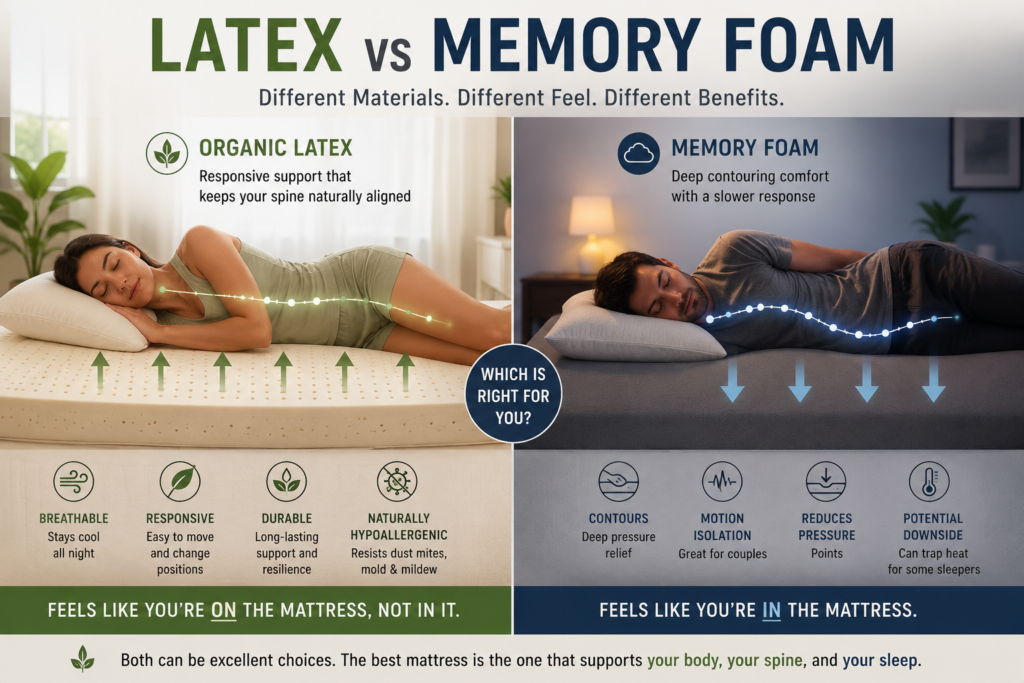
Latex behaves differently than many traditional foams.
Unlike many memory foams that allow deep sinking, latex tends to:
- support while still contouring,
- remain responsive,
- distribute pressure well,
- sleep cooler,
- and allow easier movement.
Many people describe latex as feeling more like:
“sleeping on the mattress”
rather than
“sinking into the mattress.”
Research has shown latex mattresses may improve pressure distribution and reduce pressure points while maintaining support.
Breathability Matters More Than Most People Realize
Many people sleep hot and do not realize their mattress may be contributing.
Heat retention may:
- disrupt sleep cycles,
- increase tossing and turning,
- increase inflammation,
- worsen restlessness,
- and reduce sleep quality.
Latex tends to breathe better than many dense memory foams because of its open-cell structure and airflow channels.
This becomes especially important for:
- hot sleepers,
- athletes,
- menopausal women,
- inflammatory conditions,
- and children who overheat easily.
Hypoallergenic Benefits of Latex
Natural latex also tends to resist:
- dust mites,
- mold,
- mildew,
- and allergen buildup more effectively than many conventional materials.
For allergy-sensitive individuals, that can make a major difference in nighttime breathing and sleep quality.
What About Latex Allergies?
This is important.
If someone has a true latex allergy, then latex mattresses and pillows may not be appropriate.
In those cases, higher-end adaptive memory foam systems — such as TEMPUR-Pedic TEMPUR-Adapt Medium Mattress — may become a better alternative compared to many lower-grade memory foam products.
Not all memory foam is created equally.
Memory Foam: The Pros and Cons
Memory foam became popular because it:
- contours deeply,
- reduces pressure points,
- isolates motion,
- and creates a “hugging” sensation.
For some people — especially:
- pressure-sensitive sleepers,
- lighter body types,
- or acute pain sufferers —
memory foam can initially feel incredibly relieving.
However, from a structural perspective, some people do NOT do well on highly conforming memory foam.
Why?
Because excessive sinking may:
- reduce ease of movement,
- increase rotational stress,
- allow spinal collapse,
- and create prolonged asymmetrical loading.
Many patients describe:
- waking stiff,
- feeling “stuck,”
- sleeping hotter,
- or struggling to reposition during the night.
That does NOT mean memory foam is bad.
It means different bodies respond differently to different materials.
Why Chiropractic Care Changes the Mattress and Pillow Conversation
One of the biggest mistakes people make is assuming there is a universally “perfect” mattress or pillow.
There is not.
Because the spine you are trying to support matters tremendously.
A spine that is:
- subluxated,
- compressed,
- inflamed,
- asymmetrical,
- unstable,
- neurologically imbalanced,
- or chronically adapted to stress
behaves very differently than a spine under regular corrective or maintenance chiropractic care.
This is one reason mattress recommendations become so confusing.
A person with:
- chronic spinal restriction,
- muscle guarding,
- loss of normal curves,
- pelvic imbalance,
- forward head posture,
- chronic inflammation,
- or compensation patterns
may struggle on mattresses or pillows that work beautifully for someone else.
Why?
Because a stressed and subluxated spine is often:
- stiffer,
- less adaptable,
- more compressed,
- more sensitive to pressure,
- less symmetrical,
- and neurologically less balanced.
Many people are trying to sleep on mainstream products that were never designed around their unique structural distortions.
As a result:
- pressure points increase,
- muscles guard,
- joints compress,
- sleep quality suffers,
- and pain persists.
Why Regular Chiropractic Patients Often Adapt Better
Patients under regular chiropractic care frequently experience:
- improved spinal motion,
- reduced muscular tension,
- improved posture,
- improved symmetry,
- decreased inflammation,
- better nervous system balance,
- and greater structural adaptability.
As spinal function improves, the body often becomes:
- less reactive,
- less guarded,
- more balanced,
- and easier to support during sleep.
This is important because it expands the range of mattresses and pillows a person may tolerate comfortably.
In other words:
A healthier, more adaptable spine generally has more options.
A chronically stressed spine often has fewer.
That is one reason some people:
- constantly change pillows,
- repeatedly buy mattresses,
- cannot get comfortable,
- or wake up sore no matter what they try.
The issue may not only be the mattress.
It may also be the underlying spinal and neurological stress patterns beneath the surface.
Sleep Position Matters Tremendously
Your sleep posture changes spinal loading dramatically.
Side Sleeping
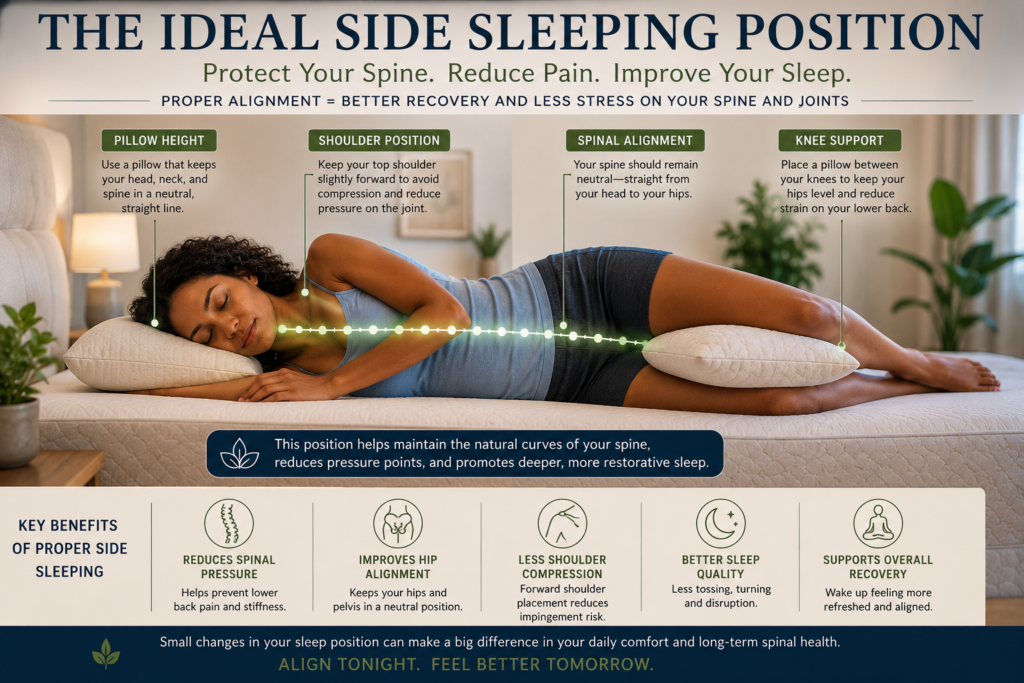
I am primarily a side sleeper.
I sleep mostly on my right side.
However, I do NOT sleep directly on my shoulder.
Instead:
- my shoulder is slightly forward,
- my torso is slightly rotated,
- and my body weight distributes more naturally.
Direct shoulder compression for hours may contribute to:
- shoulder impingement,
- numb hands,
- thoracic rotation,
- neck tension,
- and arm discomfort.
For many people, side sleeping is excellent IF:
- the pillow height is correct,
- the mattress supports the torso appropriately,
- and the spine remains level.
Pillow Height Is Critical
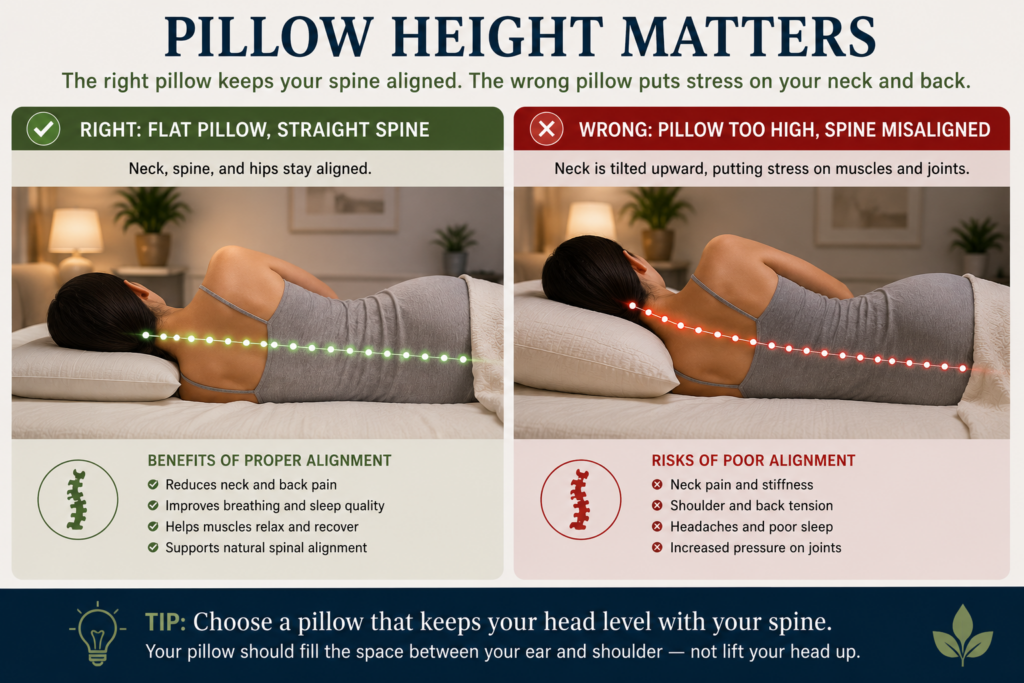
For side sleepers, the pillow must properly fill the space between:
- the head,
- neck,
- and mattress.
If the pillow is too low:
- the neck bends downward.
If too high:
- the neck bends upward.
Either may create:
- muscular tension,
- headaches,
- joint irritation,
- and morning stiffness.
Broad shoulders generally require:
- higher loft pillows.
Petite frames generally do better with:
- flatter pillows.
Back Sleeping
Back sleeping may allow excellent symmetry for some people.
However:
- thick pillows often force forward head posture,
- flatten the cervical curve,
- and strain the neck for hours.
Back sleepers usually do better with:
- lower-profile pillows,
- gentle cervical support,
- and sometimes a pillow beneath the knees.
A pillow beneath the knees may reduce stress on the lumbar spine and pelvis.
Stomach Sleeping
Stomach sleeping is usually the hardest on the spine.
Why?
Because:
- the neck remains rotated,
- the lumbar spine increases extension stress,
- and the pelvis often twists asymmetrically.
Many stomach sleepers wake up with:
- headaches,
- neck pain,
- jaw tension,
- shoulder tightness,
- or lower back stiffness.
If someone absolutely must stomach sleep:
- a very thin pillow,
- or sometimes no pillow,
may reduce stress somewhat.
Why Pillows Matter So Much
Your pillow controls:
- neck position,
- cervical curve support,
- muscle tension,
- airway positioning,
- and upper spinal alignment.
A poor pillow may contribute to:
- headaches,
- numb hands,
- neck pain,
- jaw tension,
- poor sleep quality,
- and even breathing issues.
Personally, I use a very small and relatively flat pillow.
Why?
Because many pillows today are dramatically too thick.
Especially for:
- smaller-framed individuals,
- people with forward head posture,
- or those with flattened cervical curves.
Pillows Between the Knees: One of the Simplest Solutions for Lower Back Pain
For side sleepers, placing a pillow between the knees may:
- reduce pelvic rotation,
- decrease lumbar twisting,
- improve hip alignment,
- and reduce lower back strain.
This is especially helpful for:
- sciatica,
- SI joint irritation,
- hip pain,
- pregnancy,
- and asymmetrical tension patterns.
Without support between the knees, the top leg often collapses downward, twisting the pelvis and lumbar spine for hours.
Sleep and Children: Why This Matters Early
Children are not simply “small adults.”
Their:
- spines,
- posture,
- airway development,
- ligaments,
- and nervous systems
are constantly developing.
That means their sleep environment matters tremendously.
Infants
Infants should sleep on:
- a firm flat mattress,
- without pillows,
- without thick soft bedding,
- and without excessive padding.
Safety and airway protection are critical.
Toddlers and Young Children
Many parents unknowingly give toddlers:
- oversized pillows,
- extremely soft mattresses,
- or thick bedding.
But many children actually do better with:
- firmer support,
- smaller pillows,
- and more neutral spinal positioning.
Children’s cervical spines are smaller and lighter.
Oversized pillows may force:
- forward head posture,
- neck flexion,
- and altered spinal alignment overnight.
Teenagers and Adolescents
This is one of the MOST overlooked stages structurally.
During adolescence:
- growth accelerates,
- posture changes rapidly,
- sports intensify,
- and screen time explodes.
This is when many teens begin developing:
- forward head posture,
- rounded shoulders,
- pelvic imbalance,
- asymmetrical movement patterns,
- headaches,
- neck pain,
- and chronic tightness.
A poor mattress during these developmental years may reinforce those patterns every single night.
Teen Athletes and Sleep Recovery
Teen athletes especially need:
- pressure relief,
- spinal support,
- temperature regulation,
- and movement freedom.
Athletic bodies recover during sleep.
Poor sleep surfaces may:
- increase recovery time,
- increase stiffness,
- and reduce tissue healing efficiency.
Signs Your Mattress or Pillow May Be a Problem
You wake up with:
- headaches,
- neck stiffness,
- numb hands,
- shoulder pain,
- hip pain,
- lower back tightness,
- tossing and turning,
- jaw tension,
- fatigue,
- or pain that improves once you start moving.
These are often signs your sleep environment may not be supporting your structure appropriately.
The Chiropractic Perspective
In chiropractic, we evaluate:
- spinal mechanics,
- posture,
- movement,
- nervous system function,
- and structural stress patterns.
If the spine is already:
- subluxated,
- unstable,
- asymmetrical,
- rotated,
- or compensating…
then spending 7–8 hours every night in poor alignment may reinforce those patterns continuously.
Sometimes patients improve temporarily…
But then re-create the stress overnight.
Your sleeping posture becomes part of your healthcare.
Ultimate Mattress Comparison Guide
| Mattress Type | Best For | Potential Downsides | Breathability | Ease of Movement |
|---|---|---|---|---|
| Organic Latex | Structural support, hot sleepers, combination sleepers | Latex allergy | Excellent | Excellent |
| Memory Foam | Pressure sensitivity, motion isolation | Heat retention, excessive sinking | Moderate | Moderate |
| Hybrid Mattress | Combination sleepers | Depends on construction | Good | Good |
| Pillow Top | Plush comfort lovers | Can lose support faster | Moderate | Moderate |
| Extra Soft Mattress | Pressure-sensitive lightweight individuals | May worsen spinal collapse | Moderate | Lower |
| Firm Mattress | Back sleepers, heavier body types | Pressure points for some side sleepers | Good | Excellent |
Ultimate Pillow Comparison Guide
| Pillow Type | Best For | Potential Downsides |
|---|---|---|
| Latex Pillow | Cooling, responsiveness, support | Latex allergy |
| Memory Foam Pillow | Pressure relief, contouring | Heat retention |
| Feather Pillow | Softness preference | Inconsistent support |
| Cervical Pillow | Neck support | Wrong size may worsen symptoms |
| Adjustable Pillow | Multiple sleep positions | Requires customization |
Best Pillow Height by Sleep Position
| Sleep Position | Usually Best Pillow Style |
|---|---|
| Side Sleeper | Medium-to-high loft |
| Back Sleeper | Low-to-medium loft |
| Stomach Sleeper | Very thin pillow |
| Broad Shoulders | Higher loft |
| Petite Frame | Lower loft |
| Forward Head Posture | Usually thinner pillow |
Best Mattress Style by Body Type
| Body Type / Condition | Often Does Better With |
|---|---|
| Hot Sleeper | Latex or breathable hybrid |
| Heavier Individual | Medium-firm to firm support |
| Pressure Sensitive | Adaptive foam or hybrid |
| Sciatica | Medium-firm with knee support |
| Shoulder Pain | Responsive side-sleeper support |
| Hypermobile Spine | Stable non-collapsing surface |
| Athletes | Responsive support with movement freedom |
Mattress and Pillow Recommendations for Children
| Age Group | General Recommendation |
|---|---|
| Infants | Firm flat mattress, no pillow |
| Toddlers | Small low-loft pillow if needed |
| Young Children | Medium-firm breathable support |
| Adolescents | Proper support during growth spurts |
| Teen Athletes | Pressure relief plus structural support |
Final Thoughts
There is no perfect mattress for everyone.
There is no universally perfect pillow.
The best sleep setup is the one that:
- supports your spinal curves,
- reduces stress,
- promotes movement,
- minimizes asymmetry,
- improves recovery,
- and allows your nervous system to truly rest.
The body adapts to what it experiences repeatedly.
And your bed is one of the most repeated environments in your life.
At Ptak Family Chiropractic, we believe spinal health is not only about how you move during the day…
It is also about what your body spends every night lying on.
(310) 473-7991 www.ptakfamilychiropractic.com 3122 Santa Monica Blvd. Ste Santa Monica, CA 90404