
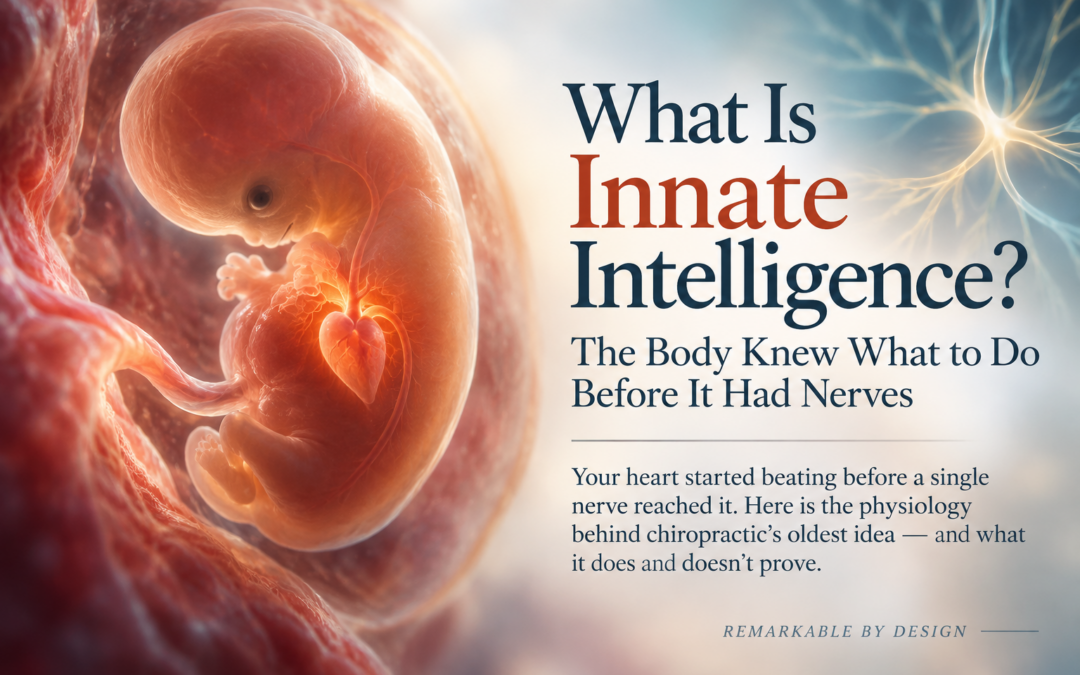
Your heart started beating before a single nerve reached it. Here is the physiology
behind chiropractic’s oldest idea — and what it does and doesn’t prove.
Jeffrey Ptak, DC, DSS, MSS, MA
Yesterday marked 131 years since the day chiropractic traces its beginning, September
18, 1895. So today seems like the right time to talk about one of the oldest — and most
misunderstood — ideas in chiropractic: innate intelligence.
Innate intelligence is chiropractic’s name for the body’s built-in capacity to
organize, regulate and repair itself. It is a philosophical idea, not a
laboratory measurement. But the physiology it points to is real: the body
begins organizing itself before the nervous system exists, and once the
nervous system is in place, it becomes woven into how the body regulates,
heals and defends itself.
You cut your finger. You do nothing. Within minutes the bleeding stops. Within days the
gap closes. Within weeks you can barely find the scar.
You didn’t tell your platelets where to go. You didn’t schedule the inflammation or order
new skin. Something organized all of it without asking you.
Chiropractic has had a name for that something for more than a century.
A Word Chiropractic Has Used Since 1910
D.D. Palmer gave the first chiropractic adjustment in Davenport, Iowa, in 1895. Fifteen
years later he wrote about “innate intelligence”: the organizing wisdom by which a living
body maintains and heals itself. Chiropractors have repeated a shorter version ever since:
the power that made the body heals the body.
Palmer meant it in an explicitly spiritual sense. Modern chiropractic historians, most
notably Simon Senzon, have argued that today’s systems biology offers another way to
understand his idea of a body that organizes itself.
Medicine arrived at the same observation by a different road. In 1932 the Harvard
physiologist Walter Cannon published The Wisdom of the Body and gave the body’s self-
regulation a scientific name: homeostasis.
Innate intelligence is a philosophy. You can’t put it under a microscope. But you can test the
physiology it points to, and that physiology is remarkable.
Your Heart Started Before Its Nerves Did
About three to four weeks after conception, the human heart begins to beat. At that stage it
is a simple tube of cells. No nerve directs it. The rhythm is generated by the heart muscle
itself, in specialized pacemaker cells that fire on their own.
The nerves that will later speed the heart up and slow it down arrive afterward.
Organization comes first. The body does not wait for wiring before it begins to live.
Then the Nerves Take Over the Fine Tuning
A transplanted heart shows the other half of the story.
When a heart is transplanted, the nerves connecting it to the brain and spinal cord are cut.
The heart still beats. But it no longer beats the same way. Its resting rate is typically faster,
because the vagus nerve is no longer slowing it. During exercise it can only speed up slowly,
waiting for adrenaline to arrive through the bloodstream instead of receiving an immediate
nerve signal. Over months and years some nerve fibers grow back, usually incompletely.
Life continues without the connection. Regulation suffers without it.
The Salamander’s Lesson
Salamanders can regrow a lost limb. In 1823 the Scottish physician Tweedy John Todd
noticed something about that ability: if he cut the nerves to the limb, it didn’t grow back. In
the 1940s and 1950s the biologist Marcus Singer showed that regeneration requires a
threshold amount of nerve supply.
Then researchers found a twist. Salamanders raised so that their limbs never received
nerves can regenerate those limbs without them. It is only after a limb has been innervated
that its regeneration comes to depend on the nerve.
That may be the clearest picture of innate intelligence in biology. The capacity to organize is
present from the beginning. Once the nervous system arrives, the body builds it into the way
it maintains and repairs itself — and from then on, it relies on it.
The Nervous System Is Woven Into Healing
This isn’t limited to salamanders. Over the past twenty-five years, research has shown the
nervous system taking part in processes once thought to run entirely on their own.
- Wound healing. In mice, removing a group of sensory nerve cells impaired both skin
wound repair and muscle regeneration. Those nerves help steer immune cells from
the inflammatory phase of healing into the repair phase. - Inflammation. The vagus nerve senses inflammation and signals back to restrain it in
real time, a circuit its discoverer named the inflammatory reflex. - Bone. In mice, a signal from the brain acting through the sympathetic nervous
system helps regulate how much bone is formed. - Blood stem cells. Also in mice, sympathetic nerves in the bone marrow release blood-
forming stem cells into circulation on a daily rhythm. - Digestion. The gut contains its own nervous system, with more neurons than the
spinal cord. An isolated segment of intestine can still move its contents along.
The pattern repeats. Cells can do a great deal on their own. But the nervous system is
involved in coordinating, timing and tuning what they do.
What These Examples Show — and What They Don’t
These findings show that the body is self-organizing, and that the nervous system is deeply
involved in regulation, repair and defense.
They do not prove that a chiropractic adjustment will improve any one of those processes in
any one person. Much of the research above was done in animals, and research on how
spinal care influences these systems is still early. Anyone who tells you otherwise is claiming
more than the evidence shows.
What they do support is the premise chiropractic was built on: how well the nervous system
is working matters to how well the body is working.
Where Chiropractic Fits
Your spine houses and protects the spinal cord, and its joints are richly supplied with
sensory receptors that report position and movement to your nervous system, continuously.
The chiropractic premise is that when spinal joints aren’t moving well, the information the
nervous system receives changes, and so can the way it responds. Research has begun to
look at this directly. In one study, people with recurring neck problems showed measurable
changes in how the brain processed sensory input after a cervical adjustment, changes that
lasted about twenty minutes and did not occur in a control group.
That’s a beginning, not a final answer. But it points in the direction chiropractic has always
pointed.
After forty years in practice, this is what I believe: whatever else is going on in your body,
you are better off with a nervous system working without interference than with it. That is
not a promise about any particular condition. It is the reason I examine the nervous system
in every patient who walks through my door.
Good regulation isn’t simply more drive. The nervous system needs a gas pedal and a brake,
and it needs the signals to both to come through clearly.
Let’s Check You
At Ptak Family Chiropractic in Santa Monica, we examine how your spine moves and how
your nervous system is functioning: reflexes, sensation, strength, balance and coordination,
along with the joints and muscles involved in whatever brought you in.
What we find determines what we do. If we find something we can help change, we’ll show
you what it is and what we plan to do about it. If it belongs with your physician or another
specialist, we’ll tell you that too.
If you want to know how well your nervous system is doing its job, let’s check you. We
never charge you to sit down and talk about your needs. Call Ptak Family Chiropractic at
310.473.7991 and make an appointment.
You don’t need to believe in innate intelligence before you come in. That’s what the
examination is for.
Selected References
Palmer DD. The Science, Art and Philosophy of Chiropractic (The Chiropractor’s Adjuster). Portland Printing
House; 1910.Cannon WB. The Wisdom of the Body. W.W. Norton; 1932.
Senzon SA. Constructing a philosophy of chiropractic: evolving worldviews and premodern roots. Journal of
Chiropractic Humanities. 2011;18(1). Wenban AB, Denis FL. Innate intelligence in the philosophy of chiropractic: a comparative analysis. Journal of Contemporary Chiropractic. 2026;9(1):185–206. Männer J. When does the human embryonic heart start beating? A review of contemporary and historical sources of knowledge about the onset of blood circulation in man. Journal of Cardiovascular Development and Disease. 2022;9(6):187.
Kumar A, Brockes JP. Nerve dependence in tissue, organ, and appendage regeneration. Trends in
Neurosciences. 2012;35(11):691–699.
Lu YZ et al. CGRP sensory neurons promote tissue healing via neutrophils and macrophages. Nature.
2024;628:604–611.
Tracey KJ. The inflammatory reflex. Nature. 2002;420:853–859.
Takeda S et al. Leptin regulates bone formation via the sympathetic nervous system. Cell. 2002;111(3):305–317.
Méndez-Ferrer S, Lucas D, Battista M, Frenette PS. Haematopoietic stem cell release is regulated by circadian
oscillations. Nature. 2008;452:442–447.
Purves D et al., eds. Neuroscience. 2nd ed. Sinauer Associates; 2001. The Enteric Nervous System.
Haavik-Taylor H, Murphy B. Cervical spine manipulation alters sensorimotor integration: a somatosensory
evoked potential study. Clinical Neurophysiology. 2007;118(2):391–402.
About the author. Dr. Jeffrey Ptak, DC, DSS, MSS, MA, is the founder of Ptak Family Chiropractic in Santa
Monica, where he has practiced since 1986. His postgraduate study includes Chiropractic Functional Neurology
through the Carrick Institute and advanced training through the International Association of Functional
Neurology and Rehabilitation. He is the author of the forthcoming book It’s Like You Never Left, to be
published by Indigo River Publishing.
Educational purposes only. This article describes a philosophy of health and summarizes published research; it does not
diagnose any condition, is not a substitute for medical care, and does not claim that chiropractic care treats or cures any
disease. Several studies described were conducted in animals. Do not start, stop or change any prescribed treatment
without consulting your physician. Individual results vary and no particular outcome is promised.
Ptak Family Chiropractic
We listen… We care… We get results…
Chiropractic for Adults and Children
3122 Santa Monica Blvd., Suite 102 · Santa Monica, CA 90404
310.473.7991 · ptakfamilychiropractic.com
Mon / Wed / Thurs 8:00–12:15 and 2:00–6:00 · Tues / Fri 8:00–12:00 · Sat 10:00–12:00