
Why Good Posture Feels So Hard to Maintain
If you’ve ever tried to sit up straight or pull your shoulders back, you’ve probably noticed something frustrating. You can hold it for a few minutes, and then your body pulls you right back into the same slouched position.
This isn’t a lack of discipline. It’s how your nervous system works.
At Ptak Family Chiropractic, we help patients understand that posture is not just about muscles. It is a learned neurological pattern.
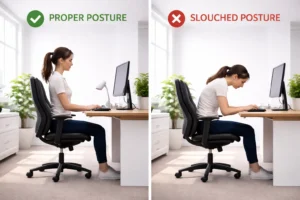
Posture Is Programmed Into Your Nervous System
Over time, your body adapts to whatever position you spend the most time in. Sitting at a desk, looking down at your phone, driving, and leaning forward all reinforce the same pattern.
Your brain begins to recognize that position as normal.
In my 40 years of practice, I’ve seen this pattern repeat over and over again. Patients don’t have poor posture because they are lazy. Their body has simply adapted to repetition.

The Pattern Behind Poor Posture
There is a common pattern we see clinically known as upper-cross syndrome.
This involves tight chest muscles pulling the shoulders forward, weak upper back muscles failing to hold you upright, the head drifting forward in front of the shoulders, and increased curvature in the upper spine.
The body becomes strong in the wrong areas and weak where it matters most.
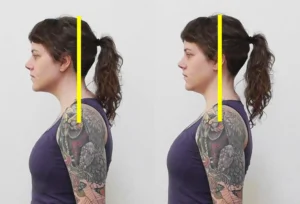
Why Trying Harder Doesn’t Work
Most people think posture is about effort. Just sit up straight.
But effort alone fails because your body has already created a default pattern.
Your nervous system has essentially memorized the slouched position. Without retraining that pattern, your body will always return to what feels familiar.
You’re not failing. Your body is following its programming.
The Posture Feedback Loop
Poor posture is not just muscular. It becomes a cycle.
Imbalanced muscles begin to pull joints out of proper alignment. Spinal joints lose normal motion and position. This affects the nerves that control those same muscles. The muscles then function even less efficiently, and the pattern continues to reinforce itself.
This is why stretching alone rarely solves the problem.

What It Takes to Correct Posture
True posture correction requires a combination of approaches.
Passive care involves chiropractic adjustments that help restore proper motion and alignment in the spine. This reduces stress on the nervous system and allows the body to function more efficiently.
Active care involves specific exercises that retrain the muscles to support proper posture.
The adjustment creates the opportunity. The exercises help your body keep it.

How Long Does It Take
This is one of the most important conversations we have with patients.
Posture changes do not happen overnight.
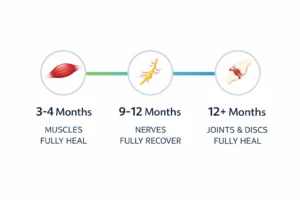
During the first four to eight weeks, people often experience improved movement and early muscle activation changes. Over three to six months, the body begins to stabilize new patterns.
Your nervous system needs time and repetition to accept a new normal.
A Simple Exercise You Can Start Today
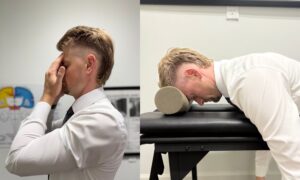
One of the most effective exercises is the chin tuck.
Gently pull your head straight back over your shoulders, hold for five seconds, and repeat ten times. Perform this throughout your day.
This helps activate the deep muscles that support proper head and neck alignment.
When Do Posture Problems Begin
Earlier than most people realize.
I’ve seen early postural patterns in children, especially in those who mouth breathe, use screens frequently, or spend long periods on phones and tablets.
These patterns often begin young and continue into adulthood if not addressed.

The Most Important Thing to Understand
Your body is always adapting.
Every position you spend time in is being recorded and reinforced by your nervous system. If that position is poor posture, it becomes your default.
If you want to change it, you must give your body consistent, repeated input through better movement, better alignment, and better muscle activation.
Over time, your body learns a new normal.
Final Thought
Posture is not about perfection. It is about consistency.
Small changes, repeated over time, create lasting results.
One adjustment. One movement. One day at a time.
Quick Answers
How long does it take to fix posture
Most people begin to notice changes in four to eight weeks, with more lasting improvements developing over several months.
Can I fix posture with exercise alone
Exercise helps, but addressing spinal alignment and nervous system function allows the body to respond more effectively.
Why does posture worsen during the day
Postural muscles fatigue, and the body returns to the pattern it has learned over time.
Can poor posture cause headaches
Yes. Forward head posture places stress on the neck and can contribute to headaches.
Want Help Improving Your Posture
If you’re in the Santa Monica area and want to correct posture and reduce strain on your spine, the team at Ptak Family Chiropractic is here to help you move better, feel better, and function at your best.