

Most people think of exercise as something that benefits muscles, fitness, or weight. But what if one of its most powerful effects happens in the brain… and lasts a lifetime?
Emerging research continues to confirm something both simple and profound: movement in childhood helps build a better brain.
A study published in NeuroImage found that children who regularly participate in exercise develop stronger brain structure and function over time. Specifically, physical activity was linked to improved response inhibition, a critical part of cognitive control.
In simple terms, this means the ability to pause, think, and make better decisions.
And that ability impacts everything.
Academic performance
Emotional regulation
Focus and attention
Impulse control
Long-term health behaviors
This is not just about being active. This is about how the brain wires itself during development.
When children move, especially through activities that require coordination, balance, timing, and skill, the brain adapts. It becomes more efficient, more connected, and more capable of handling complex tasks.
The research highlights three key changes that occur in the brain with regular physical activity:
Increased cortical thickness, which supports higher-level thinking and processing
Improved efficiency of neural pathways, meaning the brain works faster and more effectively
Stronger communication between the left and right hemispheres of the brain
These changes are not temporary. They help shape how a child thinks, learns, and responds to the world well into adulthood.
One of the most important outcomes is improved inhibitory control.
This is the brain’s ability to override impulses and distractions in favor of better, more appropriate actions. It is what allows a child to focus in class, resist distractions, regulate emotions, and make healthier choices.
There are two main types of inhibitory control.
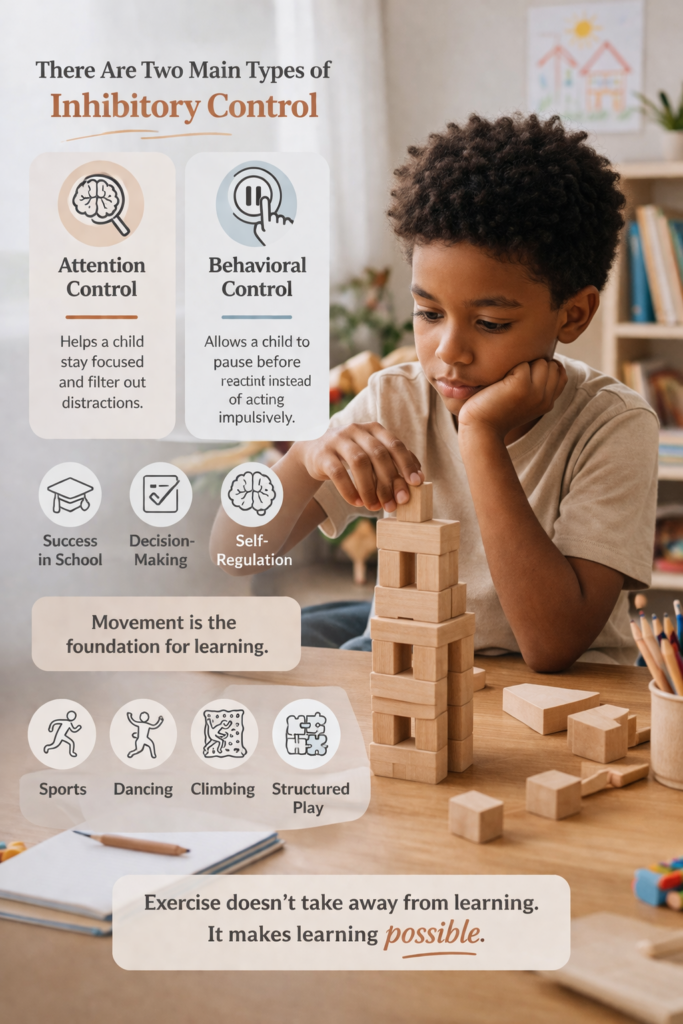
The first is attention control, which helps a child stay focused and filter out distractions.
The second is behavioral control, which allows a child to pause before reacting, rather than acting impulsively.
Both are essential for success in school and life. But behavioral control plays an even bigger role in long-term health, because it influences decision-making, habits, and self-regulation.
Here is where things become especially important.
Modern lifestyles are moving in the opposite direction.
Children today are spending more time sitting, more time on screens, and less time engaging in meaningful physical activity. In many cases, schools are reducing or replacing physical education in an effort to prioritize academics.
But the research suggests this may be doing the exact opposite of what is intended.
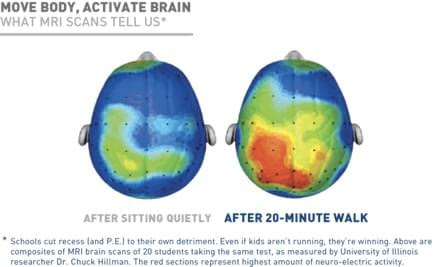
Reducing movement does not enhance learning. It may limit the brain’s ability to learn.
Exercise is not a break from learning. It is a foundation for it.
Activities that involve coordination and skill, such as sports, dancing, climbing, or even structured play, appear to have the greatest impact. These types of movements challenge the brain, not just the body.
They require timing, awareness, balance, and decision-making, all of which stimulate neurological development.
This is one of the most overlooked aspects of health today.
We often wait until there is a problem before we act. But brain development is happening every day, especially in childhood. The habits formed early can influence cognitive and emotional function for decades.
The takeaway is simple, but powerful.
Daily movement is not optional. It is essential.
Encouraging children to be active every day, both in school and at home, is one of the most important investments we can make in their future.
Play with them
Move with them
Encourage sports, exploration, and outdoor activity
Support schools that prioritize physical education
Because what we are really supporting is not just physical health.
We are helping build stronger, more capable, more resilient brains.
And that is something that lasts a lifetime.
If you have questions about how movement, posture, and nervous system function impact your child’s development, our team at Ptak Family Chiropractic is here to help guide you.
Call us at (310) 473-7991.