

It is one of the most common things we hear in our office.
“I slept all night… so why do I feel stiff when I wake up?”
Most people assume sleep should fix everything. After all, your body has been resting for hours. It would make sense that you should wake up feeling refreshed, loose, and ready to move.
But that is not always what happens.
In many cases, waking up stiff is not about how you slept. It is about how your body has been functioning leading up to that sleep.
In over four decades of practice, one pattern has remained consistent. What you feel in the morning is often a reflection of what has been building quietly over time.
Your body does not suddenly become stiff overnight. It reveals what has already been there.
Your Spine Changes While You Sleep

Throughout the day, your spinal discs are under constant pressure.
Sitting, standing, walking, and even normal daily activity compress the discs and push fluid out. This is a natural process.
At night, when you lie down, that pressure is reduced. Your discs begin to reabsorb fluid and rehydrate. This is one of the reasons you are slightly taller in the morning than in the evening.
However, this recovery process depends on one key factor.
Motion.
For discs to absorb fluid effectively, the spine must be moving well during the day. If certain segments are not moving properly, the discs in those areas do not receive the same level of hydration.
Instead of restoring, those areas remain restricted.
So when you wake up, the stiffness you feel is often coming from areas that did not fully recover overnight.
Sleep Position Matters More Than Most People Realize
How you sleep can either support your spine or add more stress to it.
If you sleep on your stomach, your neck is typically turned to one side for hours at a time. This creates constant rotational stress on the cervical spine.
If you sleep on your side without proper support, your top shoulder may roll forward and your spine may not stay in a neutral position.
If you sleep on your back but your pillow is too high or too flat, your neck may be pushed out of alignment for the entire night.
None of these positions cause immediate damage, but over time, they reinforce the same patterns your body has already adapted to during the day.
The goal is not perfection. It is support.
A sleep position that keeps your spine as neutral and supported as possible allows your body to rest without adding additional stress.
Your Pillow and Mattress Play a Role
Your pillow is not just for comfort. It is there to support the natural curve of your neck.
If your pillow is too high, it pushes your head forward. If it is too flat, your head drops back. Either way, your neck is not in a neutral position.
Over the course of six to eight hours, that matters.
Your mattress also plays a role. If it is too soft, your body sinks and loses alignment. If it is too firm, it may not allow natural curves to be supported properly.
That said, the most important point is this.
Even the perfect pillow and mattress cannot overcome poor function.
If your spine is not moving well during the day, no sleep setup will fully correct that overnight.
Shortened Muscles Do Not Relax Just Because You Are Asleep
This is one of the most overlooked factors.
If you spend your day sitting, looking down, or repeating the same movements, certain muscles begin to shorten and tighten.
Common areas include the chest, the front of the shoulders, the hip flexors, and the muscles around the neck.
At the same time, other muscles become weaker or less active.
This creates imbalance.
When you go to sleep, those shortened muscles do not simply reset. They often stay in that same pattern.
So instead of fully relaxing, your body remains slightly guarded.
That tension is often what you feel first thing in the morning.
Your Body Adapts, Then It Holds That Pattern
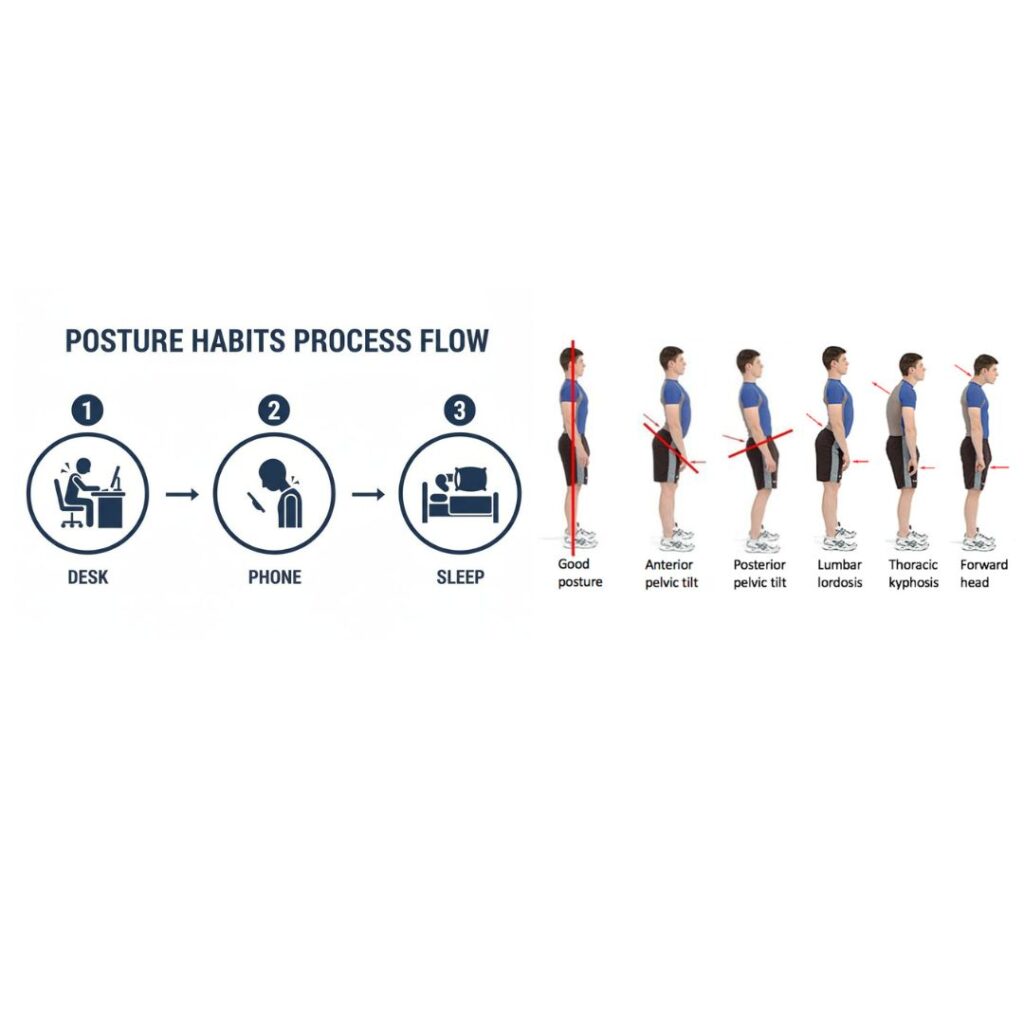
During the day, your body is constantly adapting to what you do most.
You may shift your weight slightly when standing. You may sit with a subtle lean. You may carry your head just a little forward without realizing it.
Over time, these small changes become patterns.
Your brain begins to recognize these patterns as normal.
By the time you go to sleep, your body is already functioning within those patterns.
Sleep does not erase them. It simply pauses the day.
When you wake up, your body resumes where it left off.
Why Pain Is Not Always Present

Many people assume that if there is no pain, there is no problem.
But stiffness is often one of the earliest signs that something is not functioning as well as it should.
Pain typically shows up later.
By the time pain appears, the underlying issue has usually been there for some time.
This is why people are often surprised when something “suddenly” happens, when in reality, their body has been adapting quietly for a long time.
Paying attention to stiffness early can make a significant difference.
What You Can Do to Improve Morning Stiffness
Small changes can begin to shift these patterns.
Be mindful of your sleep position and aim for a more neutral spine
Use a pillow that supports the natural curve of your neck
Avoid falling asleep in positions that place your body in rotation or imbalance
Stay consistent with movement during the day instead of remaining in one position for long periods
Pay attention to posture, especially with prolonged sitting or screen time
These are helpful steps, but they are only part of the solution.
If the underlying issue is how your spine and nervous system are functioning, that needs to be addressed directly.
What We Focus On in Our Office

At Ptak Family Chiropractic, we focus on restoring proper function.
Our approach begins before the adjustment.
Through specific neurological and musculoskeletal preparation, we help restore motion and improve how the body responds to care.
When the spine begins to move better and the nervous system communicates more efficiently, the body can recover the way it was designed to.
This is when patients begin to notice not only less stiffness in the morning, but better movement throughout the entire day.
The Real Goal Is Better Function
Waking up without stiffness is not just about comfort.
It is a reflection of how well your body is functioning.
When your body moves well, everything becomes easier. Getting out of bed, exercising, working, and simply enjoying your day all improve.
This is not about temporary relief.
It is about improving the way your body works so that these patterns do not continue to return.
Take the Next Step
If you are waking up stiff, your body may be trying to tell you something.
Even if it feels minor, it is worth paying attention to.
Call our office at (310) 473-7991 to schedule a no-charge consultation and examination.
We will help you understand what is going on, what your body is adapting to, and what you can do to improve how you move, function, and feel each day.