

Have you ever felt completely exhausted… but unable to relax?
Tired, but your mind keeps going.
Physically drained, yet your body still feels tense, tight, or “on edge.”
Most people assume this is just part of a busy life.
But what you are feeling is often your nervous system stuck in the wrong gear.
Meet Your Two Modes
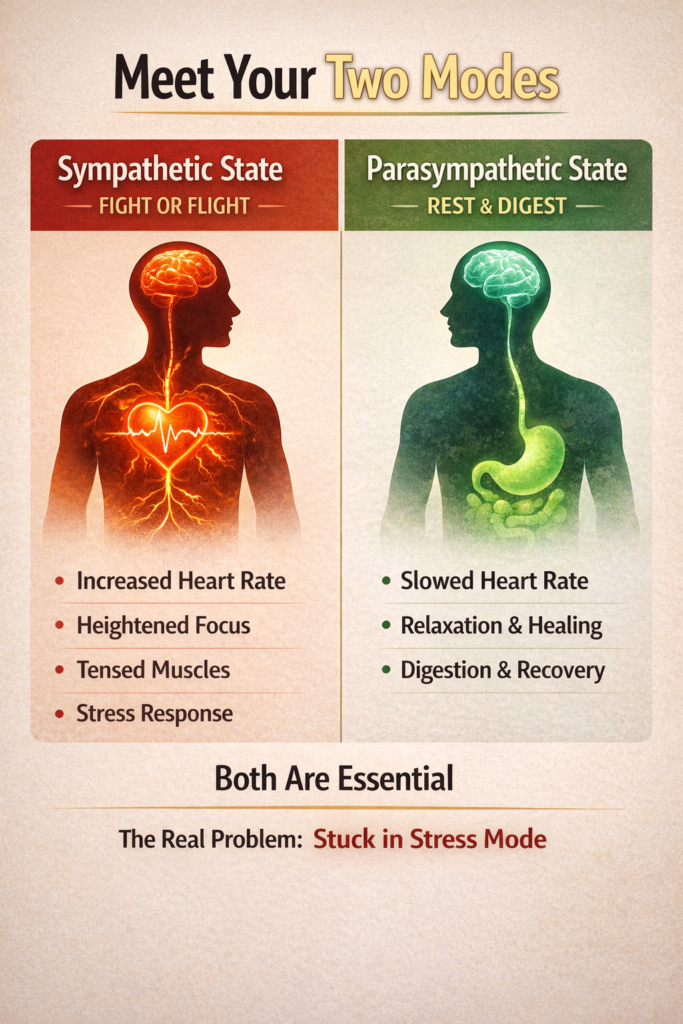
Your nervous system is constantly working behind the scenes, regulating how your body responds to everything around you.
At its core, it operates in two primary modes.
The first is the sympathetic state, commonly known as “fight or flight.” This is your body’s survival mode. It increases heart rate, sharpens focus, tightens muscles, and prepares you to respond to stress or perceived danger.
The second is the parasympathetic state, often referred to as “rest and digest.” This is your recovery mode. It slows things down, supports digestion, promotes healing, and allows your body to repair and recharge.
Both systems are essential.
The problem is not stress.
The problem is when your body never fully shifts out of it.
When Stress Becomes the Default
In today’s world, most people spend far more time in a sympathetic state than they realize.
Deadlines, emails, traffic, constant notifications, family responsibilities… your body does not distinguish between a true physical threat and modern-day stress. It responds the same way.
Over time, this creates a pattern.
Your nervous system begins to live in a constant state of low-level alert.
This is when people start to notice things like tight shoulders, jaw clenching, shallow breathing, or difficulty falling asleep. You may feel restless, irritable, or unable to fully unwind even when you have the time.
What is happening is simple.
Your body has learned to stay “on.”
The Hidden Physical Effects of Being “On” Too Much
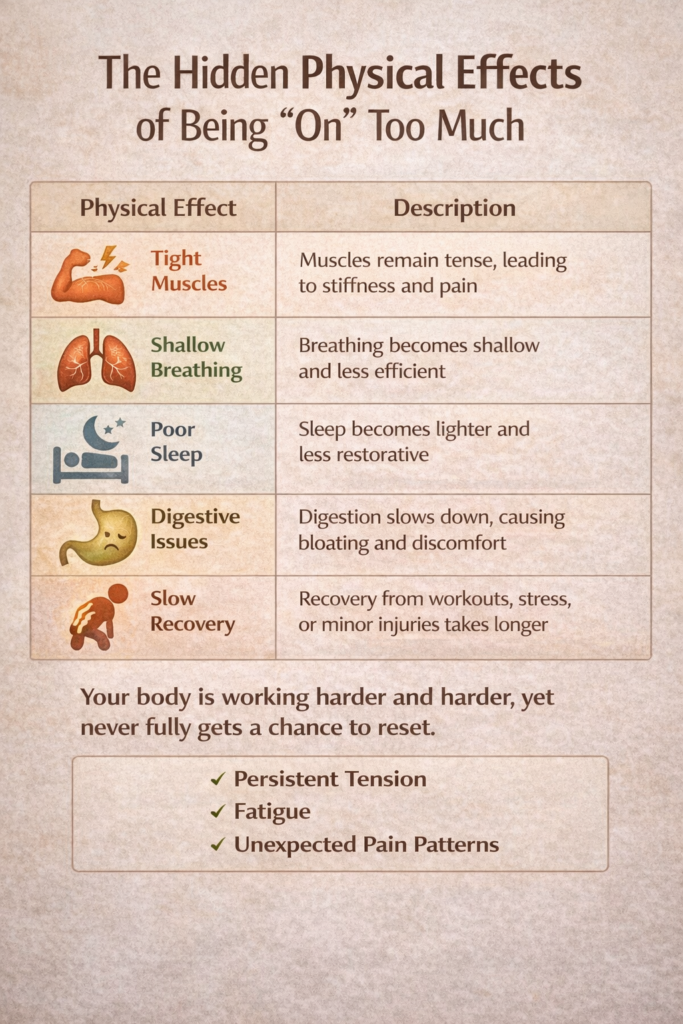
When your nervous system stays in a heightened state, it begins to affect more than just how you feel mentally.
Muscles remain tight longer than they should.
Breathing becomes shallow and inefficient.
Sleep becomes lighter and less restorative.
Digestion can slow down or become inconsistent.
Recovery—whether from workouts, daily stress, or even minor injuries—takes longer.
Over time, this creates a body that is working harder than it needs to, without ever getting the reset it requires.
This is often where people begin to notice persistent tension, fatigue, and even pain patterns that seem to come out of nowhere.
Why Your Body Doesn’t “Shut Off” Automatically
One of the biggest misconceptions is that your body should naturally relax once the day is over.
But if your nervous system has adapted to staying in a heightened state, it does not simply switch off.
Just like posture patterns or movement habits, your nervous system can learn dysfunction.
If the signals for relaxation are not registering clearly, the body continues to operate in the same pattern.
This is why some people can sit on the couch at night and still feel tense.
Or lie in bed and feel exhausted, yet wide awake.
The system has not been given the right input to shift gears.
How This Connects to the Spine and Body
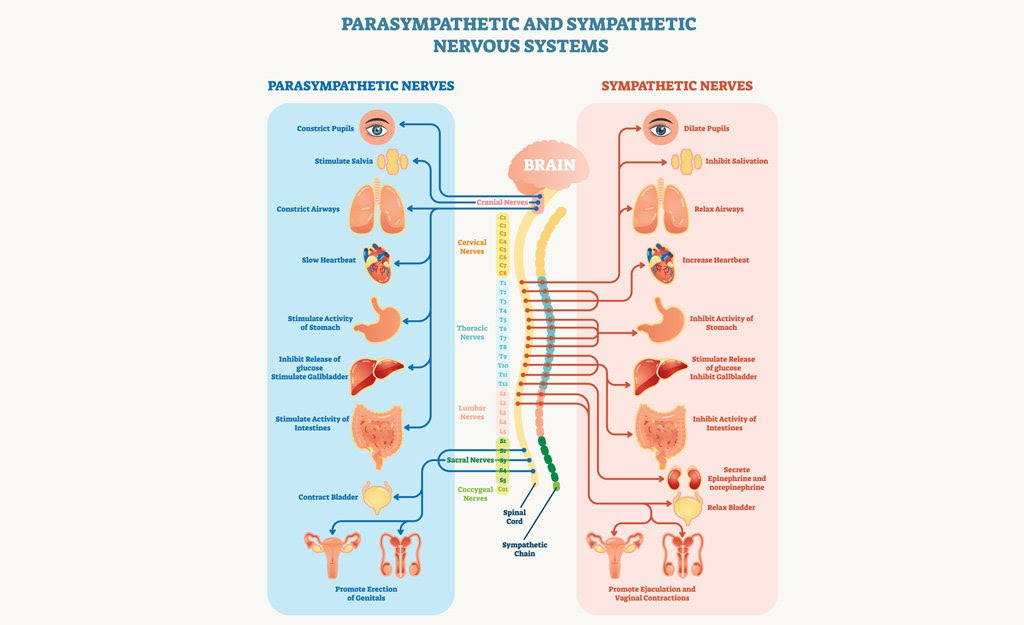
Your nervous system and your spine are directly connected.
Every signal traveling between your brain and your body passes through the spine. When there is restriction, tension, or misalignment in the spine, it can influence how effectively those signals are transmitted.
This is where many people begin to experience a disconnect.
The body may be trying to relax, but the message is not being communicated clearly.
This can contribute to ongoing muscle tension, poor recovery, and a nervous system that struggles to downshift.
Our focus is always on restoring that communication.
Because when the nervous system functions better, everything else begins to follow.
Simple Ways to Support Your Nervous System
You do not need to overhaul your life to start making changes.
Small, consistent inputs create meaningful shifts over time.
Movement is one of the most powerful tools. Even brief breaks throughout the day help reset your system and prevent it from becoming locked into one pattern.
Breathing matters more than most people realize. Slow, controlled breathing can directly signal your body to shift toward a calmer state.
Sleep routines play a major role. Going to bed at consistent times and creating a wind-down routine helps your body recognize when it is safe to relax.
Time away from constant stimulation is essential. Stepping outside, reducing screen exposure, and giving your mind space all help your system reset.
None of these need to be extreme.
They simply need to be consistent.
Why Awareness Is the First Step
Most people are not aware of how much tension they are carrying.
It becomes normal.
Until one day it is not.
Learning to recognize the signs—tightness, restlessness, shallow breathing, difficulty relaxing—is the first step toward change.
Because once you are aware, you can begin to shift it.
A Different Way to Look at Stress
Stress is not something you eliminate.
It is something you learn to move through more effectively.
A well-functioning nervous system allows you to handle stress when needed… and recover from it when it is over.
That recovery is where healing happens.
That is where your body resets, repairs, and restores.
Without it, the system stays stuck.
Where We Come In
Our role is to help your body function the way it was designed to.
Through a neurologically focused approach, we work to improve communication within the nervous system, reduce interference, and help your body shift more effectively between states.
This is not about forcing relaxation.
It is about restoring the body’s ability to do it naturally.
When that happens, people often notice better sleep, less tension, improved focus, and a greater sense of ease in their body.
The Takeaway
If you feel wired but exhausted…
If you have trouble relaxing, even when you want to…
If your body feels constantly tense or “on”…
It is not just in your head.
It is your nervous system asking for support.
And the good news is, this is something that can change.
If you are ready to better understand how your body is functioning and what steps you can take to support it, the docotrs and the team at Ptak Family Chiropractic are here to help guide you.
Call today and lets see if it is sympathetic overload that is creating your healthg issues or it its a weakend parasympathetic system at the core of your health issues. 310-473-7991. Remember we never c hgarge anyone to sit down and see if your health issue is a chiropractic one.