The Most Powerful Story You’ll Ever Tell… Is the One You Tell Yourself
By Dr. Jeffrey Ptak, DC, DSS, MSS, MA
Every day, we tell ourselves stories.
Some inspire us.
Some protect us.
And some quietly become the prison we never meant to build.
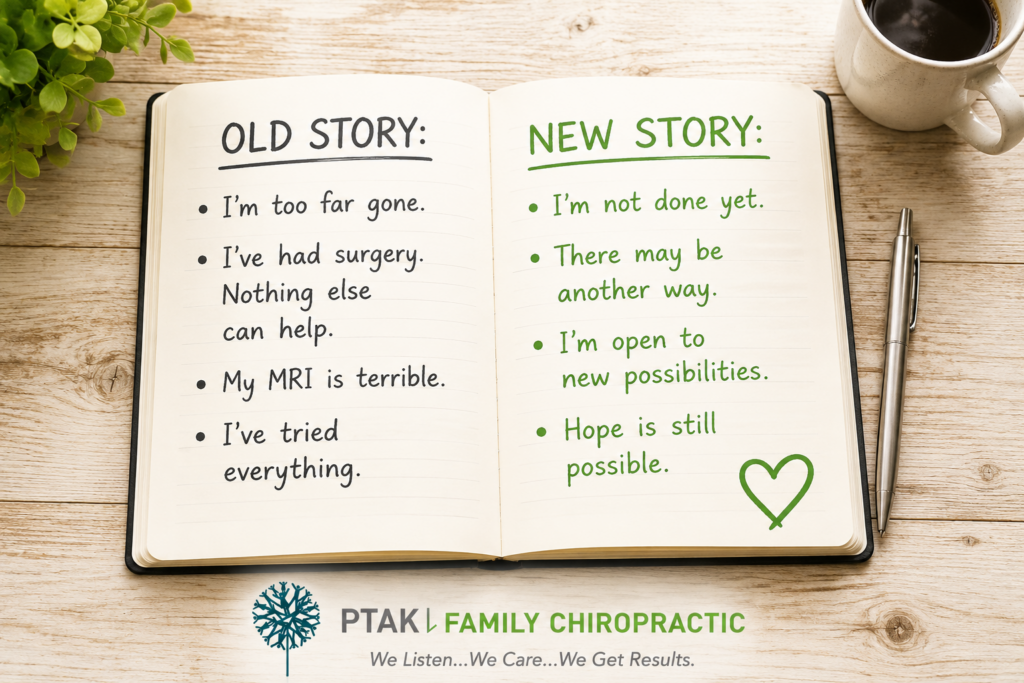
“I guess this is just part of getting older.”
“I’ve had surgery. Nothing else can help.”
“My MRI is terrible.”
“I’ve tried everything.”
“I’m too far gone.”
Over the past 40 years, I’ve heard every one of those stories.
Some were true.
Many were simply conclusions that had never been questioned.
Just today, a woman visited our office while waiting for a friend to finish her appointment.
We struck up a conversation.
She explained that chiropractic wasn’t for her.
She had undergone neck surgery.
Back surgery.
Abdominal surgery.
She had metal implants and was understandably concerned.
Then she said something I’ve heard many times over the years.
“I’m just too far gone.”
I didn’t tell her she was wrong.
The truth is, I don’t know what a thorough examination of her condition would reveal. Every person’s health history is unique, and no one should make promises without first understanding the whole picture.
But I couldn’t help wondering…
Who wrote that story?
Was it written by her surgeon?
By previous experiences?
By fear?
By disappointment?
Or had she slowly rewritten her own future without realizing it?
The stories we tell ourselves shape the lives we believe are possible.
Years ago, one of my patients, Charles B. Griffith—the screenwriter best known for The Little Shop of Horrors—gave me a gift I’ll never forget.
Instead of writing a thank-you note, he wrote me a poem.
It ended with these words:
He took away the years of pain.
And—just for good measure—
He took my cane.
I have treasured that poem ever since.
Not because it says anything extraordinary about me.
But because it reminds me what hope feels like.
Throughout my career, I’ve met people who crossed oceans searching for another opinion.
A woman traveled from the Seychelles, believing there might still be another path.
A husband and wife flew from Seoul every month for more than two years because they believed their health was worth the journey.
A woman arrived from England in a wheelchair after being told surgery was her next step. Before making assumptions, we carefully evaluated her, listened to her story, and looked at her as a whole person.
Each of these individuals had one thing in common.
They had not stopped asking questions.
Please don’t misunderstand me.
Not every story ends with someone throwing away a cane.
Not every wheelchair becomes unnecessary.
Not every condition can be reversed.
Healing doesn’t always look the way we hope it will.
But one lesson has stayed with me through four decades of practice.
The moment we become absolutely convinced that nothing can change…
…we often stop looking for what still can.
Maybe the most important question isn’t…
“Can I be fixed?”
Maybe it’s…
“Have I allowed one chapter of my life to become the entire story?”
We all have stories we’ve been telling ourselves for years.
Some deserve to be remembered.
Others deserve to be rewritten.
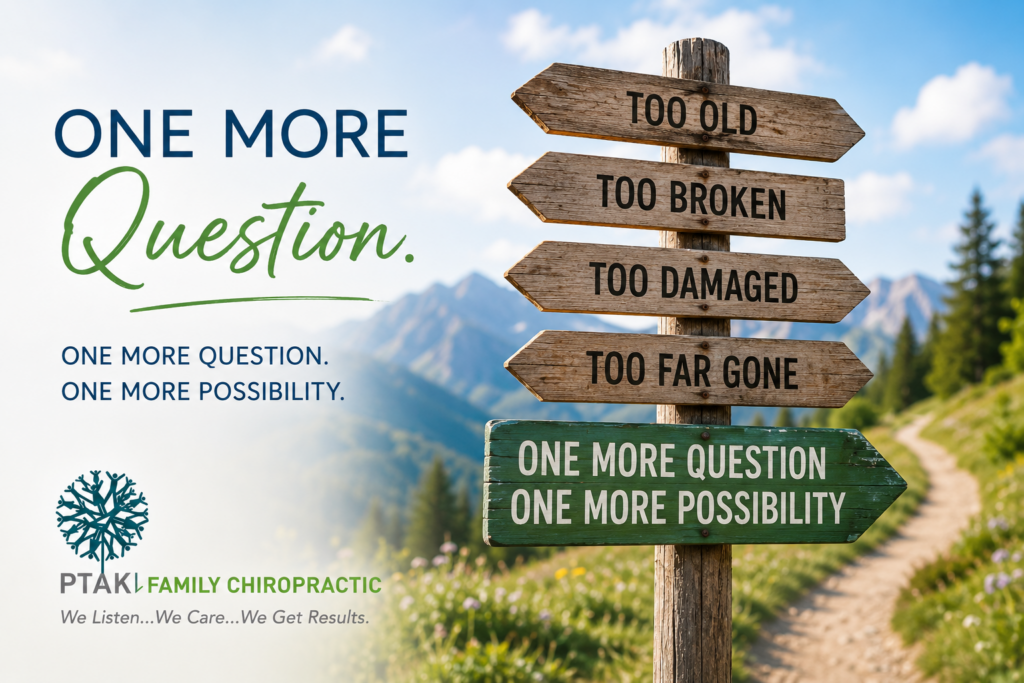
So before you decide you’re too old…
Too broken…
Too damaged…
Too far gone…
Pause for a moment.
Ask one more question.
Seek one more perspective.
Remain open to one more possibility.
Because sometimes the greatest healing begins long before an adjustment, a treatment, or a diagnosis.
Sometimes it begins the moment we decide to rewrite the story we’ve been telling ourselves.
At Ptak Family Chiropractic, we don’t promise miracles.
We don’t promise cures.
What we do promise is to listen carefully, evaluate thoroughly, and help you understand what possibilities may still exist.
After all…
No one should let fear write the final chapter of their story.
Ask the Doctor. Start the conversation. Rewrite the story.
Practical Tips to Protect Your Feet, Knees, Hips, Neck, and Back During Long Summer Days
Summer is here.
Families across the country are heading to Disneyland, Universal Studios, Knott’s Berry Farm, Six Flags, water parks, county fairs, festivals, and amusement parks of every kind.
Most people prepare for the crowds.
Most people prepare for the heat.
Most people prepare for the long lines.
What many people don’t prepare for is the physical stress that comes with spending an entire day on their feet.
By the end of the day, many visitors are dealing with:
Aching feet
Sore knees
Tight hips
Stiff necks
Low back pain
Exhaustion
The truth is that a single day at a theme park can place more physical stress on your body than an average work week.
Many visitors walk 15,000–25,000 steps in a single day while standing in lines, carrying backpacks, pushing strollers, lifting children, and navigating hot summer weather.
Fortunately, a little preparation can make a tremendous difference.
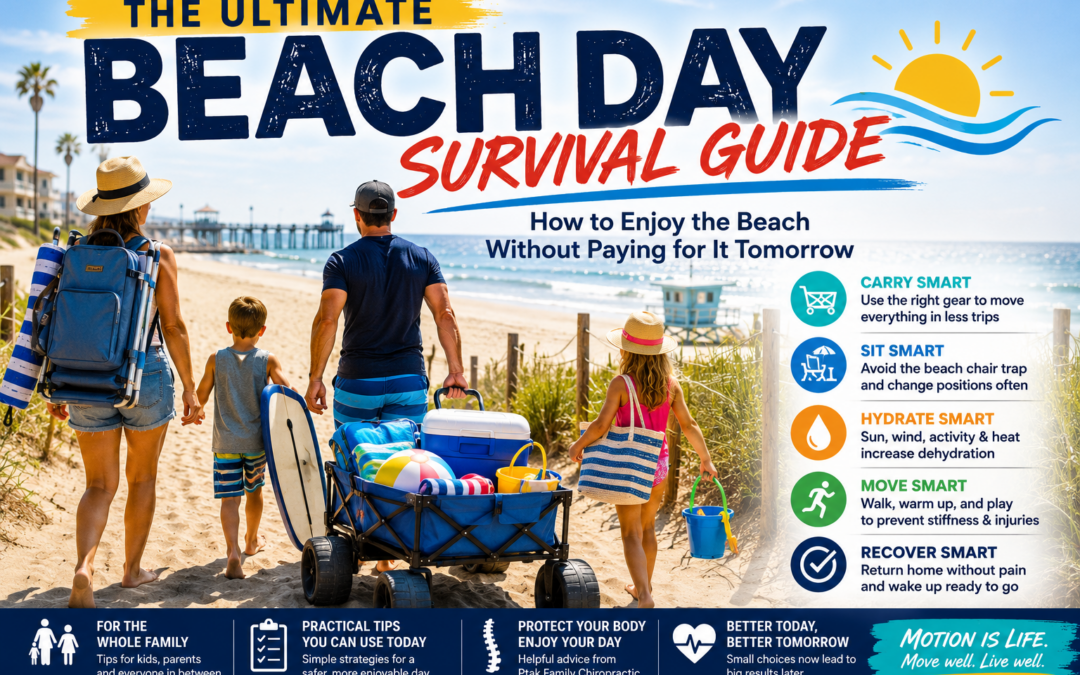
Let’s look at some simple ways to enjoy the memories without paying for them tomorrow.
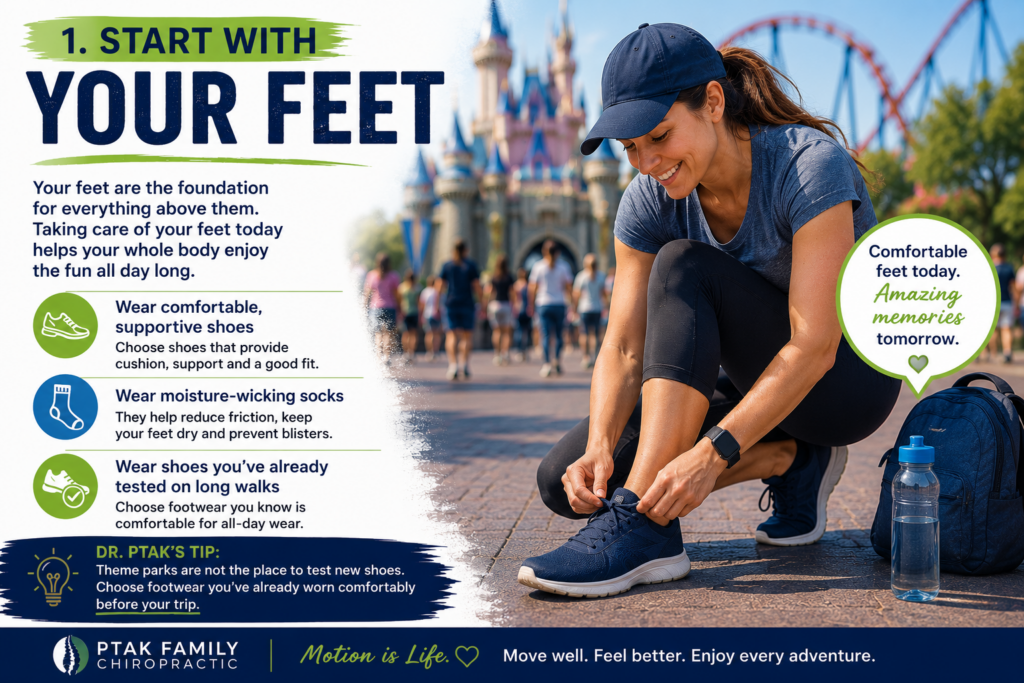
1. Start With Your Feet
Your feet are the foundation for everything above them.
If your feet become fatigued, eventually your knees, hips, and back often begin to suffer as well.
One of the biggest mistakes people make is wearing brand-new shoes to a theme park.
A theme park is not the place to break in footwear.
Choose shoes that:
Are comfortable
Provide support
Have already been broken in
Fit properly
Dr. Ptak’s Tip:
Moisture-wicking socks can help prevent blisters and keep your feet more comfortable throughout the day.
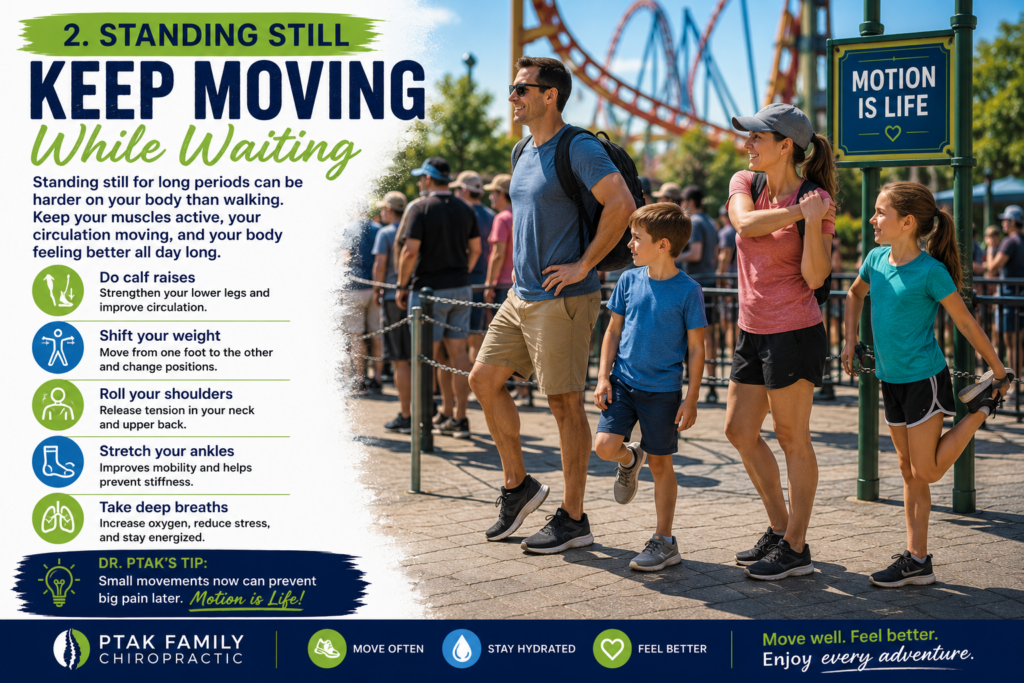
2. Standing Still Can Be Worse Than Walking
Most people assume the walking causes their pain.
Surprisingly, standing still for long periods is often harder on the body than walking.
When we stop moving:
Muscles tighten
Circulation slows
Joints stiffen
Fatigue increases
While standing in line:
Do calf raises
Shift your weight
Roll your shoulders
Stretch your ankles
Take several deep breaths
Motion is Life.
Small movements can make a big difference by the end of the day.
3. Lighten the Load
Backpacks have a way of getting heavier as the day goes on.
Many families carry:
Water bottles
Sweatshirts
Chargers
Snacks
Souvenirs
Electronics
Whenever possible:
Pack only what you need
Share the load
Alternate shoulders
Use lockers when available
Your neck and back will appreciate it.
Dr. Ptak’s Tip:
The lightest backpack is often the smartest backpack.
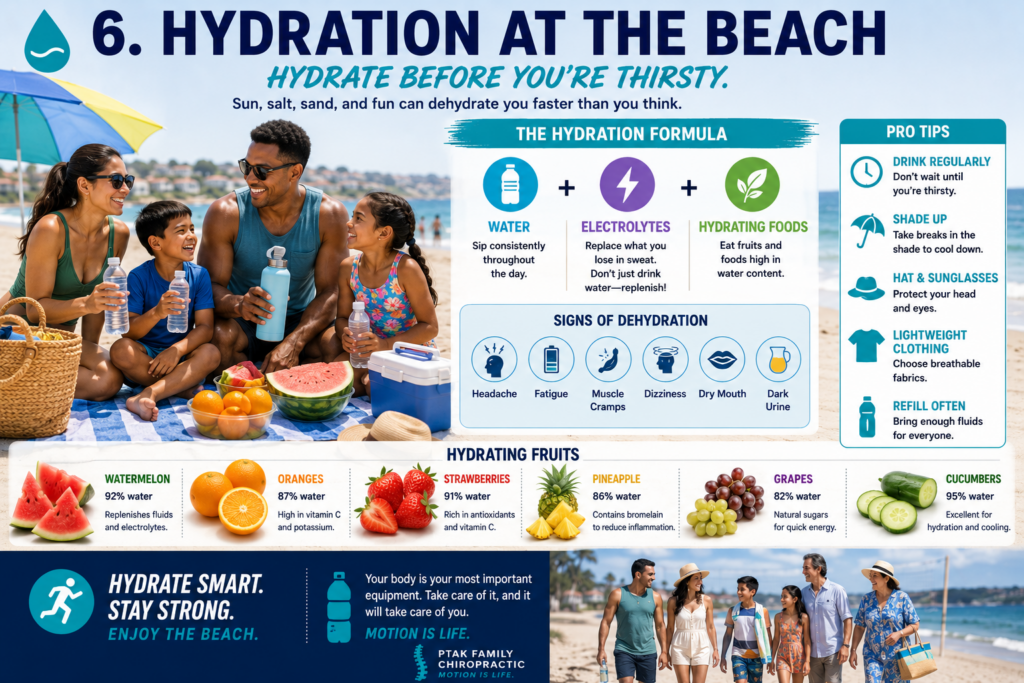
4. Stay Hydrated Before You’re Thirsty
Heat, excitement, walking, and long hours outdoors increase your body’s need for water.
Many people wait until they’re thirsty before drinking.
Unfortunately, thirst is often a late sign.
Try to drink water consistently throughout the day.
Watch for signs of dehydration:
Headaches
Fatigue
Muscle cramps
Dizziness
Reduced energy
For a deeper discussion, be sure to read our Summer Hydration Guide and Hydrating Foods Checklist.
Dr. Ptak’s Tip:
Drink before you’re thirsty.
5. Look Up and Enjoy the Day
Many visitors spend hours looking down at:
Phones
Park maps
Text messages
Ride wait times
The farther the head moves forward, the more stress is placed on the muscles and joints of the neck.
Instead:
Bring your phone up toward eye level
Take posture breaks
Look up and enjoy your surroundings
The attraction is in front of you—not on your phone.
6. Protect Your Back While Carrying Children
Every parent knows what happens around mid-afternoon.
The children who were sprinting through the park at 9 a.m. suddenly become exhausted.
Now someone has to carry them.
When lifting children:
Bend your knees
Keep them close to your body
Avoid twisting
Alternate sides frequently
Dr. Ptak’s Tip:
If you have a stroller, use it longer than you think you’ll need it.
Your back may thank you.
7. Recovery Starts Before Bed
Most people finish a theme park day and immediately collapse into bed.
Instead, spend five minutes helping your body recover.
Try:
A short walk
Gentle stretching
Extra hydration
Deep breathing
A warm shower
The better you recover tonight, the better you’ll feel tomorrow.
Dr. Ptak’s Theme Park Survival Checklist
Before You Leave
✅ Wear supportive shoes
✅ Wear moisture-wicking socks
✅ Stretch for five minutes
✅ Pack light
✅ Bring water
✅ Apply sunscreen
During The Day
✅ Keep moving in line
✅ Stay hydrated
✅ Alternate shoulders when carrying bags
✅ Keep your phone at eye level
✅ Take posture breaks
Before Bed
✅ Walk for five minutes
✅ Stretch your calves and hips
✅ Drink water
✅ Get a good night’s sleep
Dr. Ptak’s Theme Park Challenge
Every time you stop in line:
✅ Do 10 calf raises
✅ Roll your shoulders
✅ Stretch your ankles
✅ Take 5 deep breaths
These tiny habits can make a remarkable difference over the course of a long day.
Final Thoughts
Theme parks are supposed to create memories.
Not back pain.
Not neck pain.
Not sore feet.
A little preparation, movement, hydration, and recovery can help keep your body functioning at its best throughout your summer adventures.
Protect your feet.
Stay hydrated.
Keep moving.
Recover well.
And most importantly, enjoy the day.
Remember:
Motion is Life.
The more you move, the better your body tends to feel.
Ptak Family Chiropractic
Santa Monica, California
Helping individuals and families improve their health through movement, posture, spinal health, and nervous system function.
For years, healthcare professionals have warned us about the physical consequences of spending hours each day looking down at phones, tablets, computers, and gaming devices.
Those concerns are real.
In a recent Fortune article, spine surgeon Dr. Michael Gerling warned that today’s children and young adults may be heading toward a future healthcare crisis driven by excessive screen use, poor posture, chronic neck problems, and long-term spinal degeneration.
Many healthcare professionals share those concerns.
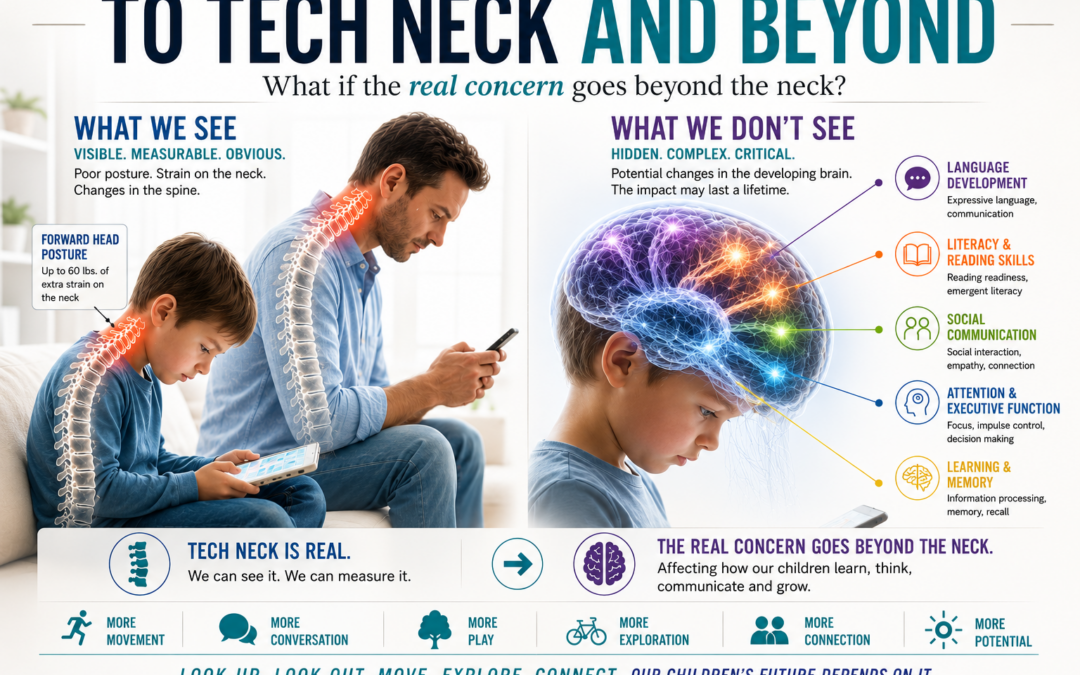
But what if Tech Neck is far more unhealthy than we ever imagined?
What if the greatest health concern isn’t the strain placed upon the muscles, ligaments, joints, discs, and nerves of the neck?
What if the real concern is what excessive screen exposure may be doing to the developing brains of our children?
Because while we can easily see poor posture, we cannot see what may be happening inside the brain.
And that may be the bigger story.
We Know Tech Neck Is Real
The mechanical consequences of Tech Neck are not difficult to understand.
The human head weighs approximately 10 to 12 pounds when balanced properly over the shoulders.
As the head moves forward, the forces experienced by the neck increase dramatically.
Muscles work harder.
Ligaments experience greater stress.
Joints experience greater compression.
The spine adapts.
Over time, those adaptations may contribute to neck pain, headaches, muscle tension, reduced mobility, and increased stress on spinal discs and joints.
Decades ago, neurosurgeon Alf Breig demonstrated how loss of normal spinal alignment could increase mechanical tension throughout the spinal cord and central nervous system.
His work reinforced an important principle:
Structure influences function.
For chiropractors, this conversation is not new.
For more than a century, chiropractic has focused on the relationship between structure and function—how the body’s physical adaptations influence the nervous system’s ability to communicate, coordinate, and adapt.
Long before the term Tech Neck existed, chiropractors were concerned with the effects of poor posture, reduced movement, and chronic stress on the developing body.
Yet perhaps posture is only the visible part of the story.
A Different Kind of Health Concern
For years, the conversation surrounding Tech Neck focused primarily on posture.
That made sense.
Poor posture is visible.
Parents can see it.
Doctors can measure it.
X-rays can document it.
The developing brain is much harder to see.
Recent MRI research involving healthy children between the ages of three and five years old identified associations between higher screen exposure and differences in white matter organization within regions of the brain involved in language, literacy, and communication.
Think about that.
Not when these children become adults.
Not twenty years from now.
Today.
During one of the most important periods of neurological development.
White matter functions as the communication network of the brain. It helps different regions communicate efficiently with one another and plays a critical role in learning, language development, reading readiness, and information processing.
Researchers also reported associations between higher screen exposure and lower performance in areas related to:
Expressive language
Rapid naming
Emergent literacy skills
These findings do not prove that screens directly cause these changes.
However, they raise important questions that deserve serious consideration.
Have we underestimated the health consequences of excessive screen exposure?
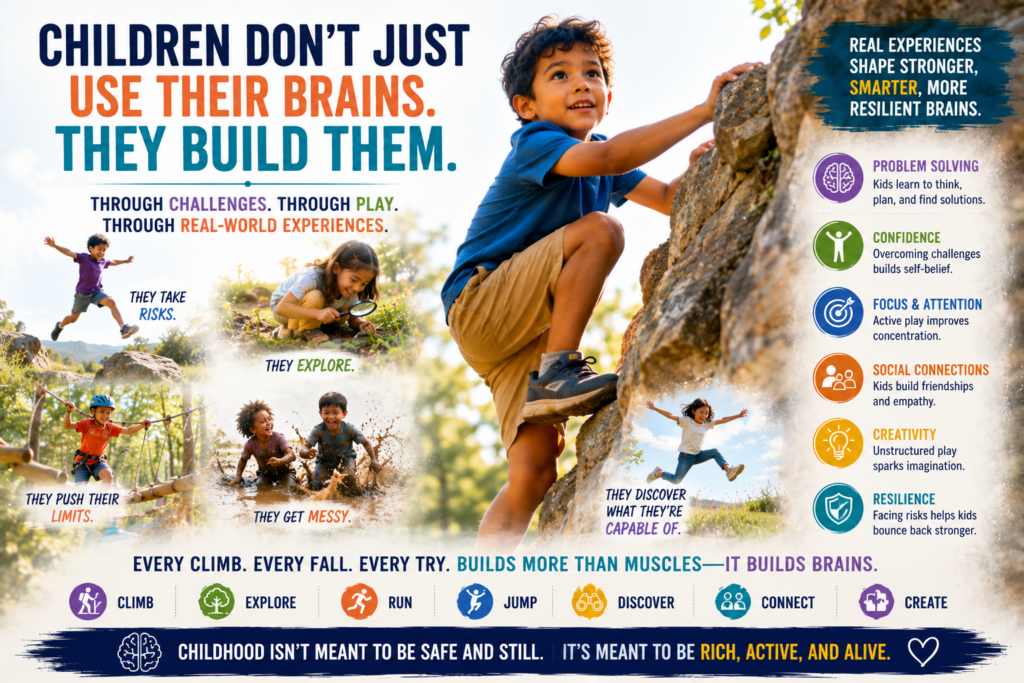
Children Don’t Just Use Their Brains. They Build Them.
This may be the most important concept in this entire discussion.
Children do not simply use their brains.
They build them.
Every movement provides information to the developing nervous system.
Every challenge provides information.
Every conversation provides information.
Every interaction provides information.
Every experience helps shape the architecture of the developing brain.
Movement is not simply exercise.
Movement is brain development.
This understanding aligns closely with a principle chiropractors have emphasized for generations:
The nervous system develops and adapts in response to the information it receives.
Movement provides information.
Balance provides information.
Gravity provides information.
Experience provides information.
The developing brain is constantly learning from the environment it is exposed to.
The human nervous system was not designed to develop primarily through a screen.
It was designed to develop through life itself.
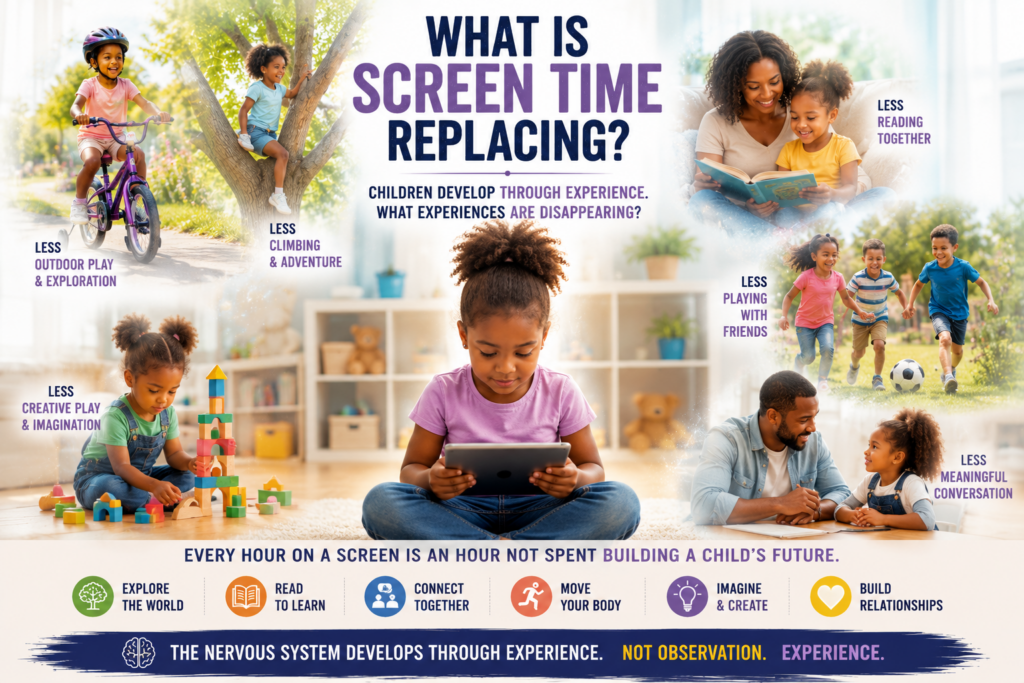
The Question Few Parents Are Asking
Most conversations about screen time focus on what children are watching.
Perhaps the more important question is:
What are children no longer doing?
When screen time increases, what experiences are being displaced?
Less conversation.
Less reading.
Less storytelling.
Less imaginative play.
Less climbing.
Less balancing.
Less running.
Less jumping.
Less exploring.
Less face-to-face interaction.
Less opportunity to engage with the physical world.
A tablet can provide information.
A screen can provide entertainment.
But neither can replace the experiences through which children develop.
The nervous system develops through experience.
Not observation.
Experience.
The Consequences May Already Be Here
The concern is not that today’s children may experience problems decades from now.
The concern is that some consequences may already be appearing.
Language delays.
Reading readiness concerns.
Attention challenges.
Reduced physical activity.
Poor posture.
Less social interaction.
Fewer opportunities for healthy neurological development.
The body and brain adapt long before they complain.
That has always been true.
What we repeatedly do becomes what we eventually become.
That principle applies to muscles.
It applies to posture.
And it applies to the brain.
This Is Not About Fear
Technology is not the enemy.
Technology has transformed communication, education, and access to information.
The goal is not eliminating screens.
The goal is balance.
Children need technology.
But they also need movement.
They need conversation.
They need creativity.
They need exploration.
They need outdoor experiences.
They need physical challenges.
They need human connection.
Most importantly, they need opportunities to experience the world rather than simply observe it.
Why This Matters To Us
At Ptak Family Chiropractic, we have spent nearly four decades helping people understand a simple truth:
The body adapts.
The nervous system adapts.
The question is not whether adaptation is occurring.
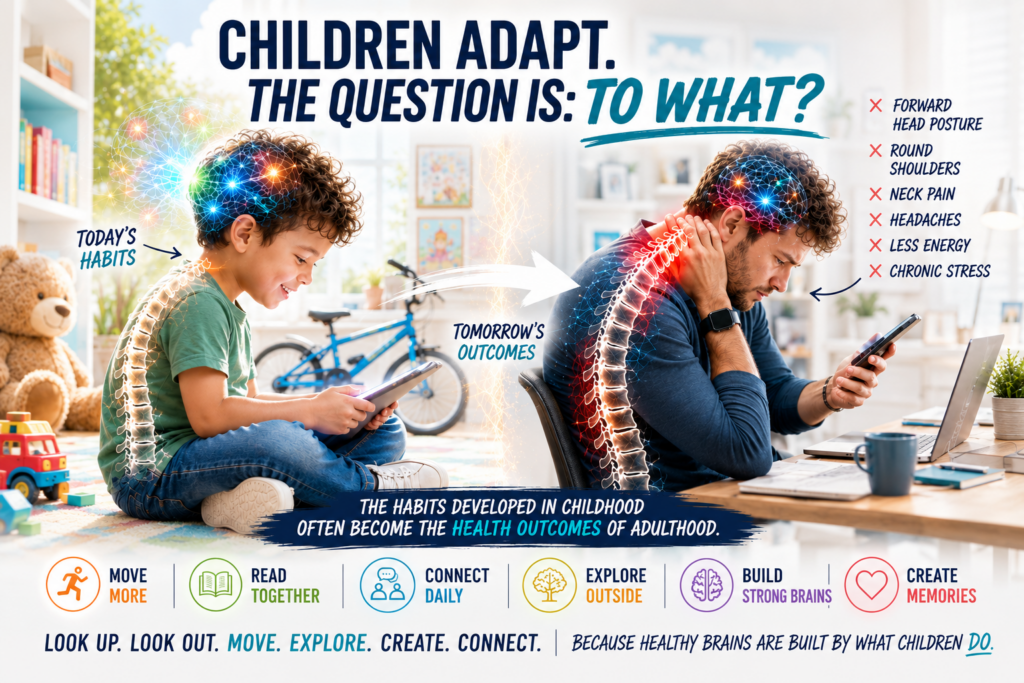
The question is:
What are we adapting to?
For years, we have encouraged our patients to move more, sit less, improve posture, strengthen healthy habits, and engage more fully with the world around them.
Today, those conversations feel more important than ever.
Because this discussion is no longer simply about neck pain.
It is no longer simply about posture.
It is about the future health and development of our children.
It is about preserving the experiences that help build healthy brains, healthy bodies, and healthy human beings.
As chiropractors, we cannot replace outdoor play.
We cannot replace reading.
We cannot replace imagination, creativity, movement, exploration, and meaningful human connection.
But we can help families understand how posture, movement, spinal health, and nervous system function contribute to overall well-being.
We can help identify unhealthy adaptations before they become larger problems.
And we can continue encouraging children and adults alike to spend more time experiencing life and less time merely observing it.
The future health of our children will not be determined by a single adjustment, a single exercise, or a single decision.
It will be shaped by thousands of daily choices.
Choices to move.
Choices to explore.
Choices to create.
Choices to connect.
Choices to look up.
Choices to look out.
If you are concerned about your child’s posture, screen habits, movement patterns, spinal health, or overall development, we invite you to schedule a consultation with our office.
Together, we can help create an environment that supports healthy growth, healthy adaptation, and a healthier future.
Because healthy brains are not built only by what children watch.
Healthy brains are built by what children do.
And that future begins today.
References
Gerling M. The “Tech Neck” Time Bomb: Why 43 Million Young Americans Could Cripple U.S. Health Care Within a Generation. Fortune. June 24, 2026.
Breig A. Adverse Mechanical Tension in the Central Nervous System. Almqvist & Wiksell International.
Hutton JS, Dudley J, Horowitz-Kraus T, DeWitt T, Holland SK. Associations Between Screen-Based Media Use and Brain White Matter Integrity in Preschool-Aged Children. JAMA Pediatrics. 2020;174(1).
Madigan S, McArthur BA, Anhorn C, Eirich R, Christakis DA. Associations Between Screen Use and Child Language Skills: A Systematic Review and Meta-analysis. JAMA Pediatrics. 2020.
Hutton JS, Horowitz-Kraus T, Mendelsohn AL, DeWitt T, Holland SK. Home Reading Environment and Brain Activation in Preschool Children Listening to Stories. Pediatrics. 2015.
American Academy of Pediatrics. Media and Young Minds. Pediatrics. 2016.
World Health Organization. Guidelines on Physical Activity, Sedentary Behaviour and Sleep for Children Under 5 Years of Age. 2019.
Christakis DA. Interactive Media Use at Younger Than the Age of 2 Years: Time to Rethink the American Academy of Pediatrics Guideline? JAMA Pediatrics. 2014.
Tamana SK, Ezeugwu V, Chikuma J, et al. Screen Time Is Associated With Inattention Problems in Preschoolers: Results From the CHILD Birth Cohort Study. PLoS One. 2019.
Why Neck Pain, Back Pain, Headaches, and Sciatica Often Start Long Before Symptoms Appear
“Doctor, I woke up with neck pain.”
“My back suddenly went out.”
“I’ve never had this problem before.”
“I didn’t do anything.”
At Ptak Family Chiropractic in Santa Monica, we hear these statements every week.
And while the symptom may be new, I have learned something important during nearly 40 years in practice:
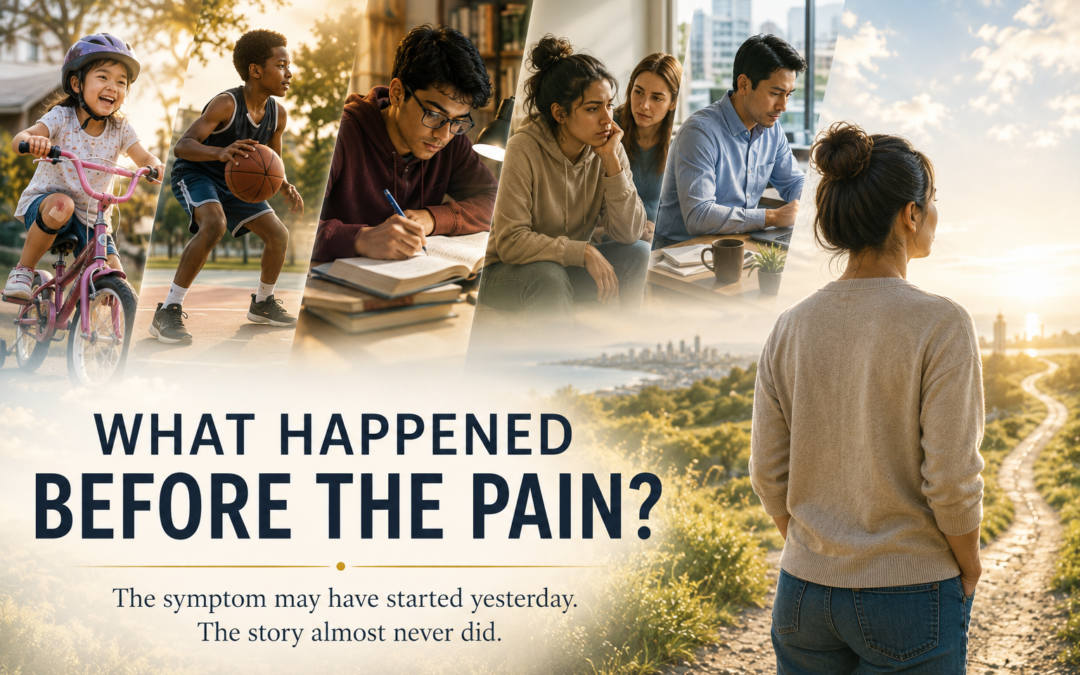
The symptom may have started yesterday. The story almost never did.
Most people believe pain is the beginning of a problem.
I often see pain as the announcement of a problem.
Whether someone is experiencing neck pain, back pain, headaches, sciatica, numbness, tingling, poor posture, or reduced mobility, the body has often been adapting long before the symptom finally appears.
“But I Didn’t Do Anything”
This may be the most common phrase I hear from new patients.
A person develops neck pain, low back pain, headaches, sciatica, shoulder pain, numbness, or tingling and when I ask what caused it, they often reply:
“Nothing.”
“I didn’t do anything.”
But as we continue talking, a different story begins to emerge.
Years of sports.
Years of stress.
Years of poor posture.
Years of sitting at a computer.
Years of looking down at phones and tablets.
Years of repetitive movements.
Years of adaptation.
Years of compensation.
Suddenly, “nothing” becomes a lifetime of experiences.
Why We Take a Health History
Most people think we are filling out paperwork.
We’re not.
We are trying to understand how the person sitting in front of us became the person sitting in front of us today.
That is why we ask about:
Childhood falls
Sports participation
Broken bones
Concussions
Car accidents
Ear infections
Breathing difficulties
Screen time
Occupation
Stress
Sleep
Previous injuries
Previous surgeries
Not because one event explains everything.
But because health is cumulative.
The symptom is one page. The history is the entire book.
Every Person Has a Health Biography
Think about your own life.
How many of these apply to you?
✓ Childhood falls
✓ Sports injuries
✓ Broken bones
✓ Car accidents
✓ Long hours sitting
✓ Desk work
✓ Poor posture
✓ Excessive screen time
✓ Stress
✓ Poor sleep
✓ Repetitive work activities
✓ Previous surgeries
Every experience leaves an imprint.
Every experience becomes part of your health story.
Every experience requires adaptation.
The body keeps adapting until one day it cannot adapt quite enough.
The Young Athlete
Many parents proudly tell me:
“My child is healthy.”
And often they are.
But healthy does not mean untouched.
Think about the average young athlete.
Years of soccer.
Baseball.
Basketball.
Tennis.
Running.
Karate.
Dance.
Cheerleading.
Gymnastics.
Volleyball.
Every practice.
Every game.
Every sprint.
Every jump.
Every fall.
Every repetition teaches the nervous system.
Every repetition shapes posture.
Every repetition creates adaptation.
The body becomes very efficient at doing exactly what it practices.
The question is not whether the body adapted.
The question is whether those adaptations are still serving the athlete years later.
The Modern Childhood Experiment
Today’s children are growing up in a world unlike any previous generation.
Many spend hours every day:
Looking down at phones
Using tablets
Playing video games
Watching screens
Sitting indoors
At the same time, many participate in competitive sports year-round.
Others struggle with:
Poor posture
Sleep issues
Breathing problems
Picky eating habits
Every experience influences development.
Every experience shapes adaptation.
Every experience becomes part of the story.
Why We Understand This for Teeth but Not for the Rest of the Body
Nobody believes a cavity begins the day it hurts.
People understand:
Cavities develop before pain
Gum disease develops before pain
Alignment problems develop before pain
That is why people schedule dental checkups.
That is why people get X-rays.
That is why parents invest years in braces.
Because they understand something important:
The absence of pain is not proof of health.
Yet many people use a completely different standard for their spine, posture, nervous system, and overall health.
“If it doesn’t hurt, it must be fine.”
Why?
The Check Engine Light
Imagine driving your car and suddenly the check engine light comes on.
You have two choices.
Investigate it.
Or ignore it.
Most of us would never cover the light and pretend everything is fine.
Yet many people do exactly that with their health.
The headache improves.
The neck pain decreases.
The sciatica settles down.
The numbness goes away.
And they assume the problem has been solved.
But symptoms are often messages.
Signals.
Warnings.
Information.
The purpose of the warning light is not to annoy you. It is to get your attention.
Why People Wait
Over the years, I have heard nearly every reason imaginable.
I thought it would go away.
I was too busy.
I was trying to save money.
I don’t have health insurance.
My insurance doesn’t cover chiropractic.
I thought it was stress.
I thought it was my mattress.
I thought I was getting older.
I didn’t think it was serious.
Most people do not delay because they don’t care.
They delay because life gets in the way.
Unfortunately, the body does not pause while we sort out our schedules, finances, or insurance coverage.
The body continues adapting.
Compensating.
Recovering.
Breaking down.
Healing.
Every single day.
The body follows biology, not insurance policies.
Most People Are Experiencing an Acute Episode on Top of a Chronic Pattern
This may be one of the most important lessons I have learned in practice.
A patient bends over to tie a shoe.
Reaches for a coffee cup.
Turns their head while driving.
Picks up a grocery bag.
And suddenly they are in pain.
The shoe wasn’t the problem.
The coffee cup wasn’t the problem.
The grocery bag wasn’t the problem.
They were simply the final straw.
Most people are experiencing an acute episode on top of a chronic pattern.
The symptom appears when the body’s ability to compensate finally reaches its limit.
Symptoms Are Usually the Last Thing to Appear
Most people think symptoms are the problem.
I often think symptoms are the announcement.
What usually comes first?
✓ Stress
✓ Adaptation
✓ Compensation
✓ Dysfunction
✓ Symptoms
By the time symptoms appear, the body may have been adapting for months, years, or even decades.
Symptoms are often the last thing to appear.
The Question That Matters Most
Most people ask:
“What caused my neck pain?”
“What caused my back pain?”
“Why do I have headaches?”
A better question might be:
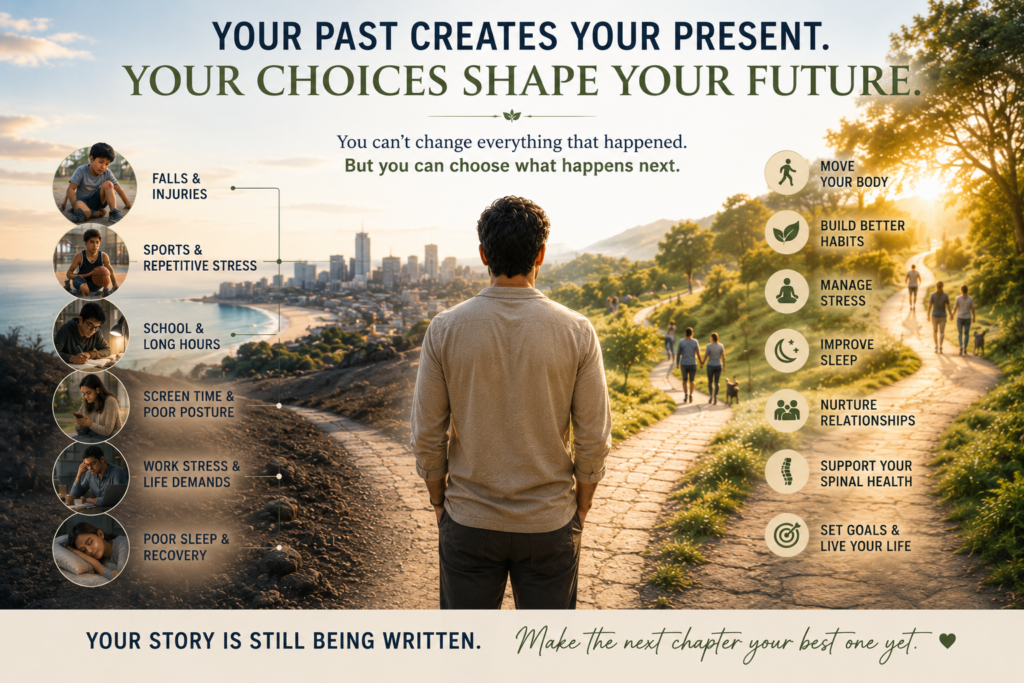
“What has my body been adapting to throughout my life?”
Falls.
Sports.
Stress.
Screens.
Work.
School.
Injuries.
Poor posture.
Sleep habits.
Life.
Some adaptations help us thrive.
Others quietly become limitations.
What Happened Before the Pain?
That is the question.
Not:
“What hurts?”
But:
“What happened before the pain?”
Because your body has been adapting since the day you were born.
The question is not whether your body has adapted.
The question is:
How well is your body functioning today because of those adaptations?
Is It Time To Learn Your Story?
Whether you are 18 or 80, your body has been keeping score.
The falls.
The injuries.
The sports.
The stress.
The screens.
The sleepless nights.
The long workdays.
The countless adaptations that allowed you to keep moving forward.
Some of those adaptations have served you well.
Others may now be limiting your health, posture, mobility, energy, performance, or quality of life.
After nearly 40 years in practice, I have heard thousands of patients say:
“I wish I had come in sooner.”
What I almost never hear is:
“I wish I had waited another six months.”
You only get:
One body.
One spine.
One nervous system.
One life.
If you are experiencing neck pain, back pain, headaches, sciatica, stiffness, numbness, balance problems, reduced mobility, poor posture, or simply feel your body is not functioning the way it once did, perhaps it is time to look beyond the symptom.
And even if you are not currently in pain, ask yourself:
How well am I really functioning?
What adaptations has my body made over the years?
Are those adaptations helping me or limiting me?
What would a thorough evaluation reveal?
What if the symptom that brought you into our office is only the tip of the iceberg?
And what if understanding the rest of the story changes the trajectory of your health for years to come?
At Ptak Family Chiropractic, we take the time to understand your history, your health story, and the factors that may be influencing how your body functions today.
The sooner you understand your story, the sooner you can begin writing the next chapter.
Call Ptak Family Chiropractic today to schedule a comprehensive health and spinal evaluation.
You may discover that what brought you into the office is only part of the story.
And understanding the rest of the story may be one of the most important investments you ever make in your health.
And understanding the rest of the story may be one of the most important investments you ever make in your health