Talking to a child about their weight can feel overwhelming. Every parent wants to protect their child, but the words we choose can either build confidence or unintentionally create shame.
Today, childhood obesity remains a significant health concern. According to the CDC, nearly 1 in 5 children and adolescents in the United States lives with obesity. At the same time, children are growing up in an environment filled with highly processed foods, sugary drinks, endless screen time, and constant social media messages about appearance. It’s no wonder so many families struggle.
The good news? Healthy change begins with connection—not criticism.
The Goal Isn’t Weight. It’s Health.
One of the biggest mistakes adults make is focusing on the number on the scale.
Children rarely need to be told they are overweight. Most already know. Many have experienced teasing at school, comparisons on social media, or hurtful comments from others. Adding more attention to their weight often increases feelings of shame, anxiety, and low self-esteem rather than motivating positive change.
Instead of asking, “How do we get my child to lose weight?” try asking:
“How do we help our family become healthier together?”
That simple shift changes everything.
Shame Doesn’t Inspire Change
Research consistently shows that weight stigma and body shaming can actually make obesity worse.
Children who feel judged about their weight are more likely to:
Eat in secret or emotionally
Develop poor body image
Experience anxiety or depression
Avoid sports or physical activity
Carry unhealthy relationships with food into adulthood
Children thrive when they feel safe, accepted, and supported—not when they feel criticized.
Focus on Healthy Habits Instead of Appearance
Rather than talking about how your child looks, talk about how healthy habits help them:
Have more energy
Sleep better
Feel stronger
Think more clearly
Play longer
Recover faster
Build confidence
Health is something every child can work toward, regardless of what the scale says.
Small Changes Create Big Results
Families often believe they must completely overhaul their lifestyle overnight.
In reality, lasting change usually comes from small, consistent improvements.
Consider starting with simple goals such as:
Drinking more water and fewer sugary beverages
Adding one new fruit or vegetable each week
Taking a family walk after dinner
Limiting processed snacks in the home
Cooking more meals together
Reducing screen time before bed
Encouraging outdoor play every day
Children are far more likely to adopt healthy habits when they see their parents modeling them.
Make It a Family Lifestyle
One of the most powerful things parents can do is remove the spotlight from the child.
Avoid creating separate meals or singling one child out because of weight.
Instead, let the entire household embrace healthier choices together.
When healthy eating, movement, sleep, and stress management become “what our family does,” children don’t feel different—they simply grow up with healthier routines.
Celebrate the Child, Not Just Their Progress
Children need to know they are loved exactly as they are today.
Praise their kindness.
Celebrate their creativity.
Encourage their curiosity.
Recognize their effort—not just the outcome.
A child with strong self-esteem is often far more willing to try new things, stay active, and develop lifelong healthy habits.
Health Is More Than Food
A child’s health is influenced by many factors beyond calories, including:
Sleep quality
Physical activity
Stress levels
Emotional health
Family relationships
Time outdoors
Nervous system regulation
At Ptak Family Chiropractic, we also recognize the important role the nervous system plays in overall health. A well-functioning nervous system helps the body better adapt to physical, emotional, and environmental stressors, supporting healthier growth and development.
The Takeaway
Children need encouragement far more than judgment.
Instead of focusing on weight, focus on creating a home where healthy food, joyful movement, quality sleep, emotional support, and positive family habits become the norm.
The healthiest gift we can give our children isn’t simply a lower number on the scale—it’s helping them develop a lifelong relationship with health, confidence, and self-worth.
Ask the Doctor
If you have questions about your child’s health, posture, physical development, or how nervous system function may influence overall wellness, we’re here to help.
At Ptak Family Chiropractic, we believe every child deserves the opportunity to grow, thrive, and reach their fullest potential.
Years ago, scientists believed that our genes were like a permanent blueprint—something we inherited and simply had to live with.
Today we know the story is far more hopeful.
Research in the growing field of epigenetics suggests that life experiences—including significant trauma—may influence how certain genes are expressed. Even more fascinating, some of those changes may be passed from one generation to the next.
That sounds intimidating at first.
But there is another side to the story.
Just as difficult experiences can influence the nervous system, healthy experiences can help reshape it.
More Than Just Genetics
Studies involving families who survived major traumatic events, including the Holocaust, found differences in how stress-related genes were regulated in both survivors and their children.
Researchers believe trauma may leave biological “footprints” that influence future generations.
This does not mean someone is destined to experience anxiety, depression, or PTSD simply because a parent or grandparent experienced trauma.
Genes are not destiny.
They are possibilities.
Your environment, relationships, habits, mindset, and daily choices all influence how those genes are expressed.
That’s incredibly hopeful.
Your Nervous System Is Always Learning
One of the most amazing discoveries in neuroscience is that the brain remains adaptable throughout life.
This ability—called neuroplasticity—means your nervous system is constantly changing.
Every healthy habit sends your brain new information.
Movement.
Exercise.
Restorative sleep.
Healthy nutrition.
Positive relationships.
Prayer.
Meditation.
Breathing exercises.
Time in nature.
Learning new skills.
Chiropractic care that supports healthy nervous system function.
All of these experiences help teach the brain that it is safe, adaptable, and resilient.
Trauma Changes the Brain—But Healing Does Too
Traumatic experiences can alter how the brain processes stress.
Certain areas involved with fear, memory, and emotional regulation may become overactive or less efficient, leaving someone feeling constantly “on guard.”
People may notice:
• Increased anxiety
• Difficulty sleeping
• Heightened sensitivity to noise or crowds
• Emotional ups and downs
• Trouble concentrating
• Feeling constantly overwhelmed
• A persistent sense that something is wrong, even when life is going well
These are not signs of weakness.
They are signs of a nervous system that has adapted to survive.
The encouraging news is that the brain can continue adapting in healthier directions.
Healing Doesn’t Just Help You
When you begin caring for your nervous system, you may also be changing the environment your children and grandchildren experience.
Children learn far more from what we model than from what we say.
Calm creates calm.
Resilience teaches resilience.
Connection builds connection.
Every healthier choice has the potential to influence future generations—not just through biology, but through everyday life.
In many ways, healing can become just as contagious as trauma.
Where Chiropractic Fits In
At Ptak Family Chiropractic, we often remind patients that our goal isn’t simply to help someone feel better.
Our goal is to help their nervous system function better.
A well-regulated nervous system is better able to adapt to physical, emotional, and chemical stress.
While chiropractic care is not a treatment for PTSD or mental health disorders, supporting healthy nervous system function may be one important piece of a much bigger picture that also includes movement, nutrition, quality sleep, counseling when appropriate, healthy relationships, and meaningful purpose.
Healing rarely comes from one thing.
It comes from many small, consistent choices that move us toward greater health.
The Better Question
Instead of asking,
“What did I inherit?”
Perhaps a better question is,
“What am I choosing to pass on?”
Because while we may not choose the experiences that shaped our past, we have tremendous influence over the habits, beliefs, health, and hope we pass to the next generation.
The story of your family does not have to end where it began.
If this article resonates with you, or if you’ve been wondering whether your nervous system could be playing a role in your health challenges, we’d love to help.
At Ptak Family Chiropractic, we believe healing begins with understanding. Whether you’re struggling with chronic pain, stress, tension, headaches, fatigue, or simply want to function at your best, our team is here to listen, answer your questions, and help you explore your options.
You don’t have to figure it out alone.
Call our office to schedule a consultation, or simply stop by and ask us your questions. There is never any obligation—just an opportunity to learn more about your health and the incredible ability of the human body to heal and adapt.
Your future isn’t written by your past. Every step toward better health is a step toward changing your story—and perhaps the story of generations to come.
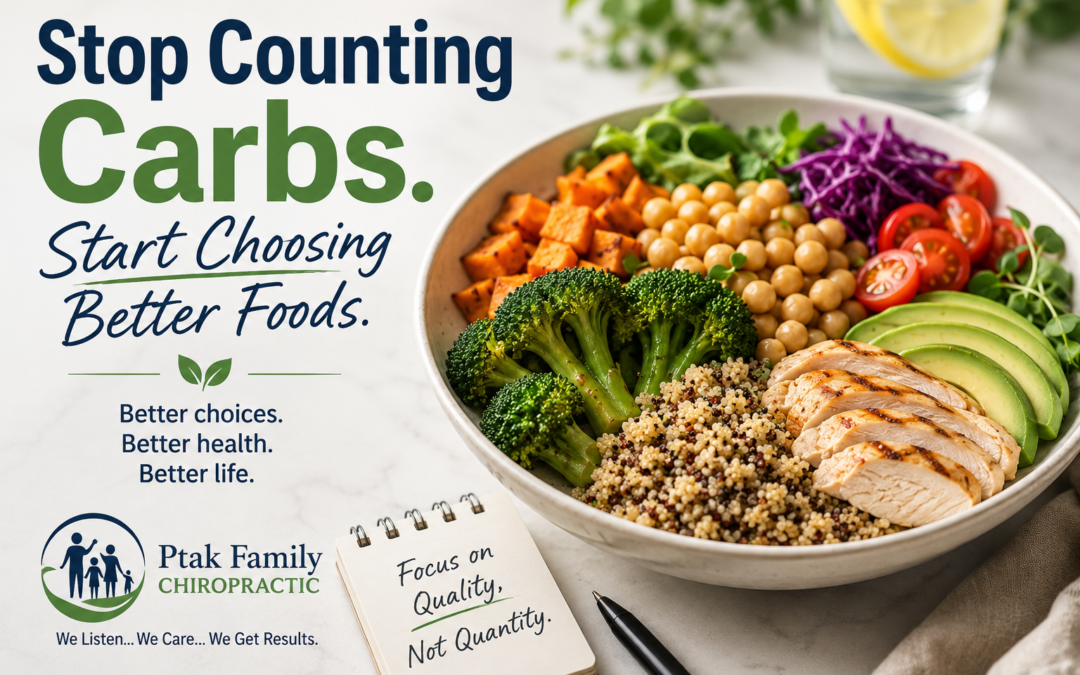
Walk through any grocery store or scroll through social media, and you’ll hear endless advice about carbohydrates.
“Cut the carbs.”
“Count your carbs.”
“Go low-carb.”
“No carbs after 6 PM.”
It’s no wonder so many people feel confused.
But what if we’ve been asking the wrong question?
Instead of asking…
“How many carbohydrates should I eat?”
A better question is…
“What kind of carbohydrates am I eating?”
That one simple shift changes everything.
Not All Carbohydrates Are the Same
Carbohydrates are your body’s preferred source of energy. Your brain, muscles, and many organs rely on them every day.
The goal isn’t to avoid carbohydrates.
The goal is to choose carbohydrates that work with your body instead of against it.
Nature already figured this out.
Whole foods package carbohydrates together with fiber, water, vitamins, minerals, and plant nutrients. That natural combination slows digestion, provides lasting energy, and helps your body regulate blood sugar more effectively.
Highly processed foods often remove much of that natural packaging. Fiber is stripped away, sugars and refined starches become more concentrated, and the result is food that’s easier to overeat while offering less nutritional value.
Think About the Original Ingredient
Here’s a simple exercise.
When you pick up a food, ask yourself:
“Does this still look like the food it originally came from?”
An apple still looks like an apple.
A sweet potato still looks like a sweet potato.
Oats still look like oats.
Beans still look like beans.
The farther food moves away from its natural form, the more processing it has typically undergone. While processing isn’t always bad, heavily processed foods often contain added sugars, refined grains, excess sodium, and unhealthy fats that can make it harder to maintain steady energy and good health.
Build Meals That Work for You
Rather than focusing on what to eliminate, focus on what to include.
Fill your plate with foods such as:
• Colorful vegetables
• Fresh fruits
• Beans and legumes
• Whole grains like oats, quinoa, and brown rice
• Nuts and seeds
• Lean proteins
• Healthy fats like avocados and olive oil
Combining carbohydrates with protein, healthy fats, and fiber can help you feel fuller longer and promote steadier blood sugar throughout the day.
Why Quality Matters
When meals are built primarily from whole, minimally processed foods, many people experience meaningful changes.
They often notice:
• More consistent energy
• Fewer afternoon crashes
• Reduced cravings
• Better digestion
• Improved concentration
• Easier weight management
• Better long-term metabolic health
These benefits don’t happen because one food is “magic.”
They happen because your body is receiving the nutrients it was designed to use.
Forget Perfection
Healthy eating isn’t about never enjoying dessert or avoiding every slice of pizza.
It’s about what you do most of the time.
Every meal is simply another opportunity to make a choice that supports your health.
Small improvements repeated consistently are far more powerful than short-lived, extreme diets.
Better Questions Create Better Health
At Ptak Family Chiropractic, we believe lasting health begins with better questions.
Instead of asking…
“How many carbs can I eat?”
Try asking…
“How can I nourish my body today?”
That question naturally leads to better choices.
And better choices, repeated over days, months, and years, create remarkable results.
Your body is always listening to what you feed it.
Choose foods that help it thrive.
Because better choices create better health.
And better questions create better lives.
Ask the Doctor
Nutrition doesn’t have to be confusing.
If you’ve tried diet after diet, counted every calorie or carb, and still don’t feel your best, it may be time to stop chasing quick fixes and start building lasting habits that support your health.
At Ptak Family Chiropractic, we believe better health comes from making better choices one meal, one habit, and one day at a time. While no single food is a cure-all, nourishing your body with whole, nutrient-rich foods is one of the greatest investments you can make in your future.
If you have questions about nutrition, inflammation, healthy living, or how your nervous system and lifestyle work together to influence your health, we’d love to help. Ask us at your next visit, give our office a call, or stop by and say hello.
Your body is always listening to the choices you make. Feed it well, move it often, care for it consistently, and it will often reward you in remarkable ways.
Do I believe in prayer, meditation, movement, gratitude, purpose, and the remarkable ability of the human body to heal?
Every single day.
But after more than forty years of caring for people, I’ve realized something even more important.
Health isn’t something we find.
It’s something we create.
Not in one dramatic moment. Not through one miracle treatment. Not with one perfect diet.
We create it through thousands of seemingly ordinary choices.
Every meal. Every thought. Every breath. Every night’s sleep. Every walk. Every act of forgiveness. Every time we choose hope instead of fear.
The quality of our lives is often a reflection of the quality of these daily decisions.
People frequently ask me for the secret.
There isn’t one.
There are simply principles that have stood the test of time.
Not because someone told me they work…
But because I’ve watched them change lives—including my own.
The Principles I Continue to Practice
Choose real food whenever possible. The closer your food looks to the way nature created it, the better chance your body has to recognize and use it.
Love generously—including yourself. The relationship you have with yourself becomes the foundation for every other relationship in your life.
Keep growing. Your fears, habits, and old stories don’t disappear on their own. They become invitations to grow beyond who you’ve been.
Laugh often. Joy isn’t a distraction from healing. Sometimes it’s part of the healing.
Do meaningful work. Purpose gives energy to the body in ways that caffeine never will.
Move every day. Your body was designed for motion, not storage.
Drink water. Your body depends on it more than most people realize.
Create moments of stillness. Whether you pray, meditate, breathe deeply, journal, or simply sit quietly, give yourself time to reconnect with the part of you that never left.
Never stop learning. The most interesting people I’ve met remain students for life.
Listen to your body. Symptoms aren’t your enemy. Often they’re your body’s way of asking for your attention before something bigger develops.
Be mindful of what you consume. Not only food, but media, conversations, relationships, and thoughts. Everything you repeatedly expose yourself to shapes who you become.
Take care of your nervous system. Your brain and nervous system coordinate every function in your body. When communication improves, your body has a better opportunity to adapt, heal, and thrive. That’s one reason regular chiropractic care has remained part of my own life for decades.
The Goal Isn’t Perfection
You won’t do these things perfectly.
Neither will I.
Life happens.
We’ll have stressful weeks. We’ll eat things we shouldn’t. We’ll skip workouts. We’ll lose our patience. We’ll forget what matters.
The goal has never been perfection.
The goal is simply to return.
To make one better choice today than yesterday.
Because abundance isn’t something that suddenly arrives one day.
It’s something we quietly build…
Choice by choice.
Day by day.
Life by life.
Innately Yours,
Dr. Jeffrey Ptak, DC, DSS, MSS, MA
Ask Dr. Ptak
Health isn’t built in a single day, and neither are the questions that matter most.
If something in this article resonated with you, or if you’re wondering how these principles apply to your own health, we’d love to hear from you.
Whether you’re dealing with pain, low energy, stress, balance problems, or simply want to stay healthy and active for years to come, we’re here to help.
Call Ptak Family Chiropractic to schedule a consultation or simply ask a question. Sometimes one conversation is all it takes to begin moving in a healthier direction.
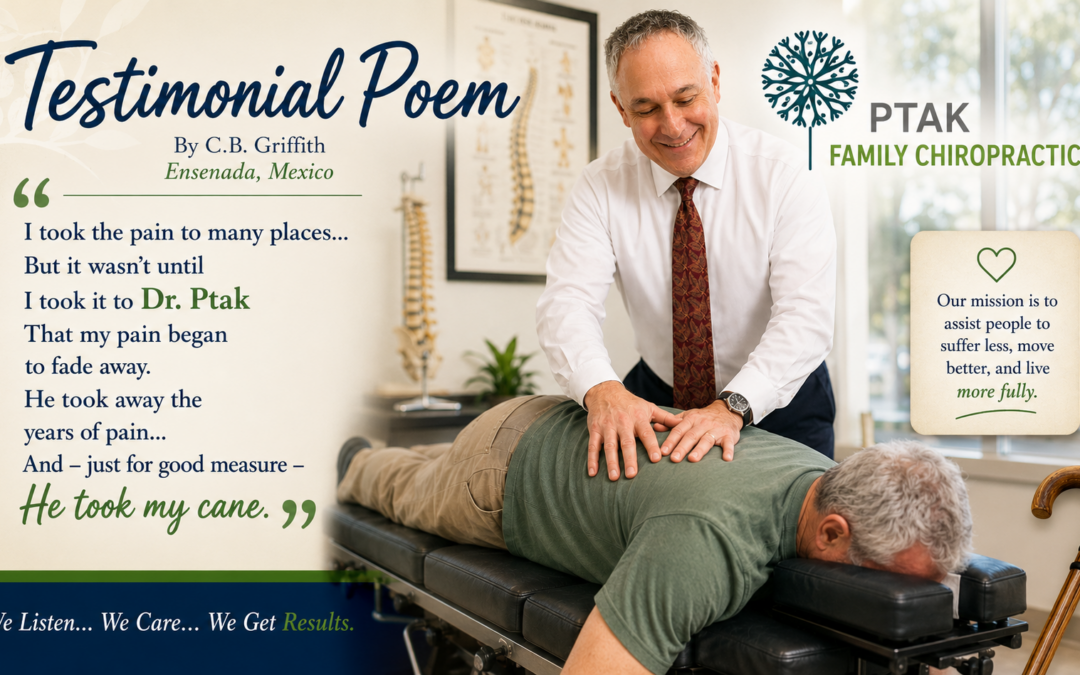
I took the pain to my HMO. They said, “Take two Tylenol and call us next year.” I took it to my orthopedist. He offered me two new hips for the price of one. I took it to my podiatrist. He trimmed my nails and gave me the boot. I took it to my neurologist. He got on my nerves.
I took it to my my dermatologist. He skinned me, but it didn’t go away. I took it to my herbalist. He handed me an acorn and said, “Eat this.” I took it to my acupuncturist. He stuck me for a couple hundred. I took it to my psychiatrist. He said it wasn’t in my leg, it was in my head. I took it to my proctologist. He just gave me a pain in the butt. I took it to my paleotantric faith healer. He didn’t believe me. I finally took it to Dr. Ptak, Who hooked me up to his leatherette rack, And just when I thought my bones would crack, He took away the years of pain. And – just for good measure – He took my cane



 Ptak Family Chiropractic
 (310) 473-7991
 ptakfamilychiropractic.com