Theme Parks, Water Parks, and Summer Back Pain: How to Survive a Day of Fun Without Paying for It Tomorrow

Theme Parks, Water Parks, and Summer Back Pain: How to Survive a Day of Fun Without Paying for It Tomorrow

Practical Tips to Protect Your Feet, Knees, Hips, Neck, and Back During Long Summer Days

Summer is here.

Families across the country are heading to Disneyland, Universal Studios, Knott’s Berry Farm, Six Flags, water parks, county fairs, festivals, and amusement parks of every kind.

Most people prepare for the crowds.

Most people prepare for the heat.

Most people prepare for the long lines.

What many people don’t prepare for is the physical stress that comes with spending an entire day on their feet.

By the end of the day, many visitors are dealing with:

  • Aching feet
  • Sore knees
  • Tight hips
  • Stiff necks
  • Low back pain
  • Exhaustion

The truth is that a single day at a theme park can place more physical stress on your body than an average work week.

Many visitors walk 15,000–25,000 steps in a single day while standing in lines, carrying backpacks, pushing strollers, lifting children, and navigating hot summer weather.

Fortunately, a little preparation can make a tremendous difference.

Let’s look at some simple ways to enjoy the memories without paying for them tomorrow.


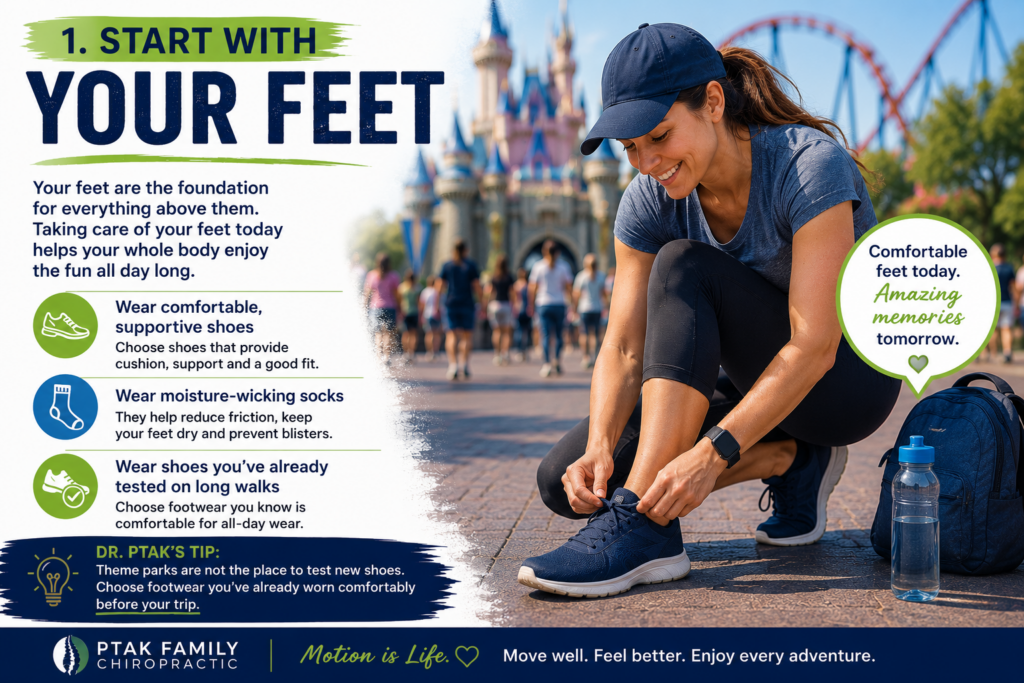
1. Start With Your Feet

Your feet are the foundation for everything above them.

If your feet become fatigued, eventually your knees, hips, and back often begin to suffer as well.

One of the biggest mistakes people make is wearing brand-new shoes to a theme park.

A theme park is not the place to break in footwear.

Choose shoes that:

  • Are comfortable
  • Provide support
  • Have already been broken in
  • Fit properly

Dr. Ptak’s Tip:

Moisture-wicking socks can help prevent blisters and keep your feet more comfortable throughout the day.


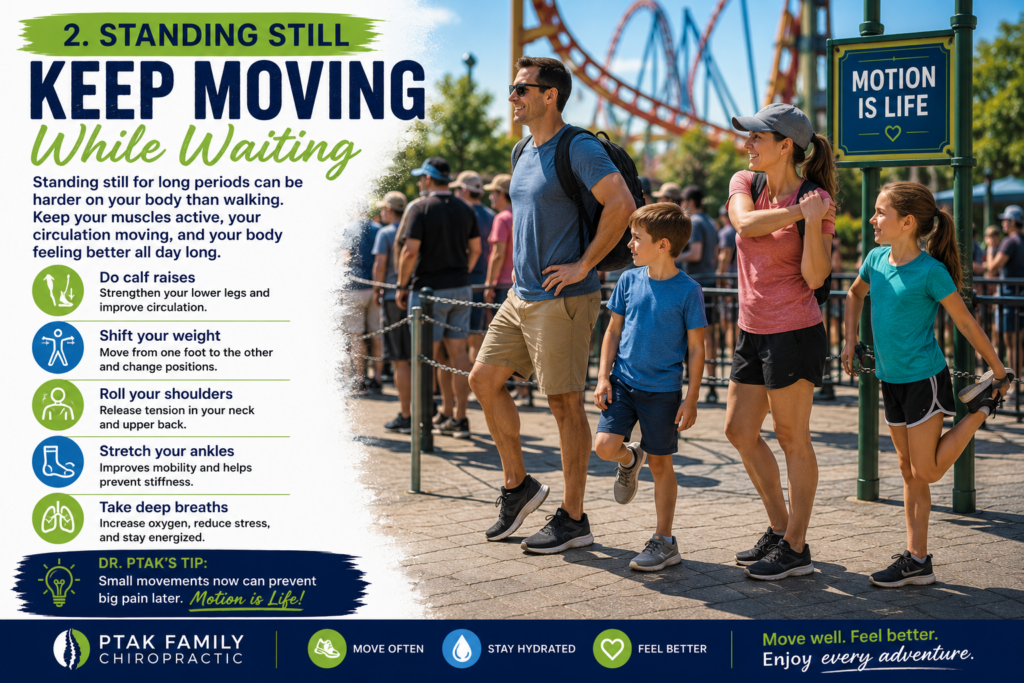
2. Standing Still Can Be Worse Than Walking

Most people assume the walking causes their pain.

Surprisingly, standing still for long periods is often harder on the body than walking.

When we stop moving:

  • Muscles tighten
  • Circulation slows
  • Joints stiffen
  • Fatigue increases

While standing in line:

  • Do calf raises
  • Shift your weight
  • Roll your shoulders
  • Stretch your ankles
  • Take several deep breaths

Motion is Life.

Small movements can make a big difference by the end of the day.


3. Lighten the Load

Backpacks have a way of getting heavier as the day goes on.

Many families carry:

  • Water bottles
  • Sweatshirts
  • Chargers
  • Snacks
  • Souvenirs
  • Electronics

Whenever possible:

  • Pack only what you need
  • Share the load
  • Alternate shoulders
  • Use lockers when available

Your neck and back will appreciate it.

Dr. Ptak’s Tip:

The lightest backpack is often the smartest backpack.


4. Stay Hydrated Before You’re Thirsty

Heat, excitement, walking, and long hours outdoors increase your body’s need for water.

Many people wait until they’re thirsty before drinking.

Unfortunately, thirst is often a late sign.

Try to drink water consistently throughout the day.

Watch for signs of dehydration:

  • Headaches
  • Fatigue
  • Muscle cramps
  • Dizziness
  • Reduced energy

For a deeper discussion, be sure to read our Summer Hydration Guide and Hydrating Foods Checklist.

Dr. Ptak’s Tip:

Drink before you’re thirsty.


5. Look Up and Enjoy the Day

Many visitors spend hours looking down at:

  • Phones
  • Park maps
  • Text messages
  • Ride wait times

The farther the head moves forward, the more stress is placed on the muscles and joints of the neck.

Instead:

  • Bring your phone up toward eye level
  • Take posture breaks
  • Look up and enjoy your surroundings

The attraction is in front of you—not on your phone.


6. Protect Your Back While Carrying Children

Every parent knows what happens around mid-afternoon.

The children who were sprinting through the park at 9 a.m. suddenly become exhausted.

Now someone has to carry them.

When lifting children:

  • Bend your knees
  • Keep them close to your body
  • Avoid twisting
  • Alternate sides frequently

Dr. Ptak’s Tip:

If you have a stroller, use it longer than you think you’ll need it.

Your back may thank you.


7. Recovery Starts Before Bed

Most people finish a theme park day and immediately collapse into bed.

Instead, spend five minutes helping your body recover.

Try:

  • A short walk
  • Gentle stretching
  • Extra hydration
  • Deep breathing
  • A warm shower

The better you recover tonight, the better you’ll feel tomorrow.


Dr. Ptak’s Theme Park Survival Checklist

Before You Leave

✅ Wear supportive shoes

✅ Wear moisture-wicking socks

✅ Stretch for five minutes

✅ Pack light

✅ Bring water

✅ Apply sunscreen

During The Day

✅ Keep moving in line

✅ Stay hydrated

✅ Alternate shoulders when carrying bags

✅ Keep your phone at eye level

✅ Take posture breaks

Before Bed

✅ Walk for five minutes

✅ Stretch your calves and hips

✅ Drink water

✅ Get a good night’s sleep


Dr. Ptak’s Theme Park Challenge

Every time you stop in line:

✅ Do 10 calf raises

✅ Roll your shoulders

✅ Stretch your ankles

✅ Take 5 deep breaths

These tiny habits can make a remarkable difference over the course of a long day.


Final Thoughts

Theme parks are supposed to create memories.

Not back pain.

Not neck pain.

Not sore feet.

A little preparation, movement, hydration, and recovery can help keep your body functioning at its best throughout your summer adventures.

Protect your feet.

Stay hydrated.

Keep moving.

Recover well.

And most importantly, enjoy the day.

Remember:

Motion is Life.

The more you move, the better your body tends to feel.


Ptak Family Chiropractic

Santa Monica, California

Helping individuals and families improve their health through movement, posture, spinal health, and nervous system function.

☎ (310) 473-7991

🌐 www.PtakFamilyChiropractic.com

TO TECH NECK AND BEYOND!

TO TECH NECK AND BEYOND!

What If The Real Concern Goes Beyond The Neck?

We have all heard about Tech Neck.

The neck pain.

The headaches.

The rounded shoulders.

The loss of the normal cervical curve.

For years, healthcare professionals have warned us about the physical consequences of spending hours each day looking down at phones, tablets, computers, and gaming devices.

Those concerns are real.

In a recent Fortune article, spine surgeon Dr. Michael Gerling warned that today’s children and young adults may be heading toward a future healthcare crisis driven by excessive screen use, poor posture, chronic neck problems, and long-term spinal degeneration.

Many healthcare professionals share those concerns.

But what if Tech Neck is far more unhealthy than we ever imagined?

What if the greatest health concern isn’t the strain placed upon the muscles, ligaments, joints, discs, and nerves of the neck?

What if the real concern is what excessive screen exposure may be doing to the developing brains of our children?

Because while we can easily see poor posture, we cannot see what may be happening inside the brain.

And that may be the bigger story.

We Know Tech Neck Is Real

The mechanical consequences of Tech Neck are not difficult to understand.

The human head weighs approximately 10 to 12 pounds when balanced properly over the shoulders.

As the head moves forward, the forces experienced by the neck increase dramatically.

Muscles work harder.

Ligaments experience greater stress.

Joints experience greater compression.

The spine adapts.

Over time, those adaptations may contribute to neck pain, headaches, muscle tension, reduced mobility, and increased stress on spinal discs and joints.

Decades ago, neurosurgeon Alf Breig demonstrated how loss of normal spinal alignment could increase mechanical tension throughout the spinal cord and central nervous system.

His work reinforced an important principle:

Structure influences function.

For chiropractors, this conversation is not new.

For more than a century, chiropractic has focused on the relationship between structure and function—how the body’s physical adaptations influence the nervous system’s ability to communicate, coordinate, and adapt.

Long before the term Tech Neck existed, chiropractors were concerned with the effects of poor posture, reduced movement, and chronic stress on the developing body.

Yet perhaps posture is only the visible part of the story.

A Different Kind of Health Concern

For years, the conversation surrounding Tech Neck focused primarily on posture.

That made sense.

Poor posture is visible.

Parents can see it.

Doctors can measure it.

X-rays can document it.

The developing brain is much harder to see.

Recent MRI research involving healthy children between the ages of three and five years old identified associations between higher screen exposure and differences in white matter organization within regions of the brain involved in language, literacy, and communication.

Think about that.

Not when these children become adults.

Not twenty years from now.

Today.

During one of the most important periods of neurological development.

White matter functions as the communication network of the brain. It helps different regions communicate efficiently with one another and plays a critical role in learning, language development, reading readiness, and information processing.

Researchers also reported associations between higher screen exposure and lower performance in areas related to:

  • Expressive language
  • Rapid naming
  • Emergent literacy skills

These findings do not prove that screens directly cause these changes.

However, they raise important questions that deserve serious consideration.

Have we underestimated the health consequences of excessive screen exposure?

Children Don’t Just Use Their Brains. They Build Them.

This may be the most important concept in this entire discussion.

Children do not simply use their brains.

They build them.

Every movement provides information to the developing nervous system.

Every challenge provides information.

Every conversation provides information.

Every interaction provides information.

Every experience helps shape the architecture of the developing brain.

Movement is not simply exercise.

Movement is brain development.

This understanding aligns closely with a principle chiropractors have emphasized for generations:

The nervous system develops and adapts in response to the information it receives.

Movement provides information.

Balance provides information.

Gravity provides information.

Experience provides information.

The developing brain is constantly learning from the environment it is exposed to.

The human nervous system was not designed to develop primarily through a screen.

It was designed to develop through life itself.

The Question Few Parents Are Asking

Most conversations about screen time focus on what children are watching.

Perhaps the more important question is:

What are children no longer doing?

When screen time increases, what experiences are being displaced?

Less conversation.

Less reading.

Less storytelling.

Less imaginative play.

Less climbing.

Less balancing.

Less running.

Less jumping.

Less exploring.

Less face-to-face interaction.

Less opportunity to engage with the physical world.

A tablet can provide information.

A screen can provide entertainment.

But neither can replace the experiences through which children develop.

The nervous system develops through experience.

Not observation.

Experience.

The Consequences May Already Be Here

The concern is not that today’s children may experience problems decades from now.

The concern is that some consequences may already be appearing.

Language delays.

Reading readiness concerns.

Attention challenges.

Reduced physical activity.

Poor posture.

Less social interaction.

Fewer opportunities for healthy neurological development.

The body and brain adapt long before they complain.

That has always been true.

What we repeatedly do becomes what we eventually become.

That principle applies to muscles.

It applies to posture.

And it applies to the brain.

This Is Not About Fear

Technology is not the enemy.

Technology has transformed communication, education, and access to information.

The goal is not eliminating screens.

The goal is balance.

Children need technology.

But they also need movement.

They need conversation.

They need creativity.

They need exploration.

They need outdoor experiences.

They need physical challenges.

They need human connection.

Most importantly, they need opportunities to experience the world rather than simply observe it.

Why This Matters To Us

At Ptak Family Chiropractic, we have spent nearly four decades helping people understand a simple truth:

The body adapts.

The nervous system adapts.

The question is not whether adaptation is occurring.

The question is:

What are we adapting to?

For years, we have encouraged our patients to move more, sit less, improve posture, strengthen healthy habits, and engage more fully with the world around them.

Today, those conversations feel more important than ever.

Because this discussion is no longer simply about neck pain.

It is no longer simply about posture.

It is about the future health and development of our children.

It is about preserving the experiences that help build healthy brains, healthy bodies, and healthy human beings.

As chiropractors, we cannot replace outdoor play.

We cannot replace reading.

We cannot replace imagination, creativity, movement, exploration, and meaningful human connection.

But we can help families understand how posture, movement, spinal health, and nervous system function contribute to overall well-being.

We can help identify unhealthy adaptations before they become larger problems.

And we can continue encouraging children and adults alike to spend more time experiencing life and less time merely observing it.

The future health of our children will not be determined by a single adjustment, a single exercise, or a single decision.

It will be shaped by thousands of daily choices.

Choices to move.

Choices to explore.

Choices to create.

Choices to connect.

Choices to look up.

Choices to look out.

If you are concerned about your child’s posture, screen habits, movement patterns, spinal health, or overall development, we invite you to schedule a consultation with our office.

Together, we can help create an environment that supports healthy growth, healthy adaptation, and a healthier future.

Because healthy brains are not built only by what children watch.

Healthy brains are built by what children do.

And that future begins today.

References

  1. Gerling M. The “Tech Neck” Time Bomb: Why 43 Million Young Americans Could Cripple U.S. Health Care Within a Generation. Fortune. June 24, 2026.
  2. Breig A. Adverse Mechanical Tension in the Central Nervous System. Almqvist & Wiksell International.
  3. Hutton JS, Dudley J, Horowitz-Kraus T, DeWitt T, Holland SK. Associations Between Screen-Based Media Use and Brain White Matter Integrity in Preschool-Aged Children. JAMA Pediatrics. 2020;174(1).
  4. Madigan S, McArthur BA, Anhorn C, Eirich R, Christakis DA. Associations Between Screen Use and Child Language Skills: A Systematic Review and Meta-analysis. JAMA Pediatrics. 2020.
  5. Hutton JS, Horowitz-Kraus T, Mendelsohn AL, DeWitt T, Holland SK. Home Reading Environment and Brain Activation in Preschool Children Listening to Stories. Pediatrics. 2015.
  6. American Academy of Pediatrics. Media and Young Minds. Pediatrics. 2016.
  7. World Health Organization. Guidelines on Physical Activity, Sedentary Behaviour and Sleep for Children Under 5 Years of Age. 2019.
  8. Christakis DA. Interactive Media Use at Younger Than the Age of 2 Years: Time to Rethink the American Academy of Pediatrics Guideline? JAMA Pediatrics. 2014.
  9. Tamana SK, Ezeugwu V, Chikuma J, et al. Screen Time Is Associated With Inattention Problems in Preschoolers: Results From the CHILD Birth Cohort Study. PLoS One. 2019.
School’s Out, Summer’s Here: 7 Ways to Avoid Back and Neck Pain While Traveling

School’s Out, Summer’s Here: 7 Ways to Avoid Back and Neck Pain While Traveling

Summer Travel Tips for a Healthy, Pain-Free Vacation

Summer is finally here.

School is out. Families are packing their bags. Airports are filling up. Road trips are being planned. Theme parks, beaches, national parks, and family reunions are calling.

Unfortunately, many people return home from vacation with more than just souvenirs and photographs.

They come home with stiff necks, aching backs, sore hips, headaches, and pain that can linger long after the vacation ends.

The problem usually isn’t the destination.

It’s the journey.

Hours spent sitting in cars, airplanes, trains, airport terminals, and hotel rooms can place tremendous stress on the muscles, joints, and nervous system.

The good news?

A few simple habits can help keep you comfortable, active, and pain-free throughout your summer travels.


1. Remember: Your Body Was Designed to Move

One of the biggest mistakes travelers make is remaining in the same position for hours at a time.

Whether you’re driving, flying, or riding a train, prolonged sitting can cause muscles to tighten, joints to stiffen, circulation to slow, and pressure to build throughout the spine.

Whenever possible:

  • Get up and walk every hour
  • Take stretch breaks during road trips
  • Walk the airport terminal before boarding
  • Use layovers as opportunities to move

Motion is life.

Even a few minutes of movement can make a tremendous difference in how you feel when you arrive.


2. Don’t Sit on Your Wallet

This may sound simple, but it is one of the most common causes of low back and hip discomfort during long drives.

Sitting on a thick wallet tilts the pelvis, creates imbalance between the hips, and places uneven stress on the lower back and sciatic nerve.

Before getting into the car:

  • Remove your wallet
  • Remove your phone
  • Remove bulky items from your back pockets

Small change.

Big impact.

Your back will thank you.


3. Support Your Lower Back

Most automobile and airplane seats provide little support for the natural curve of the lower back.

When this curve collapses, additional stress is placed on the spinal joints, discs, ligaments, and muscles.

Consider using:

  • A lumbar support cushion
  • A small travel pillow
  • A rolled-up towel

A little support can go a long way toward reducing stiffness and fatigue during long trips.


4. Keep Your Head Up

Many travelers spend hours looking down at phones, tablets, books, and laptops.

Unfortunately, the farther the head moves forward, the more stress is placed on the neck and upper back.

Instead:

  • Bring your device up toward eye level
  • Keep your ears over your shoulders
  • Take frequent posture breaks

Good posture means less pressure on your muscles, joints, and nervous system.


5. Stay Hydrated

Travel often leads to dehydration.

Airplane cabins are extremely dry. Long drives encourage people to drink less water. Coffee, soda, and alcohol can make dehydration even worse.

Proper hydration supports:

  • Muscle function
  • Joint mobility
  • Circulation
  • Energy levels
  • Nervous system performance

A simple rule:

Drink water consistently throughout your trip rather than waiting until you’re thirsty.

Well-hydrated muscles and joints simply work better.


6. Stretch Your Hips

One of the most common causes of travel-related back pain is tight hip flexor muscles.

When we sit for extended periods, the muscles at the front of the hips shorten and tighten.

These tight muscles can pull on the pelvis and increase stress on the lower back.

After a long drive or flight:

  • Stand up
  • Walk for a few minutes
  • Perform a gentle hip flexor stretch
  • Hold for 30 seconds per side

Many people experience immediate relief.

Remember:

Tight hips often create sore backs.


7. Lift Luggage Like an Athlete

Insert Image #7 Here
Image Title: Lift Luggage Like an Athlete

Many vacation injuries occur before the vacation even begins.

Lifting heavy luggage into the trunk, onto baggage carousels, or into overhead compartments can strain the back if done improperly.

Remember:

  • Bend your knees
  • Keep the load close to your body
  • Avoid twisting while lifting
  • Use both hands whenever possible
  • Ask for help when necessary

One careless lift can create pain that follows you throughout your entire vacation.


Dr. Ptak’s Summer Travel Checklist

Before You Leave:

✅ Drink water

✅ Remove items from back pockets

✅ Stretch for 5 minutes

✅ Pack lighter when possible

During Travel:

✅ Move every hour

✅ Maintain lumbar support

✅ Keep your head up

✅ Stay hydrated

After Arrival:

✅ Walk for 10 minutes

✅ Stretch your hips

✅ Take several deep breaths

✅ Give your body time to recover from the journey


Dr. Ptak’s Summer Challenge

On your next trip, set a timer and commit to moving for at least 2–5 minutes every hour.

Walk.

Stretch.

Stand.

Move.

Your body will feel dramatically different by the time you reach your destination.


When Should You Seek Professional Help?

Temporary stiffness after a long trip is common.

However, persistent pain, numbness, tingling, weakness, headaches, dizziness, or symptoms that continue long after your vacation may indicate an underlying problem that deserves professional evaluation.

Don’t ignore symptoms that are becoming more frequent, more intense, or lasting longer than expected.


Final Thoughts: Enjoy the Journey

Vacations are supposed to create memories—not back pain.

A little preparation, regular movement, proper hydration, proper lifting, and a few simple stretches can help keep your muscles, joints, and nervous system functioning at their best all summer long.

From all of us at Ptak Family Chiropractic, we wish you a safe, healthy, and adventure-filled summer.

Remember:

The body was designed to move.

Motion is life.

The more you move, the better you tend to feel.


Ptak Family Chiropractic

Santa Monica, California

Helping individuals and families improve their health through movement, posture, spinal health, and nervous system function.

☎ (310) 473-7991

🌐 www.PtakFamilyChiropractic.com

Fibromyalgia: The Missing Neurological Explanation Most People Never Hear

Fibromyalgia: The Missing Neurological Explanation Most People Never Hear

Why Fibromyalgia Is Far More Than “Muscle Pain” — And What Modern Neuroscience Is Beginning to Reveal

Fibromyalgia is one of the most misunderstood conditions in modern healthcare.

Millions of people suffer daily with widespread pain, exhaustion, brain fog, sleep disturbances, hypersensitivity, anxiety, digestive issues, headaches, stiffness, sensory overload, and a constant feeling that their body is no longer functioning normally. Yet many are told their blood work looks normal. Their imaging is “fine.” Their symptoms are dismissed as stress, anxiety, aging, depression, or “just something they have to live with.”

But what if the problem is not imaginary?

What if fibromyalgia is actually one of the clearest examples of what happens when the nervous system loses its ability to regulate and adapt appropriately?

Modern neuroscience increasingly suggests exactly that.

https://images.openai.com/static-rsc-4/vUjcXkIyyEn_mc7spZzNSPBmOjVTx7Y_moeBDsLAwE2al5sN9o_VIp96JzQQGzf0tuDcE-BklUikNpvexoa9ssw-zcM61LQuzzR_AlFwy8cvGJaVdPgdfpMzKyV8UZJroTKQv-6XbSC-GtXCg7P2_H1MeFhnftkOklhWpEe8MycVGT95duGHdqvm5llv2mPD?purpose=fullsize

Fibromyalgia is not simply a muscle disorder. It is not merely “pain everywhere.” It is not weakness. And it is certainly not laziness or fabrication.

Fibromyalgia is increasingly understood as a disorder involving altered nervous system processing, amplified sensory perception, autonomic dysregulation, abnormal pain signaling, impaired recovery physiology, and a nervous system that has become hypersensitive and overprotective.

In many ways, fibromyalgia may represent a state where the brain and nervous system begin amplifying life itself.

The Nervous System Controls More Than Most People Realize

Your nervous system is not merely responsible for movement or pain sensation. It regulates virtually every process in the human body:

  • pain perception
  • muscle tone
  • stress adaptation
  • sleep cycles
  • digestion
  • inflammation
  • immune responses
  • energy production
  • hormone signaling
  • sensory processing
  • emotional regulation
  • heart rate variability
  • recovery physiology
  • balance between sympathetic and parasympathetic function

When this system becomes overwhelmed, dysregulated, inflamed, exhausted, or hypersensitized, the effects can become widespread.

This is one reason fibromyalgia patients often experience symptoms that seem unrelated:

  • widespread pain
  • fatigue
  • digestive disturbances
  • headaches
  • dizziness
  • anxiety
  • light sensitivity
  • sound sensitivity
  • poor sleep
  • brain fog
  • temperature sensitivity
  • numbness or tingling
  • jaw tension
  • stiffness
  • exercise intolerance
  • emotional overwhelm

The body is not malfunctioning randomly.

The nervous system is struggling to regulate and adapt appropriately.

Fibromyalgia and Central Sensitization

One of the most important concepts in understanding Fibromyalgia is something called central sensitization.

Central sensitization refers to a state in which the brain and nervous system become increasingly sensitive to sensory input. Over time, the nervous system essentially turns up the “volume knob” on pain and stress signals.

Stimuli that should not normally hurt may become painful.
Minor stressors may feel overwhelming.
Light touch may become irritating.
Sleep may no longer feel restorative.
Noise, lights, temperature changes, emotional stress, and physical exertion may suddenly feel amplified.

The nervous system becomes hypervigilant.

This does not mean the symptoms are “in someone’s head.”
It means the brain and nervous system are processing information differently.

Modern brain imaging studies have demonstrated measurable changes in pain-processing regions of the brain in many fibromyalgia patients. Researchers have identified altered activity in areas involved in sensory processing, emotional regulation, stress adaptation, and pain modulation.

In other words:
the suffering is real.

https://images.openai.com/static-rsc-4/QEaiJBr-naEgRwk-zN2PkY9cTNQu_D5nqD62POKspGjQ-kbB-Rubc4BfMHpUhqTHavRVM5UqYJvXSQSFxS-vJpILqjPV5p6Ecxjscj8t0A8R5EhKyKoV__SsZ_qTBeqWKuZg1dhiqhtcou4WTAQoiO7SUI_knEbKT6o750nz8FC_oNrbze6LDYfFfziCoix7?purpose=fullsize
https://images.openai.com/static-rsc-4/EkjuDz_FAaKnpKN6Y4GIwOOBn3IxLfZzGBb6GitdYHkIHVHclD4mApIZEK5NNp2nci3XrQD78QGyih7NTmg7L2nF5MomX4FG8ZSWBd-ibnsFkE3r732lxQNQWsmkBvgF3-cqf75Xwn35RYo80myu4D2vHZoeRlWDmOtBPJNCCgk0ntii2W0odgDz9QALfPK1?purpose=fullsize
https://images.openai.com/static-rsc-4/U9Ca5b87fFeqFNCskPLmi22A8B495cvk50qr0ry3_fvpr8YZkx7vEVq-KeI3CiuGgGimJaFBPwVLPsEeDGHZobkogaA5mDL1MOQ9dvosjghobet19zjnTKInGtIZJDXYsjS2YVvZp8lJXD2N3_QuP-7JJsmKKTTS_o2h0rrTfkFO-IP-9tESh38PxeeVmrO1?purpose=fullsize

Why Standard Tests Often Look “Normal”

One of the cruelest aspects of fibromyalgia is that many patients are suffering profoundly while standard medical testing often shows little or nothing abnormal.

This creates frustration for both patients and healthcare providers.

But the absence of visible tissue damage does not mean the nervous system is functioning normally.

A computer can malfunction without the screen being cracked.
A circuit breaker can overload without the wiring visibly burning.
An orchestra can sound chaotic even when every instrument appears intact.

Function matters.

And fibromyalgia is increasingly understood as a disorder of altered function, altered processing, altered regulation, and altered neurological adaptability.

How Is Fibromyalgia Diagnosed?

Fibromyalgia is primarily diagnosed clinically, meaning the diagnosis is based largely on a patient’s symptoms, history, and physical examination rather than a single definitive laboratory or imaging test.

The American College of Rheumatology developed diagnostic criteria that focus on:

  • widespread pain occurring on both sides of the body
  • symptoms lasting longer than three months
  • fatigue
  • sleep disturbance
  • cognitive dysfunction (“fibro fog”)
  • symptom severity across multiple body regions

Historically, physicians often looked for specific “tender points” throughout the body. While tenderness can still be present, modern understanding recognizes that fibromyalgia involves far more than isolated muscle pain.

Today, fibromyalgia is increasingly viewed as a disorder involving altered nervous system processing, central sensitization, autonomic imbalance, and amplified pain perception.

Importantly, physicians must also rule out other conditions that can mimic fibromyalgia symptoms, including:

  • Lyme disease
  • rheumatoid arthritis
  • lupus
  • thyroid dysfunction
  • multiple sclerosis
  • chronic infections
  • sleep disorders
  • vitamin deficiencies
  • neurological conditions

This is one reason fibromyalgia can be difficult and frustrating to diagnose. Many patients suffer for years before finally receiving answers.

Yet the absence of abnormal imaging or laboratory findings does not mean the suffering is not real.

Increasingly, modern neuroscience suggests the dysfunction may lie less in obvious tissue damage and more in how the nervous system processes, regulates, amplifies, and responds to sensory input, stress, inflammation, and recovery.

Fibromyalgia and Lyme Disease: Why They Are Often Confused

Fibromyalgia is also frequently confused with Lyme disease because both conditions may involve:

  • widespread pain
  • fatigue
  • cognitive dysfunction
  • sleep disturbance
  • autonomic dysregulation
  • hypersensitivity of the nervous system
  • tingling sensations
  • headaches
  • dizziness
  • exercise intolerance

Some patients diagnosed with fibromyalgia later discover underlying infections or inflammatory conditions. Others may have had infections that triggered prolonged nervous system sensitization long after the infection itself improved.

This overlap further supports the growing understanding that many chronic pain conditions involve deeply interconnected relationships between:

  • the nervous system
  • immune function
  • inflammation
  • autonomic regulation
  • stress physiology
  • the body’s adaptive capacity

Regardless of the original trigger, the nervous system itself may eventually become hypersensitive, hypervigilant, exhausted, and amplified.

The “Wired and Tired” Nervous System

Many fibromyalgia patients describe the same paradoxical experience:
they are utterly exhausted, yet unable to truly relax.

They feel fatigued but restless.
Drained but hyperalert.
Exhausted but unable to sleep deeply.

This pattern often reflects autonomic nervous system imbalance.

The autonomic nervous system controls the balance between:

  • sympathetic activity (“fight or flight”)
  • parasympathetic activity (“rest, digest, heal, recover”)

In many chronic pain conditions, including fibromyalgia, the body may become trapped in prolonged sympathetic dominance.

The body begins functioning as though danger is constantly present.

When this occurs:

  • cortisol patterns may become disrupted
  • sleep quality deteriorates
  • muscles remain guarded
  • inflammation may increase
  • digestion weakens
  • heart rate variability declines
  • healing capacity becomes impaired
  • pain thresholds decrease

The nervous system loses resilience.

https://images.openai.com/static-rsc-4/Nyh2EtDaRMsci9KsXmdWGxA31zZ6GUPBPoHEmecbcULcgYA7I3uB6zolaA5R1mhWMoiZ7EeLo4U0Eoho7yglIkMrlfsWR3_gYCfAVUvXDWuzK4ZUwobAVkts9J7ZMi_HAt-zusk8BBej1pBPCgNQDwQFFAzq_BQgQWYsVK7h1glxvJ09jP8vxc5BluaUuBQX?purpose=fullsize
https://images.openai.com/static-rsc-4/kPD9a6ng_wiZA8lTYpruEEQPGIj71F7DgeO1je8R7yCZaoJIi16hIguXuuGAWq0uTu57FvlLbGLmJOeoPE6VbjATyrsBZQF3RT1N1Wy5z7yLusGjc21EJwN-3ZriIiI12Ogwq0FSf8HGmobTdlAXalc9qeEzbCiW92wzdbTptvIyj0-EZugTFiyrdIrmhpFp?purpose=fullsize
https://images.openai.com/static-rsc-4/O6g-0Dqfpt3aYjji81Oogh5TqnN9ZQq6990FTIIZ7-z3F2ztbKwnHoBIYkf_J_FpuQMel49cJxaiGA72e1N9_ZqeTz33H7hmY_T4Oo6NE7NkY6ifJhyq19dzU7dCEprR6DwIknk1XtQyYELxhqfQBnfVjpb5QaghuYDJEgNkrGj4fvKVVonQcHk35V10cd0N?purpose=fullsize

Sleep Dysfunction and Fibromyalgia

Sleep disturbance is one of the most important — and most overlooked — components of fibromyalgia.

Deep restorative sleep is critical for:

  • tissue repair
  • hormone regulation
  • immune function
  • detoxification
  • neurological recovery
  • pain modulation
  • emotional regulation

Many fibromyalgia patients do not enter or maintain deep restorative sleep effectively.

As sleep quality declines:

  • pain sensitivity rises
  • fatigue worsens
  • inflammation increases
  • cognitive function declines
  • stress tolerance decreases

The body enters a vicious cycle.

Poor sleep amplifies pain.
Pain disrupts sleep.
Fatigue reduces movement.
Reduced movement worsens neurological adaptability.
Stress accumulates.
The nervous system becomes increasingly sensitized.

Why Stress Matters So Much

Stress is not “just emotional.”

Stress is physiological.

Every emotional experience creates neurological, hormonal, muscular, autonomic, and biochemical changes inside the body.

Chronic stress can alter:

  • cortisol regulation
  • inflammatory signaling
  • muscle tension
  • breathing patterns
  • autonomic balance
  • vagus nerve function
  • immune responses
  • pain perception
  • sensory processing

Over time, the nervous system may become increasingly reactive and protective.

This is why many fibromyalgia patients report worsening symptoms during:

  • emotional stress
  • poor sleep
  • weather changes
  • illness
  • trauma
  • sensory overload
  • hormonal shifts
  • prolonged sitting
  • inactivity
  • overexertion

The nervous system begins losing flexibility and adaptability.

Movement Is More Important Than Most Patients Realize

Movement is not merely exercise for muscles.

Movement feeds the brain.

Healthy movement provides critical sensory input to the nervous system involving:

  • balance
  • coordination
  • joint position
  • muscle activation
  • posture
  • spatial awareness
  • cerebellar integration
  • vestibular processing

When movement decreases due to chronic pain and fatigue, the nervous system may become even more dysregulated.

This creates another vicious cycle:
pain reduces movement,
reduced movement worsens neurological adaptability,
which may increase pain sensitivity further.

This is why carefully graded movement programs often help fibromyalgia patients more than prolonged inactivity.

The goal is not punishment.
The goal is neurological reconditioning.

https://images.openai.com/static-rsc-4/iElTKnvRB9-WLn5h-RyZu2PpJ--7MZM6S625vVWyDco2HR_NOeDVy-azST3Q6ioVkj9An6iWlVPA8rWErxfaXXUbzVm8M36zaO7lUbtFKeUYuKzOC_KhO0-NGXHjPEb4tu7OMCm-638zo1HTO9uW2SPLkdZM4QyMdzeditr59DT78FZ7YigCoUfLvL91_HH-?purpose=fullsize

The Vagus Nerve, Inflammation, and Recovery

The vagus nerve plays a major role in regulating:

  • parasympathetic activity
  • inflammation
  • digestion
  • heart rate variability
  • stress recovery
  • immune signaling

Many researchers now believe impaired vagal regulation may contribute to chronic inflammatory and pain conditions.

When vagal tone decreases:

  • the body may remain in chronic stress physiology
  • inflammation may increase
  • recovery mechanisms may weaken
  • stress tolerance may decline

This helps explain why many fibromyalgia patients simultaneously experience:

  • digestive issues
  • anxiety
  • shallow breathing
  • tension
  • fatigue
  • sleep disturbances
  • chronic pain
  • hypersensitivity

These systems are deeply interconnected.

The Guaifenesin Protocol and Fibromyalgia

Some fibromyalgia patients explore alternative approaches such as the “Guaifenesin Protocol,” popularized by Dr. R. Paul St. Amand. Guaifenesin is traditionally used as an expectorant medication for respiratory conditions, but some practitioners and patients have proposed that it may help reduce fibromyalgia symptoms in certain individuals.

Some patients report improvements in pain, fatigue, sleep, and cognitive clarity during flare-ups, while others report little or no benefit. Importantly, mainstream medical research has not conclusively validated the protocol as an established evidence-based treatment for fibromyalgia.

Interestingly, many fibromyalgia patients describe the condition as occurring in cycles — periods where the nervous system becomes more overwhelmed, hypersensitive, inflamed, exhausted, or reactive, followed by periods of relative stability and improved function.

This fluctuating pattern further supports the growing understanding that fibromyalgia may involve complex interactions between:

  • the nervous system
  • inflammation
  • stress physiology
  • sleep quality
  • autonomic regulation
  • immune signaling
  • the body’s overall adaptive reserve

Fibromyalgia Is Not “Weakness”

One of the most damaging myths surrounding fibromyalgia is the belief that patients are weak, exaggerating, or simply unable to cope with normal life.

In reality, many fibromyalgia patients have extraordinarily strong nervous systems that have spent years adapting to chronic overload, stress, trauma, inflammation, sleep dysfunction, sensory bombardment, or physiological exhaustion.

Eventually, the system loses reserve capacity.

The body becomes less adaptable.
Less resilient.
More protective.
More reactive.

Fibromyalgia may represent a nervous system that has been pushed beyond its ability to compensate efficiently.

Can the Nervous System Change?

This may be the most important question of all.

The answer is:
yes.

The nervous system is plastic.
It can change.
It can adapt.
It can reorganize.

This process is called neuroplasticity.

Just as the nervous system can become sensitized over time, it may also become more regulated over time when provided with the appropriate inputs and environment.

This is why many approaches may help support recovery:

  • improving sleep quality
  • graded movement
  • stress reduction
  • breathing exercises
  • anti-inflammatory nutrition
  • nervous system regulation strategies
  • vagal stimulation
  • posture improvement
  • gentle exercise
  • mindfulness practices
  • social connection
  • chiropractic care
  • massage therapy
  • rehabilitation exercises
  • reducing sensory overload
  • improving autonomic balance

No single approach is a magic cure.

But the goal is no longer simply suppressing symptoms.

The goal becomes helping restore adaptability, regulation, resilience, movement, and neurological balance.

https://images.openai.com/static-rsc-4/s_HBvCQclLKZA8IF61v30DHsRBug8oYxEKns5Htl98qbusPaJf7VE9YMaJ5RAbl-avzP70nYQtOiCgyLhshLg3zrY6lTWC3yVO0dzTPiJ8s_LdfEwwlqyOPfoqy6lRIk1QaPldErYr8EmMK1jzQ1qtc9LpETLjusIaqkBg0cQTmzLQN_sewN5QYhP8GeCyK3?purpose=fullsize
https://images.openai.com/static-rsc-4/brCYKPkqS2P8B39glPhwX2h4VS9A-955jRnkuzxz-4ROw-_sgqBOHfEvvjv6gmM6K7j7RdH68t0UxB0OIJFxUkgUDlIjDDOPVKX1tF0iIaBXsViDGpmUuD_mv52rfpcwHs7qzey9ael0oaluffyExSc77-95e38U1XLpP5v2HqPjqL5-YtxMND75TpE9Bf5F?purpose=fullsize

A Different Way to Understand Fibromyalgia

For decades, fibromyalgia patients were often made to feel invisible because their condition did not fit neatly into older models of medicine.

But modern neuroscience is changing that conversation.

Fibromyalgia is increasingly revealing something profound:

The human nervous system can become dysregulated, hypersensitive, overloaded, hypervigilant, inflamed, exhausted, and amplified long before catastrophic tissue damage appears on a scan.

That does not make the suffering less real.
It may actually explain why the suffering becomes so widespread.

The future of understanding chronic pain may depend less on asking:
“Where is the damage?”

And more on asking:
“How is the nervous system functioning?”

That shift changes everything.

Final Thoughts

Fibromyalgia is not imaginary.
It is not laziness.
It is not weakness.
And it is not “all in your head.”

It is increasingly understood as a complex disorder involving the nervous system, sensory processing, autonomic regulation, recovery physiology, inflammation, stress adaptation, sleep dysfunction, and altered brain-body communication.

Many chronic conditions we once viewed only through structural, psychological, or symptom-based models may actually involve profound disturbances in neurological regulation and the body’s adaptive capacity.

Fibromyalgia may be one of the clearest examples.

And perhaps the most hopeful part of all is this:

If the nervous system can change in the wrong direction…
it may also change in the right direction.

Ready to Take the Next Step?

At Ptak Family Chiropractic, we believe health is not merely about masking symptoms — it is about improving the body’s ability to function, adapt, regulate, and heal.

Our approach focuses on the nervous system, movement, spinal function, brain-body communication, posture, and helping patients suffer less while restoring resilience and adaptability over time.

If you or someone you love is struggling with chronic pain, fatigue, nervous system overload, or fibromyalgia-like symptoms, we invite you to learn more.

📍 Ptak Family Chiropractic
3122 Santa Monica Blvd. Suite 102
Santa Monica, CA 90404

📞 (310) 473-7991

References

  1. Clauw DJ. Fibromyalgia: A Clinical Review. JAMA. 2014;311(15):1547–1555.
    A landmark review discussing central sensitization, altered pain processing, sleep dysfunction, and the neurobiology of fibromyalgia.
  2. Häuser W, Ablin J, Fitzcharles MA, et al. Fibromyalgia. Nature Reviews Disease Primers. 2015;1:15022.
    Comprehensive overview of fibromyalgia pathophysiology, diagnosis, nervous system involvement, and treatment approaches.
  3. Wolfe F, Clauw DJ, Fitzcharles MA, et al. The American College of Rheumatology Preliminary Diagnostic Criteria for Fibromyalgia and Measurement of Symptom Severity. Arthritis Care & Research. 2010;62(5):600–610.
    One of the foundational modern diagnostic criteria papers for fibromyalgia.
  4. Meeus M, Nijs J. Central Sensitization: A Biopsychosocial Explanation for Chronic Widespread Pain in Patients with Fibromyalgia and Chronic Fatigue Syndrome. Clinical Rheumatology. 2007;26(4):465–473.
    Discusses how altered nervous system processing contributes to chronic widespread pain conditions.
  5. Tracey I, Bushnell MC. How Neuroimaging Studies Have Challenged Us to Rethink: Is Chronic Pain a Disease? The Journal of Pain. 2009;10(11):1113–1120.
    Explores measurable brain changes associated with chronic pain syndromes.
  6. Martinez-Lavin M. Fibromyalgia and Small Fiber Neuropathy: The Plot Thickens! Clinical Rheumatology. 2018;37(12):3167–3171.
    Discusses neurological and autonomic involvement in fibromyalgia.
  7. Staud R. Peripheral and Central Mechanisms of Fatigue in Inflammatory and Noninflammatory Rheumatic Diseases. Current Rheumatology Reports. 2012;14(6):539–548.
    Examines fatigue, nervous system dysfunction, and pain amplification.
  8. Yunus MB. Central Sensitivity Syndromes: A New Paradigm and Group Nosology for Fibromyalgia and Overlapping Conditions. Current Rheumatology Reviews. 2008;4(2):70–85.
    Introduces the concept of overlapping central sensitivity disorders.
  9. Thayer JF, Sternberg E. Beyond Heart Rate Variability: Vagal Regulation of Allostatic Systems. Annals of the New York Academy of Sciences. 2006;1088:361–372.
    Discusses vagus nerve regulation, autonomic balance, stress physiology, and inflammation.
  10. St. Amand RP, Marek KC. What Your Doctor May Not Tell You About Fibromyalgia. Warner Books.
    One of the most widely known publications discussing the Guaifenesin Protocol for fibromyalgia.
  11. Bennett RM, Clark SR, Goldberg L, et al. Aerobic Fitness in Patients with Fibrositis: A Controlled Study of Respiratory Gas Exchange and 133Xe Clearance from Exercising Muscle. Arthritis & Rheumatism. 1989;32(4):454–460.
    Research supporting the importance of movement, conditioning, and exercise physiology in fibromyalgia.
  12. Moldofsky H. Sleep and Fibromyalgia. Rheumatic Disease Clinics of North America. 2009;35(2):275–283.
    Foundational work on the relationship between sleep dysfunction and fibromyalgia symptoms.
  13. National Institute of Arthritis and Musculoskeletal and Skin Diseases (NIAMS). Fibromyalgia.
    NIAMS Fibromyalgia Overview
  14. Centers for Disease Control and Prevention. Fibromyalgia Basics.
    CDC Fibromyalgia Information
Gravity, the Brain, and the Spine

Gravity, the Brain, and the Spine

Why Human Health Depends on How Well You Adapt to Gravity

Gravity is the most constant physical stress your body will ever face.

It never turns off.

Every second of every day, gravity is compressing your spine, loading your joints, challenging your balance, and forcing your nervous system to constantly adapt.

Most people never think about it.

But gravity influences posture, movement, balance, energy, coordination, spinal health, brain function, and even the aging process itself.

In many ways, the human body is an anti-gravity machine.

And when the brain and body stop adapting efficiently to gravity, people slowly begin to break down.

Your Brain Is Constantly Measuring Gravity

Modern neuroscience and functional neurology have shown that the brain continuously monitors:

  • Head position
  • Eye movement
  • Balance
  • Spatial orientation
  • Posture
  • Movement
  • Muscle tone

Specialized receptors in the inner ears, eyes, muscles, joints, and spine constantly feed information into the brain about where your body is in space relative to gravity.

Functional neurologist Dr. Cedrick Noel has helped popularize the idea that many chronic health and movement problems may involve a poor neurological relationship with gravity itself.

His work focuses heavily on the integration of:

  • The vestibular system (balance)
  • The visual system (eyes)
  • The proprioceptive system (body awareness)

Interestingly, this connects directly with what we discussed in our recent article on brain integration.

The brain is not designed to function in isolated compartments.

True neurological efficiency depends on integration.

The emotional brain, motor brain, sensory brain, visual brain, balance centers, autonomic nervous system, and higher cognitive centers must all communicate together efficiently.

When integration decreases, compensation increases.

And gravity exposes those weaknesses immediately.

Gravity Exposes Neurological Weakness

A well-integrated nervous system handles gravity efficiently.

A poorly integrated nervous system often compensates through:

  • Poor posture
  • Muscle tension
  • Fatigue
  • Balance issues
  • Coordination problems
  • Chronic stress patterns
  • Altered movement
  • Increased wear and tear on the spine and joints

Many people are unknowingly fighting gravity all day long.

The body begins using excessive energy simply trying to stay upright and stable.

This is one reason patients often report feeling:

  • Lighter
  • Taller
  • More balanced
  • More energized

after chiropractic adjustments.

The body is functioning more efficiently against gravitational stress.

Chiropractic and the Anti-Gravity System

Your spine is the central support structure of your anti-gravity system.

When spinal motion, posture, and neurological communication become altered, gravity no longer distributes evenly through the body.

Over time this may contribute to:

  • Forward head posture
  • Disc compression
  • Degeneration
  • Joint stress
  • Reduced mobility
  • Muscle imbalance
  • Chronic tension
  • Fatigue

Chiropractic care helps restore:

  • Motion
  • Spinal mechanics
  • Neurological communication
  • Postural efficiency
  • Movement patterns
  • Brain-body integration

This is not simply about pain relief.

It is about improving the body’s ability to adapt to the constant physical force acting upon it every second of every day.

Gravity and Aging

One of the clearest signs of aging is compression.

People literally collapse forward over time.

Disc spaces narrow. Posture changes. Balance declines. Movement decreases.

Gravity never stops applying force to the body.

The healthier and more integrated the nervous system remains, the better the body can resist long-term breakdown.

Children are adapting to gravity too.

From infancy through adolescence, the nervous system is constantly learning balance, coordination, posture, movement, and spatial awareness.

Movement, play, crawling, climbing, running, jumping, sports, and physical activity all help children build stronger neurological and structural relationships with gravity.

Healthy movement early in life helps create healthier posture, better coordination, stronger balance systems, and greater resilience later in life.

Final Thoughts

You cannot escape gravity.

But you can improve how your brain, spine, and nervous system adapt to it.

At Ptak Family Chiropractic, we focus on improving spinal function, posture, neurological integration, and movement efficiency so the body can better handle the physical demands of life.

Because health is not simply about avoiding pain.

It is about adapting well to gravity, stress, movement, and life itself.

A strong spine. A resilient nervous system. Better adaptation. Better movement. Better life.

References

  1. Kandel ER, Schwartz JH, Jessell TM. Principles of Neural Science. McGraw-Hill Education.
  2. Panjabi MM. The Stabilizing System of the Spine. Journal of Spinal Disorders.
  3. Plaza-Manzano G, et al. Changes in biochemical markers of pain perception and stress response after spinal manipulation. Journal of Orthopaedic & Sports Physical Therapy. 2014.
  4. Carrick Institute — Educational material on vestibular integration, proprioception, posture, and neurological rehabilitation.
  5. Dr. Cedrick Noel — Concepts involving neurological adaptation to gravity, vestibular integration, and postural orientation.
  6. National Institute of Neurological Disorders and Stroke — Information regarding balance systems, proprioception, vestibular processing, and neurological coordination.
  7. American Posture Institute — Educational material on posture, biomechanics, and spinal loading.
  8. Research literature on vestibular-visual-somatosensory integration and postural control in human movement science.
The Ultimate Guide to Dizziness, Vertigo, Balance Disorders, Motion Sensitivity, the Vestibular System, Proprioception, Autonomic Dysfunction, and Central Neurological Vertigo

The Ultimate Guide to Dizziness, Vertigo, Balance Disorders, Motion Sensitivity, the Vestibular System, Proprioception, Autonomic Dysfunction, and Central Neurological Vertigo

Why So Many People Feel Dizzy, Off-Balance, Motion Sensitive, Foggy, Unstable, or Overwhelmed — And How Proper Neurological Evaluation and Rehabilitation May Finally Provide Answers

Every day people walk into doctors’ offices saying:

“The room spins.”
“I feel dizzy all the time.”
“I feel like I’m walking on a boat.”
“I get overwhelmed in grocery stores.”
“I feel off balance for no reason.”
“I feel disconnected from my body.”
“I can drive perfectly fine… but I cannot sit in the front passenger seat of a car.”
“Traffic makes me panic.”
“I feel motion sick when someone else is driving.”
“My MRI was normal, but I still feel terrible.”
“I’ve been told it’s anxiety.”

For some people the symptoms come suddenly.

For others they slowly develop over months or years.

And one of the biggest problems in healthcare today is that dizziness is often treated as though it is one simple condition.

It is not.

Dizziness is one of the most neurologically complex symptoms in the human body.

Because balance is not controlled by the inner ear alone.

Balance is created by massive communication between:

  • The vestibular system
  • The eyes
  • The brainstem
  • The cerebellum
  • The autonomic nervous system
  • The upper cervical spine
  • Proprioception
  • Sensory integration pathways
  • Postural control systems
  • Motion prediction systems
  • Right and left brain communication

When these systems lose synchronization, the body may begin producing symptoms that are frightening, exhausting, confusing, and life altering.

The encouraging news is this:

Many people suffering from dizziness, vertigo, imbalance, motion sensitivity, and neurological overload have never actually had a comprehensive functional neurological and proprioceptive evaluation to determine WHY their symptoms are occurring in the first place.

Understanding the source of the dysfunction is often the first major step toward recovery.

The Three Major Balance Systems

Your brain determines where you are in space by constantly integrating information from three major systems simultaneously.

1. The Vestibular System (Inner Ear)

The vestibular system is located inside the inner ear.

It detects:

  • Head movement
  • Rotation
  • Gravity
  • Acceleration
  • Directional change

Tiny structures inside the vestibular apparatus constantly tell the brain whether your body is moving, tilting, accelerating, or remaining stable.

2. The Visual System

Your eyes constantly orient you to the world around you.

Visual input helps stabilize posture, movement, and orientation.

This is why many dizzy patients feel worse in:

  • Grocery stores
  • Airports
  • Crowds
  • Escalators
  • Traffic
  • Busy visual environments

The nervous system becomes overwhelmed trying to process excessive visual motion and sensory information.

3. The Proprioceptive System

Proprioception is the body’s internal positioning and movement system.

Neurological receptors in the:

  • Muscles
  • Joints
  • Ligaments
  • Feet
  • Spine
  • Neck

…constantly tell the brain where the body is positioned in space.

The upper cervical spine is especially important because it contains one of the highest concentrations of proprioceptive receptors in the body.

The brain integrates all three systems into one coordinated perception of stability.

When one system becomes dysfunctional — or when the brain can no longer integrate them correctly — dizziness, vertigo, disequilibrium, motion sensitivity, and neurological overload may develop.

Dizziness vs Vertigo — They Are NOT the Same

One of the most misunderstood concepts in healthcare is that dizziness and vertigo are not identical.

Vertigo

Vertigo is the false sensation of movement.

Patients commonly describe:

  • Spinning
  • Tilting
  • Rocking
  • Swaying
  • Falling sensations
  • Feeling pulled sideways

Vertigo often involves dysfunction within:

  • The vestibular system
  • Inner ear
  • Brainstem
  • Central vestibular pathways

It may also include:

  • Nausea
  • Vomiting
  • Sweating
  • Severe motion sensitivity
  • Eye jerking movements called nystagmus

Dizziness

Dizziness is a much broader term.

Patients may actually mean:

  • Lightheadedness
  • Brain fog
  • Floating sensations
  • Disequilibrium
  • Feeling disconnected
  • Motion sensitivity
  • Feeling unstable
  • Feeling “off”

This may involve:

  • Brainstem dysfunction
  • Autonomic nervous system dysregulation
  • Proprioceptive mismatch
  • Concussions
  • Cervical dysfunction
  • Sensory integration overload
  • Blood pressure instability
  • Central neurological dysfunction

Understanding this distinction is critically important because rehabilitation depends heavily on the underlying cause.

Peripheral Vertigo — Inner Ear Disorders

Peripheral vertigo originates primarily within the vestibular apparatus of the inner ear.

Common Causes Include:

Benign Paroxysmal Positional Vertigo (BPPV)

Tiny calcium crystals become displaced inside the semicircular canals.

Symptoms often include:

  • Sudden spinning
  • Rolling over in bed causing vertigo
  • Looking upward triggering dizziness
  • Short intense episodes

Vestibular Neuritis

Inflammation of the vestibular nerve, often after viral illness.

Labyrinthitis

Inflammation involving both balance and hearing systems.

Ménière’s Disease

A disorder involving abnormal inner ear fluid regulation.

Symptoms may include:

  • Vertigo
  • Ear fullness
  • Ringing in the ears
  • Hearing fluctuations

Rehabilitation for Inner Ear Vertigo

Inner ear rehabilitation focuses on helping recalibrate vestibular function.

Common Approaches Include:

Canalith Repositioning Maneuvers

Especially for BPPV.

Examples include:

  • Epley maneuver
  • Semont maneuver
  • Brandt-Daroff exercises

The goal is repositioning displaced inner ear crystals.

Gaze Stabilization Exercises

Patients focus on a target while moving the head side to side.

This retrains vestibulo-ocular reflex pathways.

Habituation Exercises

Repeated controlled exposure to provoking movements helps reduce hypersensitivity.

Balance Retraining

Examples include:

  • Tandem walking
  • Single-leg standing
  • Foam surface balancing
  • Dynamic movement drills

Central Vertigo and Neurological Dizziness

Central vertigo originates within the brain and nervous system itself.

This is often far more complex than simple inner ear vertigo.

Structures commonly involved include:

  • Brainstem
  • Cerebellum
  • Vestibular nuclei
  • Midbrain
  • Cortical sensory integration pathways

These patients often do NOT describe true spinning.

Instead they say:

  • “I feel off.”
  • “I feel disconnected.”
  • “I feel foggy.”
  • “I feel unstable.”
  • “I feel like I’m floating.”
  • “I feel overwhelmed in stores.”
  • “My nervous system feels overloaded.”

The Brainstem and Autonomic Nervous System

The brainstem is one of the major balance-processing centers in the body.

It regulates:

  • Vestibular integration
  • Eye coordination
  • Heart rate
  • Blood pressure
  • Breathing
  • Postural reflexes
  • Spatial orientation
  • Autonomic nervous system activity

When the brainstem becomes dysregulated, patients may experience:

  • Motion sensitivity
  • Anxiety sensations
  • Heart palpitations
  • Brain fog
  • Visual overwhelm
  • Lightheadedness
  • Sensory overload

This is one reason dizziness and anxiety overlap so frequently.

The body no longer feels neurologically stable.

Brainstem Rehabilitation Approaches

Rehabilitation often focuses on improving sensory integration and autonomic regulation.

Examples Include:

Eye Movement Rehabilitation

Including:

  • Smooth pursuits
  • Saccadic eye exercises
  • Gaze fixation training

Vestibulo-Ocular Integration Drills

Coordinating eye movement with head movement.

Breathing Rehabilitation

Slow diaphragmatic breathing to reduce sympathetic overactivation.

Vagal Stimulation Strategies

Examples may include:

  • Humming
  • Controlled breathing
  • Meditation
  • Cold facial stimulation
  • Parasympathetic activation work

Graded Sensory Exposure

Gradually retraining tolerance to:

  • Motion
  • Visual complexity
  • Crowds
  • Busy environments

Cerebellar Dysfunction and Rehabilitation

The cerebellum plays a major role in:

  • Coordination
  • Timing
  • Balance
  • Precision
  • Movement smoothing
  • Spatial accuracy

Cerebellar dysfunction may produce:

  • Swaying
  • Clumsiness
  • Motion sensitivity
  • Wide-based gait
  • Poor coordination

Rehabilitation May Include:

Coordination Exercises

Examples:

  • Finger-to-nose drills
  • Alternating movement exercises
  • Rapid directional changes

Balance Challenges

Including:

  • Tandem walking
  • Foam surface exercises
  • Uneven terrain balancing

Dual-Task Training

Combining:

  • Cognitive tasks
  • Eye tracking
  • Movement tasks

Rhythmic Movement Training

Helping improve cerebellar timing and coordination.

Proprioception and Cervicogenic Dizziness

The upper cervical spine communicates directly with:

  • The vestibular nuclei
  • Brainstem
  • Cerebellum
  • Eye coordination centers

If abnormal sensory input develops from the neck due to:

  • Whiplash
  • Concussions
  • Poor posture
  • Injury
  • Muscle tension
  • Subluxation patterns

…the brain may receive distorted information about head position and orientation.

This may produce:

  • Floating sensations
  • Disequilibrium
  • Brain fog
  • Motion sensitivity
  • Head pressure
  • Neck tightness
  • Visual instability

Rehabilitation for Proprioceptive Dysfunction

Cervical Rehabilitation

Including:

  • Deep neck flexor training
  • Cervical stabilization exercises
  • Postural correction

Joint Position Retraining

Helping restore accurate head-position awareness.

Sensorimotor Integration Work

Combining:

  • Eye movement
  • Neck movement
  • Balance work
  • Postural control

Why Grocery Stores, Crowds, and Busy Environments Trigger Symptoms

This is extremely common in central vestibular dysfunction.

Large visually complex environments create enormous amounts of sensory input.

The brain must rapidly coordinate:

  • Visual processing
  • Vestibular information
  • Spatial orientation
  • Postural control
  • Motion prediction

When the nervous system becomes overloaded, symptoms may worsen dramatically.

Patients may feel:

  • Foggy
  • Overstimulated
  • Disconnected
  • Disoriented
  • Unstable

Why Some People Can Drive Fine But Cannot Ride Passenger

One of the most common — yet least understood — symptoms in vestibular and neurological patients is difficulty riding in a car, especially as a passenger.

Patients often say:

  • “I can drive, but I cannot sit passenger.”
  • “Traffic overwhelms me.”
  • “I panic in the front seat.”
  • “I feel motion sick when someone else is driving.”
  • “My nervous system cannot process all the movement.”

This symptom is extremely real.

And it is often neurological.

Why Driving Feels Different Than Riding Passenger

When you are driving, your brain actively predicts movement.

You are:

  • Steering
  • Anticipating turns
  • Preparing for braking
  • Visually tracking the environment
  • Coordinating movement with expectation

The nervous system feels more in control.

But when riding passenger, the brain must react to movement instead of initiating it.

For people with:

  • Vestibular dysfunction
  • Concussion history
  • Central vertigo
  • Autonomic dysregulation
  • Proprioceptive mismatch
  • Motion sensitivity

…the nervous system may become overwhelmed trying to process:

  • Speed
  • Peripheral motion
  • Lane changes
  • Traffic flow
  • Directional acceleration
  • Visual complexity

This creates sensory mismatch and neurological overload.

The body may respond with:

  • Dizziness
  • Nausea
  • Panic sensations
  • Sweating
  • Hypervigilance
  • Brain fog
  • Motion sickness

Many patients mistakenly believe:
“I’m developing anxiety.”

But often the anxiety developed AFTER the nervous system lost confidence in processing movement and spatial orientation.

Rehabilitation for Passenger-Seat Motion Sensitivity

Vestibular Rehabilitation

Helping recalibrate motion-processing pathways.

Eye Movement Training

Improving visual tracking and vestibulo-ocular coordination.

Cervical Proprioceptive Rehabilitation

Improving neck-based sensory input.

Autonomic Regulation Strategies

Helping reduce sympathetic overactivation.

Graded Motion Exposure

Slowly retraining tolerance to:

  • Traffic
  • Passenger riding
  • Visual motion
  • Complex movement environments

Concussions and Persistent Dizziness

Concussions frequently disrupt:

  • Vestibular integration
  • Eye tracking
  • Brainstem regulation
  • Proprioception
  • Autonomic stability

Symptoms may persist long after imaging appears normal.

This is because many post-concussion problems involve functional neurological dysregulation rather than structural damage visible on MRI or CT scans.

Chiropractic, Functional Neurology, and the Brain-Body Balance Connection

One of the most important things patients must understand is this:

Many forms of dizziness, vertigo, imbalance, motion sensitivity, and neurological disequilibrium are not simply “ear problems.”

They are often problems involving how the brain and nervous system process, integrate, and coordinate information.

At Ptak Family Chiropractic our approach focuses on the relationship between:

  • The brain
  • Nervous system
  • Vestibular system
  • Upper cervical spine
  • Proprioceptive input
  • Postural control systems
  • Sensorimotor integration
  • Autonomic nervous system regulation

Through comprehensive neurological, postural, orthopedic, spinal, vestibular, and proprioceptive evaluation, it is often possible to better determine:

  • WHY a patient feels dizzy
  • Whether symptoms are more vestibular, central, proprioceptive, autonomic, or cervicogenic in nature
  • Whether concussion or whiplash may be contributing
  • Whether sensory integration dysfunction is present
  • Which neurological systems may not be functioning or integrating properly

This becomes critically important because proper rehabilitation depends heavily on identifying the underlying source of dysfunction.

Depending on the individual patient, care in our office may involve:

  • Chiropractic adjustments
  • Upper cervical correction
  • Vestibular rehabilitation
  • Proprioceptive rehabilitation
  • Eye movement exercises
  • Cervical stabilization work
  • Balance retraining
  • Postural rehabilitation
  • Functional neurological rehabilitation approaches
  • Autonomic nervous system regulation strategies

The goal is not simply masking symptoms.

The goal is improving neurological communication, sensory integration, adaptability, stability, and overall nervous system function.

Many patients are surprised to discover that improving:

  • Cervical biomechanics
  • Vestibular integration
  • Proprioceptive signaling
  • Brain-body coordination
  • Postural control
  • Autonomic regulation

…may significantly influence how stable, clear, coordinated, and neurologically regulated they feel.

Functional Neurology and Neuroplasticity

One of the most encouraging concepts in neurological rehabilitation is neuroplasticity.

The brain can adapt.

The nervous system can reorganize.

Function can improve.

Functional neurology and vestibular rehabilitation approaches — including concepts taught through organizations such as the Carrick Institute — often emphasize individualized rehabilitation based on which neurological systems are dysfunctional.

The goal is not merely symptom suppression.

The goal is improving neurological integration and nervous system adaptability.

Final Thoughts

Dizziness is not one condition.

Vertigo is not always an inner ear problem.

And balance is far more neurologically complex than most people realize.

True stability requires constant communication between:

  • The vestibular system
  • Eyes
  • Brainstem
  • Cerebellum
  • Proprioceptive system
  • Autonomic nervous system
  • Upper cervical spine
  • Sensory integration pathways

When these systems lose synchronization, symptoms may emerge that are frightening, exhausting, confusing, and life altering.

But the encouraging news is this:

The nervous system is adaptable.

The brain is plastic.

Function can improve.

And for many patients, understanding WHY they feel dizzy is the first major step toward recovery.

If you or a loved one struggles with dizziness, vertigo, motion sensitivity, balance problems, passenger-seat intolerance, post-concussion symptoms, brain fog, cervicogenic dizziness, or chronic neurological overload, a comprehensive neurological and chiropractic evaluation may help provide important answers and direction toward proper care.

At Ptak Family Chiropractic we believe the nervous system matters, balance matters, and proper neurological function is foundational to how human beings move, heal, adapt, and experience the world around them.

Call to schedule your no charge consultation by calling (310) 473-7991.